Step 1: Define the Scope and Goals
WHPT clarifies whether the need is an employee assessment, ergonomic review, workshop, screening initiative or return-to-work plan.

Workplace health is influenced by more than an office chair. Prolonged computer work, repetitive hand use, driving, lifting, standing, patient handling, reaching and poorly organized tasks can all increase physical strain. The same workstation may suit one employee and aggravate another because body size, job demands, previous injury, breaks, workload and health conditions differ. Effective workplace wellness therefore combines ergonomics, movement, education and access to appropriate clinical care.

Workplace wellness should connect practical ergonomic guidance, early support and clear clinical referral pathways. WHPT Pakistan considers the worker, task, environment and organizational context rather than blaming posture alone.
Workplace health is influenced by more than an office chair. Prolonged computer work, repetitive hand use, driving, lifting, standing, patient handling, reaching and poorly organized tasks can all increase physical strain. The same workstation may suit one employee and aggravate another because body size, job demands, previous injury, breaks, workload and health conditions differ. Effective workplace wellness therefore combines ergonomics, movement, education and access to appropriate clinical care.
Assessment and treatment should be individualized. Seek medical evaluation for severe, worsening or unexplained symptoms, major trauma, progressive weakness or numbness, fever, or other urgent concerns.
The workplace pathway can be adapted to desk, driving, teaching, healthcare, service and physically demanding roles.
| Work setting or need | Main focus | Relevant WHPT pathway |
|---|---|---|
| Computer and hybrid work | Workstation, movement, neck, back and upper limb | Postural Problems / regional pages |
| Driving and prolonged sitting | Seat setup, breaks, mobility and spine symptoms | Spine & Posture / Comprehensive Assessment |
| Healthcare and patient handling | Manual handling, reach, strength and task design | Workplace program / individual assessment |
| Manual and repetitive work | Force, repetition, lifting and recovery | Upper / Lower Limb and Therapeutic Exercise |
| Return after injury | Graded capacity and task modification | Condition page / Post-Surgical Rehabilitation |
| Employee education | Ergonomics, movement and early symptom response | Workplace Wellness program |
| Persistent individual symptoms | Diagnosis and rehabilitation | Comprehensive Assessment |
| Long-term fitness | Strength and physical activity | Recovery Beyond Rehabilitation |
Work-related does not always mean work-caused. Symptoms may reflect health conditions, sport, sleep, previous injury or combined exposures. The assessment considers the full picture while still identifying workplace changes that can reduce unnecessary strain.Healthcare and caregiving roles often involve unpredictable loads, time pressure and awkward access around patients. Safe handling education is useful, but adequate staffing, equipment and workflow remain essential. Technique alone cannot eliminate risk when the system requires one worker to manage an unsafe load.Workshops can cover workstation setup, movement variability, manual-handling principles, early symptom response and the limits of self-treatment. They should use examples from the actual workforce rather than generic stock scenarios. A workshop is most useful when employees can ask questions and managers are prepared to address barriers identified during discussion.
An employee with significant trauma, progressive weakness, persistent numbness, systemic illness signs or major functional loss needs individual clinical or medical assessment. Group education and ergonomic advice cannot replace diagnosis.
Organizations may also need occupational-health, industrial-hygiene, legal or safety expertise beyond physiotherapy scope. WHPT focuses on musculoskeletal health, function, ergonomics and rehabilitation and recommends additional specialists when required.
Planning begins with the organization’s goals and workforce rather than a standard package. A small office, school, clinic, call center and manual workplace face different demands. The program may combine education, ergonomic review, individual screening, referral pathways and return-to-work support.Programs can be layered. A basic level may include education and a referral pathway. A more detailed level may include representative workstation reviews, manager training, individual screening or return-to-work support. WHPT defines deliverables before work begins so the organization knows what the program includes and what is outside scope.Return-to-work support is distinct from a general wellness program. It requires knowledge of the employee’s medical restrictions, current capacity and essential job demands. With consent, the therapist can describe functional abilities and recommended progression without disclosing unnecessary diagnostic details. Temporary recommendations should include a review date because duties that are appropriate during early recovery may become unnecessarily restrictive later. Clear communication reduces the risk that an employee remains on vague restrictions after capacity has improved.
Program planning may include:
Job roles, work schedules, hybrid arrangements and physical demands
Common symptom reports, absence patterns or musculoskeletal concerns
Workstation and equipment setup for representative tasks
Repetition, force, reach, lifting, driving and sustained-position exposure
Opportunities for task variation, movement breaks and workflow improvement
Employee education needs and confidentiality arrangements
Referral criteria for individual physiotherapy or medical care
The exact service depends on whether the request comes from an individual employee or an organization.
WHPT clarifies whether the need is an employee assessment, ergonomic review, workshop, screening initiative or return-to-work plan.
The clinician reviews representative tasks, workstation setup and employee concerns while respecting privacy and operational needs.
Adjustments, movement strategies, education and referral pathways are prioritized according to impact and feasibility.
Employees with clinical problems can be directed to comprehensive assessment and relevant condition pages with consent.
Follow-up identifies what was adopted, what remains difficult and whether further organizational or clinical action is needed.
| Stage | What happens | Why it matters |
|---|---|---|
| Scope definition | Goals, workforce and service type are agreed | Prevents vague or unsuitable programs |
| Observation and data gathering | Tasks, workstations and concerns are reviewed | Identifies priorities |
| Recommendations | Practical changes and referral routes are provided | Supports implementation |
| Individual care | Employees needing diagnosis enter clinical pathways | Protects safety and confidentiality |
| Follow-up | Adoption and outcomes are reviewed | Allows refinement |
The Role of Employers and Employees
Employers support workplace wellness by providing realistic workloads, suitable equipment, implementation time and a culture in which symptoms can be reported early. Employees contribute by participating in assessment, using equipment as intended, varying positions, following clinical advice and reporting when recommendations are impractical. Neither group should be blamed for complex symptoms; the goal is shared problem-solving. Leadership should model participation and allow time for recommended practices. Employees should be able to raise barriers without being told simply to comply. A recommendation that cannot be used during real work needs redesign, not repeated reminders.
A well-designed musculoskeletal wellness program may help:
| Potential benefit | What it may allow |
|---|---|
| Better ergonomic understanding | More practical setup and task decisions |
| Earlier symptom response | Faster access to appropriate care |
| Improved task variation | Less sustained or repetitive strain |
| Return-to-work planning | Safer progression after injury or surgery |
| Organizational learning | A more consistent approach to musculoskeletal health |
Outcomes depend on leadership support, workforce participation, job design and implementation. Workplace wellness cannot prevent every injury, diagnose every employee through group screening or guarantee a specific financial return. Its value lies in creating a structured, evidence-informed approach to musculoskeletal health and access to care.Some organizations seek workplace wellness ideas such as step challenges or exercise sessions. These can support physical activity, but they should be voluntary, inclusive and appropriate for different abilities. They do not replace hazard control, ergonomic design or individual rehabilitation.Workplace wellness providers vary widely. Organizations should ask what professional scope, assessment method, confidentiality process, deliverables and follow-up are included. A physiotherapy-led service is particularly relevant when the priority is musculoskeletal health, physical work demands, ergonomic exposure and rehabilitation pathways.

Mild temporary discomfort does not always indicate harm, but employees should not be encouraged to ignore progressive pain, weakness, numbness, instability or symptoms that affect safe work. Early discussion allows the task or workload to be reviewed before the problem becomes harder to manage.
Complete avoidance can also increase fear and deconditioning. Individual guidance helps distinguish safe activity from aggravating exposure and supports a graded return to normal work rather than an all-or-nothing approach.
Ergonomic observation and education are generally low risk. Physical testing or treatment requires informed consent and appropriate clinical screening. Personal medical details should remain confidential and should not be shared with an employer without the employee’s permission, except where law or immediate safety obligations require otherwise.
WHPT separates general workplace recommendations from individual clinical records. Organizations receive the agreed program findings, while employees receive private advice about their own health and referral needs.For organizational projects, WHPT should clarify data handling, consent, reporting format and whether photographs or measurements will be collected. Transparent boundaries protect both employees and the organization.
Workplace Symptoms and Actions
| Symptom or situation | Possible meaning | Next step |
|---|---|---|
| Mild stiffness that improves with movement | Sustained-position or workload response | Review setup and movement pattern |
| Persistent numbness or weakness | Possible nerve or neurological involvement | Individual clinical assessment |
| Pain after major lifting incident | Possible acute injury | Prompt assessment and medical referral if indicated |
| Chest pain, sudden weakness or severe breathlessness | Emergency concern | Seek urgent medical care |
| Repeated team complaints from one task | Possible system-level exposure | Review job and workflow |
Additional planning may be needed for manufacturing, healthcare handling, prolonged driving, shift work, pregnancy, disability, remote work, recent surgery, neurological conditions or safety-critical roles. A generic office checklist is not sufficient for these settings. The scope may require occupational health, safety engineering or medical coordination alongside physiotherapy. Pregnancy and disability require individualized, non-discriminatory planning. The goal is reasonable support and safe participation, not automatic exclusion from work or a universal restriction based on diagnosis.
Workplace wellness addresses groups, environments, tasks, education and organizational pathways. It can identify common risks and encourage early action, but it does not provide a full diagnosis for every employee.
| Feature | Workplace Wellness | Postural / condition pages |
|---|---|---|
| Primary role | Organization, employee and ergonomic pathway | Detailed individual clinical guidance |
| Main topics | Work systems, programs, ergonomics and return to work | Posture, symptoms, diagnosis and rehabilitation |
| Keyword ownership | workplace wellness; workplace health; ergonomic physiotherapy | posture correction and condition-specific terms |
| Internal-link role | Routes employees to the appropriate clinical page | Provides detailed assessment and treatment |
| Cannibalization control | Links without repeating protocols | Owns detailed exercises, FAQs and metadata |
Individual physiotherapy is confidential clinical care for a specific person. It includes history, examination, diagnosis, treatment and reassessment. Employees with persistent or significant symptoms should move from general wellness guidance to individual care.A practical program creates a visible route between the two levels: employees learn when to seek help, managers understand how to respond, and clinicians receive enough job information to plan rehabilitation.
External authority resource: World Health Organization — Healthy Workplace Framework and Model

A chair can improve comfort when it fits the worker and task, but it cannot compensate for excessive workload, prolonged immobility, poor monitor placement, repetitive force, limited breaks or an untreated medical condition. Product searches often oversimplify ergonomics into furniture.
WHPT focuses on the complete work system: person, task, equipment, environment and organization. The most effective change may be an adjustment, a new work practice, clinical rehabilitation or a combination of these—not necessarily a purchase.The same principle applies to keyboards, mice, standing desks, lumbar supports and wearable posture devices. Equipment may be useful when it solves a defined problem, but product selection should follow assessment rather than advertising.
An employee changes chairs repeatedly but symptoms continue because the monitor, keyboard reach, workload and long uninterrupted sitting remain unchanged. A combined task review, movement plan and individual assessment identifies practical changes that furniture alone did not solve.
Sustainable improvement comes from matching the worker, task, environment and rehabilitation plan—not changing furniture alone.
WHPT combines ergonomic reasoning with direct access to physiotherapy assessment, regional condition pages, treatment approaches and return-to-work rehabilitation. Organizations receive practical recommendations, while employees who need clinical care can move into an appropriate pathway without confusing a wellness workshop with diagnosis. Depending on the agreed scope, an ergonomic report can separate immediate adjustments, low-cost recommendations, equipment considerations, clinical referrals and organizational actions. This hierarchy helps decision-makers avoid treating every observation as equally urgent or turning a useful assessment into an unmanageable purchasing list.
| WHPT Pakistan approach | Why it matters |
|---|---|
| Physiotherapy-led ergonomic reasoning | Connects work exposure with movement and symptoms |
| No perfect-posture messaging | Reduces fear and unrealistic rules |
| Task and workload review | Looks beyond furniture |
| Confidential individual assessment | Protects employee privacy |
| Condition-specific referrals | Provides clinical depth when needed |
| Return-to-work planning | Matches capacity with job demands |
| Organizational follow-up | Supports implementation rather than one-time advice |
Workplace wellness is a coordinated approach to employee health and sustainable work. WHPT focuses on musculoskeletal health, ergonomics, movement, early guidance and return-to-work rehabilitation.
Ergonomics is the process of adapting work, tools and the environment to the person and task to reduce unnecessary physical strain and support effective performance.
WHPT can assess workstation and task factors for individuals or organizations according to the agreed scope and location.
No. Drivers, teachers, healthcare staff, manual workers, service employees and hybrid teams may all have relevant physical demands.
No single product cures every condition. The task, workload, movement, individual diagnosis and equipment fit all matter.
WHPT can develop physiotherapy-led musculoskeletal wellness, ergonomic education, screening and referral pathways according to organizational needs. The scope can range from a single education session to workstation reviews, screening, referral pathways and follow-up, depending on the organization.
It may reduce modifiable risks and improve early action, but no program can prevent every injury or guarantee a specific outcome.
General organizational findings are separated from individual clinical information. Personal health details are shared only with appropriate consent and legal safeguards.
Yes. Individual rehabilitation and graded return-to-work planning can be coordinated with job demands and medical restrictions.
WHPT Pakistan is based in Bahria Town, Lahore. Organizational services are discussed and arranged according to scope and location.
An employee may become comfortable at work before fully rebuilding general strength, endurance and physical activity. Long-term exercise can support health beyond the workstation and help maintain gains after rehabilitation. Workplace activity initiatives should accommodate different starting levels and avoid public rankings that discourage people with disability, pain or lower fitness.
Suitable individuals may transition to supervised fitness, strength, flexibility or personal training through Alpha Fitness & Martial Arts Club. Workplace programs can also encourage employees to use appropriate community activity options while respecting medical needs.
No single sitting or standing position prevents every symptom. Workload, repetition, recovery, task variation and individual capacity also matter.
Useful workplace changes are practical, measurable and compatible with the real job.
Employees with persistent or significant symptoms should move from general guidance to confidential individual assessment.
Employees can book an individual physiotherapy assessment, while organizations can contact WHPT Pakistan to discuss workplace wellness, ergonomic review, education, screening and return-to-work support.
WHPT Resources

Understand upper back pain causes, common movement patterns, and warning signs that should not be ignored.
Read article →
Explore common causes of lower back pain, what symptoms may reveal, and when an assessment can help.
Read article →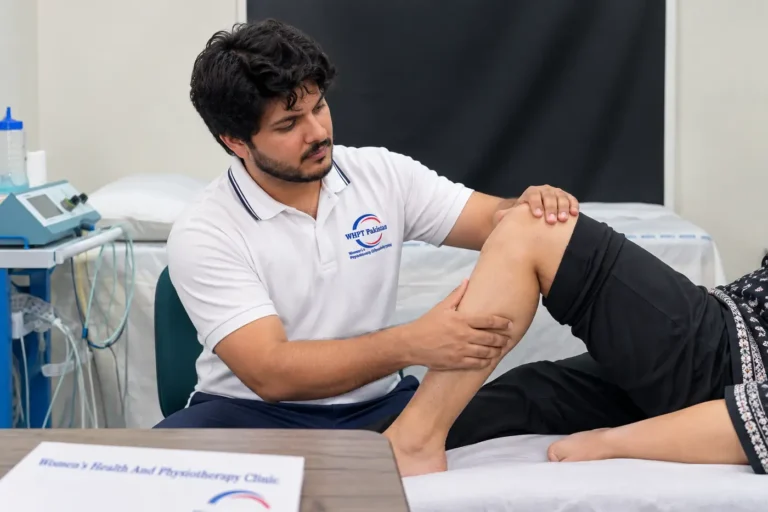
A knee assessment looks beyond pain alone. Learn how movement, strength, function, history, and symptoms guide rehabilitation.
Read article →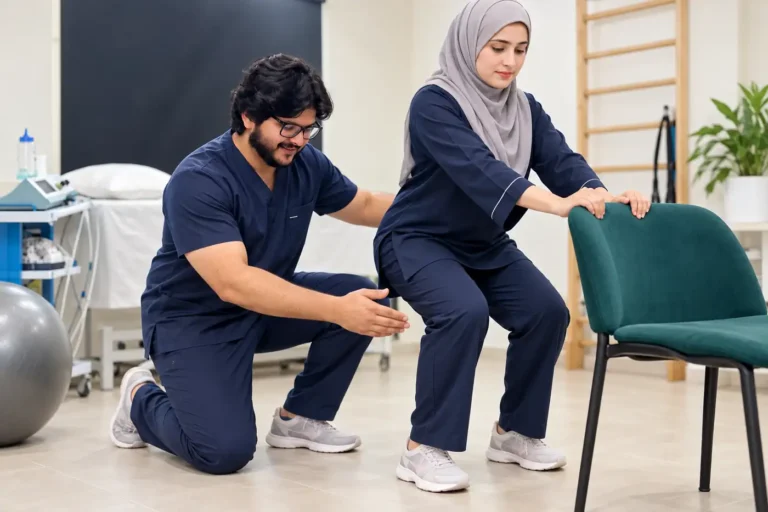
Some exercises may temporarily aggravate an irritated knee. Learn how to modify loading without giving up movement completely.
Read article →
Knee pain can return even after symptoms improve. Learn why recurrence happens and which factors may need more attention.
Read article →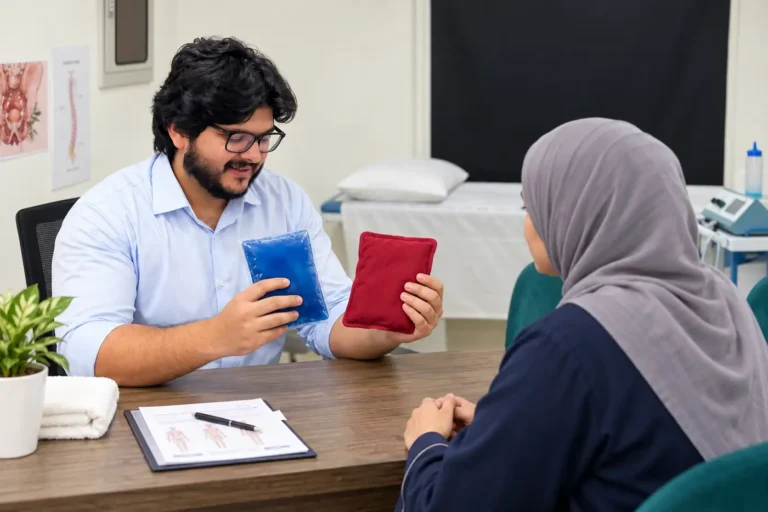
Heat and ice can both help knee symptoms in certain situations. Learn when each option may be useful and what…
Read article →EXCELLENT Based on 19 reviews
 Posted on Google
 MUHAMMAD USMAN SALEEM MUHAMMAD SALEEMIt’s actually the place where Doctors have a right knowledge to treat. Strongly recommend best clinic in LahorePosted on Google
 Nasira ShaheenVery satisfied with the services and care given to my daughter from Dr. Rabail. She wasn't able to speak sentences and many words before and has improved more then that now in her behavior and speech. I am very grateful for Dr. Rabail and WHPT and had no concerns through our sessions with them.Posted on Google
 Mahnoor MughalMy father-in-law experienced severe low back spasms, and WHPT Pakistan's at-home physiotherapy service was a lifesaver. The therapist arrived fully equipped and provided highly effective, personalized care right in the comfort of our home. The treatment not only eased his pain but also gave him exercises to help prevent future episodes. The convenience and quality of care were superb, and we’re very grateful for their compassionate and professional service!Posted on Google
 Noaman Younasgood doctor team coprative doctorPosted on Google
 Ali AghadeerStaff is very professional and humble Great experiencePosted on Google
 Fatima ZahraI was tired of writing “physiotherapy near me” for my neck pain. Luckily, i ended up in WHPT Pakistan, arguably the most trusted physiotherapy clinic in Bahria Town Lahore. Highly recommendedVerified by TrustindexTrustindex verified badge is the Universal Symbol of Trust. Only the greatest companies can get the verified badge who has a review score above 4.5, based on customer reviews over the past 12 months. Read more
WHPT Pakistan
1st Floor, Plaza 82, Block AA Commercial,
Bahria Town, Lahore