
Upper back pain causes often come to mind when a sharp ache appears between your shoulders after desk work, while taking a deep breath, or when turning in bed. A familiar muscle ache is common, but discomfort around the upper back deserves a little more context than a quick posture diagnosis. The thoracic spine connects with the ribs, neck and shoulders, and medical problems outside the spine can sometimes be felt there too.
Upper back pain may involve thoracic muscles, rib joints, spinal joints, neck referral, or changes in workload and movement. Location alone does not confirm a muscular cause. Chest symptoms, breathing difficulty, fever, trauma, or unexplained worsening require medical assessment. For stable movement-related pain, history, functional examination and gradual activity can help determine next steps.
At a Glance
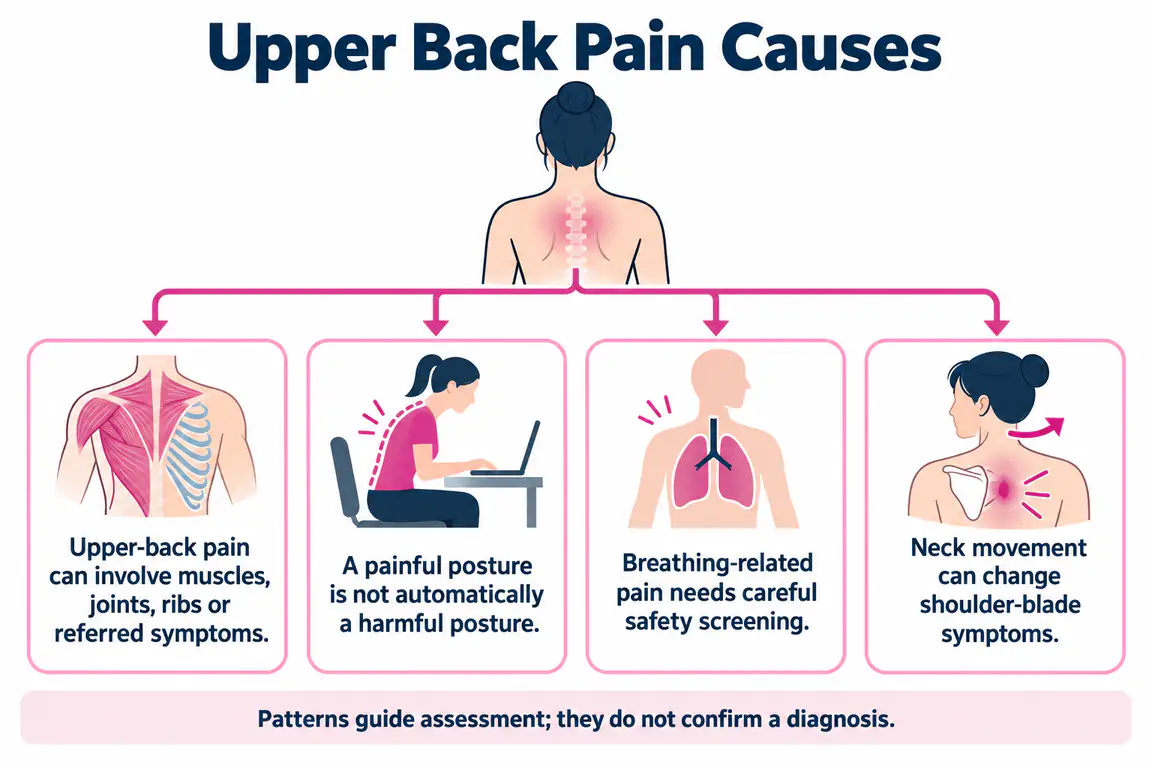
- Upper-back pain can involve muscles, joints, ribs or referred symptoms.
- A painful posture is not automatically a harmful posture.
- Breathing-related pain needs careful safety screening.
- Neck movement can change shoulder-blade symptoms.
- Severe chest symptoms require emergency care.
- Persistent unexplained pain warrants evaluation.
Where Is the Upper Back, Anatomically?
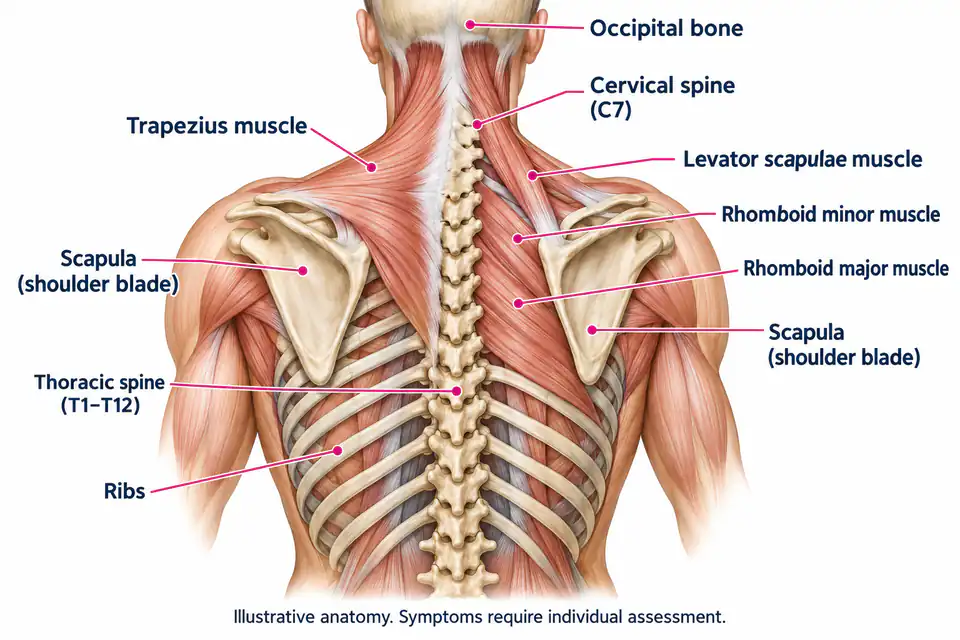
The upper back usually refers to the thoracic region near the shoulder blades, although people use the term differently. Thoracic vertebrae connect to ribs and function with the neck, shoulder blades and surrounding muscles. The region moves during reaching, turning, breathing and lifting; discomfort may arise from more than one structure working together.
The same person may feel pain while typing with arms unsupported and while reaching overhead for a cupboard.
It helps to distinguish an explanation from a diagnosis. In this part of the assessment, associated medical symptoms and their timing matter more than a single provocative movement or a phrase from an online search. The clinician looks for several clues that agree with one another, while staying open to alternatives. A temporary symptom increase does not automatically prove that tissue damage is worsening; new loss of strength or other warning signs, however, should not be ignored.
Describe whether pain is central, toward one shoulder blade, or related to rib movement rather than assuming the whole upper back is one muscle.
The upper thoracic region sits behind the rib cage and between the shoulder girdles, but people use 'upper back' for several different places. Pain at the neck-shoulder junction can be cervical or muscular; pain beside the shoulder blade can reflect shoulder-girdle work; a deeper central ache can relate to thoracic movement. Ask someone to point with one finger to the area, then compare reaching, head turning, trunk rotation and inhalation. Those distinctions help avoid conflating upper-back symptoms with the separate middle-back article, which focuses more on the central thoracic region below the upper shoulder-blade level.
Can Muscles Become Sensitive After Desk Work?
Holding the arms forward for long periods can fatigue muscles around the shoulder blades and thoracic region, particularly if the workday includes few position changes. That does not make one posture inherently dangerous. Local sensitivity often reflects time spent in the same demand, recent exercise changes and limited recovery rather than a permanent postural defect.
A student may feel aching after three hours over a laptop and notice improvement during a short walk.
Try varied working positions, a comfortable screen setup and regular movement instead of forcing your shoulders into a rigid upright position all day.
For an assessment-led explanation of related symptoms, see WHPT Pakistan’s neck pain physiotherapy resource. It explains what an individualized assessment and rehabilitation pathway may involve.
Typing with unsupported arms loads the shoulder girdle differently from reading with elbows resting on a desk. A worker may feel burning fatigue around the shoulder blades near the end of a shift yet recover after movement breaks. That pattern is not evidence that the vertebrae have moved out of place. Test simple adjustments first: support the forearms, bring the screen to a comfortable height, vary tasks, and take regular opportunities to move. If pain is persistent despite reducing those demands, examine the neck, shoulders and thoracic region rather than repeatedly massaging the same tender spot.
How Do Rib and Thoracic Joints Contribute?
Rib joints and the thoracic spine move together during rotation and breathing. Irritation around these structures may be felt when twisting, reaching or taking a deeper breath. Pain reproduction with movement is informative, but it does not completely rule out medical causes, especially when breathlessness or chest discomfort is present.
Turning in a car seat or reaching across the body may reproduce a familiar localized ache.
If the same pain is predictable with certain movements and no systemic warning signs occur, discuss movement tolerance and load with a clinician rather than assuming a rib is displaced.
Thoracic joints and rib attachments move during reaching, twisting and respiration. An irritated chest-wall or rib-region structure may feel sharper with a deep breath or rolling in bed. However, movement-related pain does not automatically rule out lung or heart problems. Chest tightness, new breathlessness, faintness, coughing blood or unexplained sharp pain during breathing needs prompt medical evaluation. In the absence of those features, a clinician can explore whether pain reliably follows trunk rotation, rib pressure or lifting. Safe diagnosis depends on the whole history, not the assumption that tenderness always makes chest symptoms harmless.
Can the Neck or Shoulder Refer Pain?
Neck joints and surrounding tissues can contribute to symptoms felt along the upper back or inner shoulder blade. The shoulder itself may also change how the upper back is loaded. Numbness or tingling into the arm needs further evaluation, particularly if strength is changing. Neither tenderness over the shoulder blade nor a screenshot of your posture is diagnostic.
Someone may describe shoulder-blade pain that worsens when looking down at a phone rather than when moving the shoulder.
A careful assessment compares neck, shoulder and thoracic movement so the painful location is not confused with the source.
The NHS guidance on chest pain explains why serious chest symptoms deserve urgent medical attention. Movement-related pain should not be used as a home test to rule out medical causes.
The neck can refer discomfort toward the upper inner shoulder blade, while a sensitive shoulder may lead someone to hold the arm differently and overload surrounding muscles. A useful practical check is whether reaching overhead reproduces the familiar pain more than twisting the trunk, or whether neck rotation changes it. Symptoms travelling into the hand with pins and needles require neurological screening. Because several regions interact during daily activities, effective management may involve the shoulder or neck even when the patient initially says 'my upper back hurts.'
For appropriately screened upper-back rehabilitation and mobility information, see Cambridge University Hospitals: Upper-back physiotherapy resources. This is a movement resource, not a tool for ruling out cardiac or respiratory causes of new upper-back pain.
Why Might Breathing Change the Pain?
Normal breathing moves the ribs and chest wall, so an irritated muscle or joint may be more noticeable with a deep breath. Nevertheless, breath-related pain can also occur with lung and cardiovascular problems. Sudden breathlessness, chest pressure, fainting or severe unexplained pain requires emergency care.
A person recovering from an unfamiliar gym workout may notice localized chest-wall soreness, but another with new breathlessness requires a different response.
Treat breathing-related upper-back pain as a triage question first; home stretching should never delay urgent medical care when warning signs accompany it.
Breathing-related upper-back pain deserves its own assessment question: Is the pain only felt when you expand the ribs, or is it accompanied by cough, fever, shortness of breath or chest discomfort? Repeated coughing can overload chest-wall muscles, but pleurisy, pneumonia and pulmonary embolism are among conditions clinicians must consider in the appropriate context. People with new breathlessness, bloody sputum or sudden severe chest/back pain should not book routine musculoskeletal treatment first. If it is clearly a stable mechanical pattern after medical concerns are excluded, controlled breathing and gentle rib motion can later be introduced without forcing sharp pain.
If desk-related discomfort is part of the picture, WHPT’s postural problems resource discusses position variation rather than a rigid perfect-posture rule.
What If the Pain Is Persistent or Unusual?
Upper-back pain without a clear movement link, especially when it persists at rest, is associated with fever or unexplained illness, or follows significant trauma, deserves professional assessment. Most discomfort is not serious, but the thoracic location means it is sensible to ask about medical history, chest symptoms and other systems.
Pain that wakes someone repeatedly and is accompanied by feeling unwell does not fit the same pattern as mild stiffness after carrying bags.
Record duration, aggravating factors and associated symptoms, then choose appropriate medical or physiotherapy input rather than self-labeling it as posture-related.
When upper-back discomfort persists, assess the time course and what has changed. A muscle-sensitive episode after lifting may gradually ease as the workload settles. Pain that steadily worsens without a clear activity relationship, causes major night disturbance, or is associated with unexplained fever or weight loss calls for medical advice. After a fall, especially in a person with fragile bones, a fracture may need consideration. This balanced triage prevents two mistakes: treating every ache as dangerous and dismissing an unusual presentation simply because desk posture is an easy explanation.
What Can Help With Movement-Related Upper Back Pain?
When serious causes have been reasonably excluded, varied movement and progressive strength may help someone tolerate working, lifting and reaching. Gentle thoracic rotation and shoulder-blade movements are options, not universal fixes.
Try brief position changes during desk work, manageable pulling exercises, or supported arm positions; decide on exercises through individual response rather than a rigid posture rule.

For uncomplicated movement-related upper-back pain, begin with tasks you can perform comfortably, not a maximal 'posture correction' routine. Gently move the arms through an easy range, rotate the trunk while seated if comfortable, and progressively return to pulling, carrying or desk work. A person who notices worsening pain after long computer sessions can compare shorter intervals with supported elbows. If symptoms increase with breathing or appear with exertion and feel unlike familiar muscle discomfort, stop treating them as an exercise problem and arrange medical review.
When pain appears mainly with reaching rather than trunk movement, the shoulder pain pathway may be the more relevant clinical starting point.
What Does Upper Back Assessment Include?
Assessment needs both a musculoskeletal history and appropriate medical screening. A clinician may check neck and shoulder movement, thoracic and rib motion, strength, sensory changes and the relationship with breathing and activity.
If the symptoms suggest a nonmusculoskeletal problem, appropriate medical referral should come before exercise progression. A physiotherapy approach is most useful once that distinction is made.
Assessment is often more informative when it reproduces the actual difficult task. A physiotherapist might compare neck rotation with thoracic rotation, evaluate shoulder movement and check whether the chest wall is sensitive to appropriate examination. Strength and endurance around the shoulder girdle can matter for people returning to prolonged computer work or overhead activity. Medical screening remains essential before attributing chest-associated pain to muscles. Treatment is matched to the conclusion: graded loading for a credible mechanical pattern, medical referral for unclear or concerning features, and reassessment when the response is unexpected.
When Should Upper Back Pain Be Medically Checked?
New breathlessness, chest pressure, collapse, severe pain after trauma, fever, or rapidly worsening neurological symptoms warrant urgent care. Do not conclude pain is harmless simply because a movement reproduces it.
Sudden chest pain, major breathlessness, fainting or severe pain related to breathing should be treated as a possible medical emergency rather than a simple muscle spasm. Pain reproduced with movement can still coexist with medical conditions; don't use a home movement test to exclude them. Follow local emergency-service guidance if breathing difficulty or chest-related warning signs are present.
Persistent unexplained night pain or pain that is steadily progressing also deserves a clinician’s assessment instead of prolonged self-treatment.
Urgent upper-back assessment is appropriate with severe chest pain, breathing difficulty, collapse, neurological deficit or major trauma. Persistent but less dramatic pain with fever, unexplained systemic symptoms or significant medical history also deserves timely evaluation. For otherwise stable pain that mainly appears after tasks, the first useful change may be reducing repetitive load and restoring comfortable movement. One rule does not fit everyone, which is why symptom combinations matter more than whether the back feels stiff or whether you can find a tender knot.
Frequently Asked Questions
Can stress cause upper back tightness?
Stress can influence muscle tension, sleep and pain sensitivity. It should not be used to dismiss persistent symptoms or symptoms associated with medical warning signs.
Is upper back pain always posture-related?
No. Workload and prolonged positions may contribute, but rib joints, neck referral, shoulder problems and nonmusculoskeletal causes should also be considered.
Should I stretch a sharp upper-back pain?
Not automatically. First assess whether the pattern is stable and movement-related, particularly when breathing or chest symptoms are involved.
Could upper back pain come from the neck?
Yes. Neck-related symptoms can extend toward the shoulder blade. An examination can compare neck, shoulder and thoracic movements to help clarify the contribution.
Can upper-back discomfort spread around the ribs?
Sometimes. Thoracic joints, rib-related tissues and muscles can produce symptoms that wrap toward the side of the chest. Because breathing difficulty, chest pressure or unexplained illness can have medical causes, those accompanying symptoms require medical assessment rather than assuming rib tightness.
Is upper-back pain with breathing always muscular?
No. Ribs and chest-wall tissues move during breathing, but pleurisy and other medical conditions can create similar pain. New breathlessness or chest symptoms require medical assessment before exercise.
Should I constantly sit up straighter at my desk?
Not necessarily. Support, breaks, and variation usually matter more than a rigid posture rule. Try changing task duration or forearm support and see whether those adjustments improve work tolerance.
A Safer Way to Understand Upper Back Pain
If an upper-back ache keeps returning with desk work or lifting, a physiotherapy assessment can explore neck, shoulder and thoracic contributions after medical concerns are screened.
For relevant assessment and rehabilitation options, explore WHPT Pakistan’s back pain physiotherapy. Contact the clinic by WhatsApp or phone if you need help choosing the appropriate appointment.
Upper-back discomfort deserves neither panic nor automatic dismissal as bad posture. The combination of movement behavior, associated symptoms and examination findings guides a safer, more useful response.
The upper back does not need to be held rigidly upright to be healthy. Variation is valuable: reading, lifting, reaching, walking and breathing all load tissues in different ways. A good outcome could mean finishing a computer shift without a spreading ache or carrying a backpack with confidence. If an exercise relieves soreness briefly but function does not improve over time, consider whether the workload or neighboring neck/shoulder function has been addressed. The goal is capacity in real life, not perfect posture in a photograph.
References

About Dr Salman Sabir PT
Dr Salman Sabir PT is a consultant physiotherapist, clinical leader and co-founder of WHPT Pakistan. He holds an MS in Orthopedic Manual Therapy and is undertaking doctoral study in Exercise Physiology. His work focuses on assessment-led rehabilitation, patient education, progressive exercise and long-term recovery.
Need Help Applying This to Your Situation?
General information cannot account for your injury history, strength, movement, medical conditions or personal goals.
BOOK ASSESSMENTCall +92 334 8205557