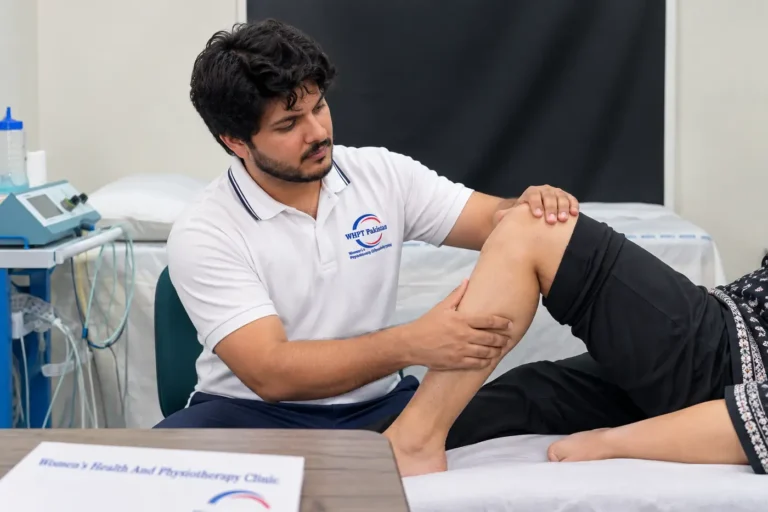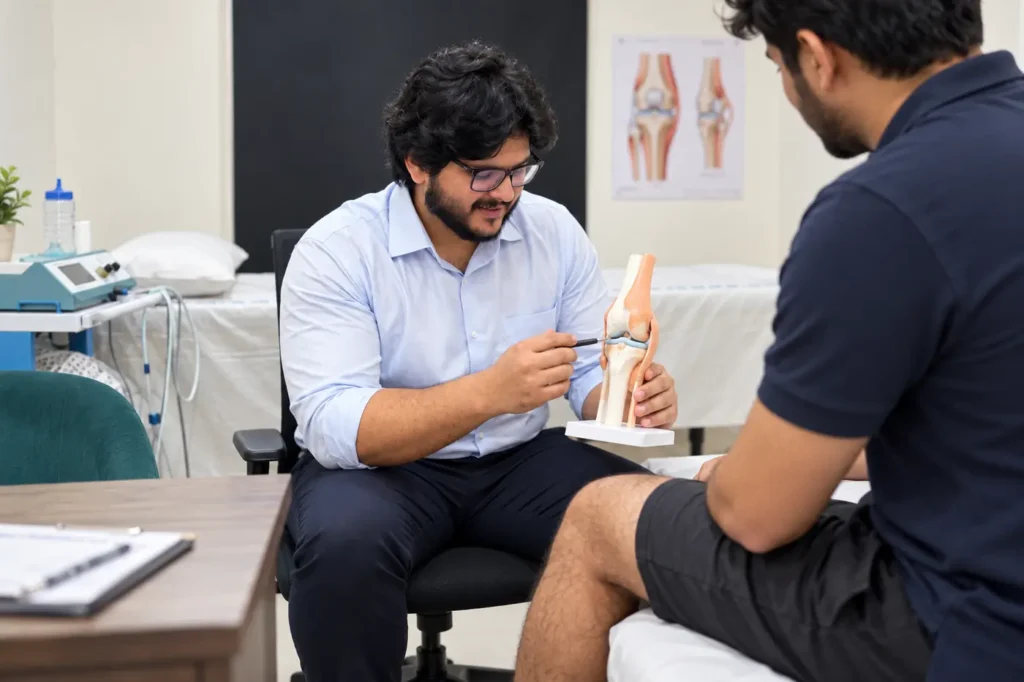
A sore knee after an unusually active day may settle. A knee that repeatedly swells, gives way, will not fully straighten, or suddenly becomes hot and red tells a different story. The challenge is knowing which early changes are worth watching and which deserve faster assessment.
This article is not a list designed to make every ache sound dangerous. Most knee pain is not an emergency. It is a practical guide to symptoms that carry more information than pain intensity alone.
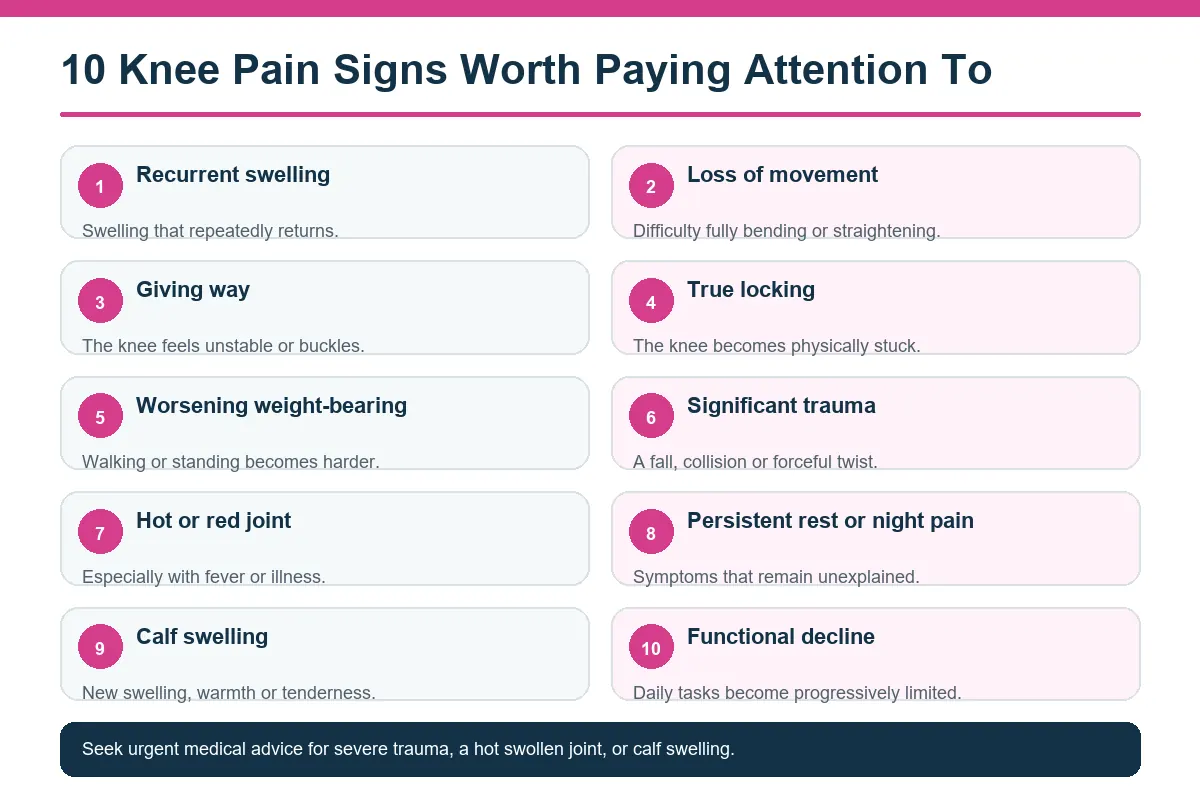
Early knee-pain signs worth paying attention to include recurrent swelling, inability to fully straighten or bend the knee, giving way, true locking, worsening weight-bearing, pain after significant trauma, increasing heat or redness, persistent night or rest pain, calf swelling, and symptoms that keep returning or steadily reduce function. Some require urgent medical care; others are reasons to arrange a physiotherapy assessment rather than repeatedly waiting for another flare to settle.
At a Glance
- Pain severity alone does not tell you how serious a knee problem is.
- Swelling, instability, loss of movement, and trauma add important information.
- A true locked knee is different from a knee that simply feels stiff.
- A hot swollen knee with fever needs medical attention, not an exercise trial.
- Recurring symptoms can justify assessment even when each flare eventually settles.
- The right response depends on the whole pattern, not one sign in isolation.
Why Early Signs Matter More Than a Pain Score
People often judge a knee problem by asking whether the pain is a three, six, or nine out of ten. That number is useful, but it is incomplete. A painful knee may be irritable without being seriously injured, while a significant ligament or meniscus injury can sometimes feel surprisingly manageable once the first shock has passed.
More useful early information includes whether there was trauma, how quickly swelling appeared, whether the knee can bear weight, whether it moves fully, and whether it feels stable. The Sports Injuries pathway at WHPT uses these functional clues alongside pain rather than treating pain intensity as a diagnosis.
1. The Knee Keeps Swelling
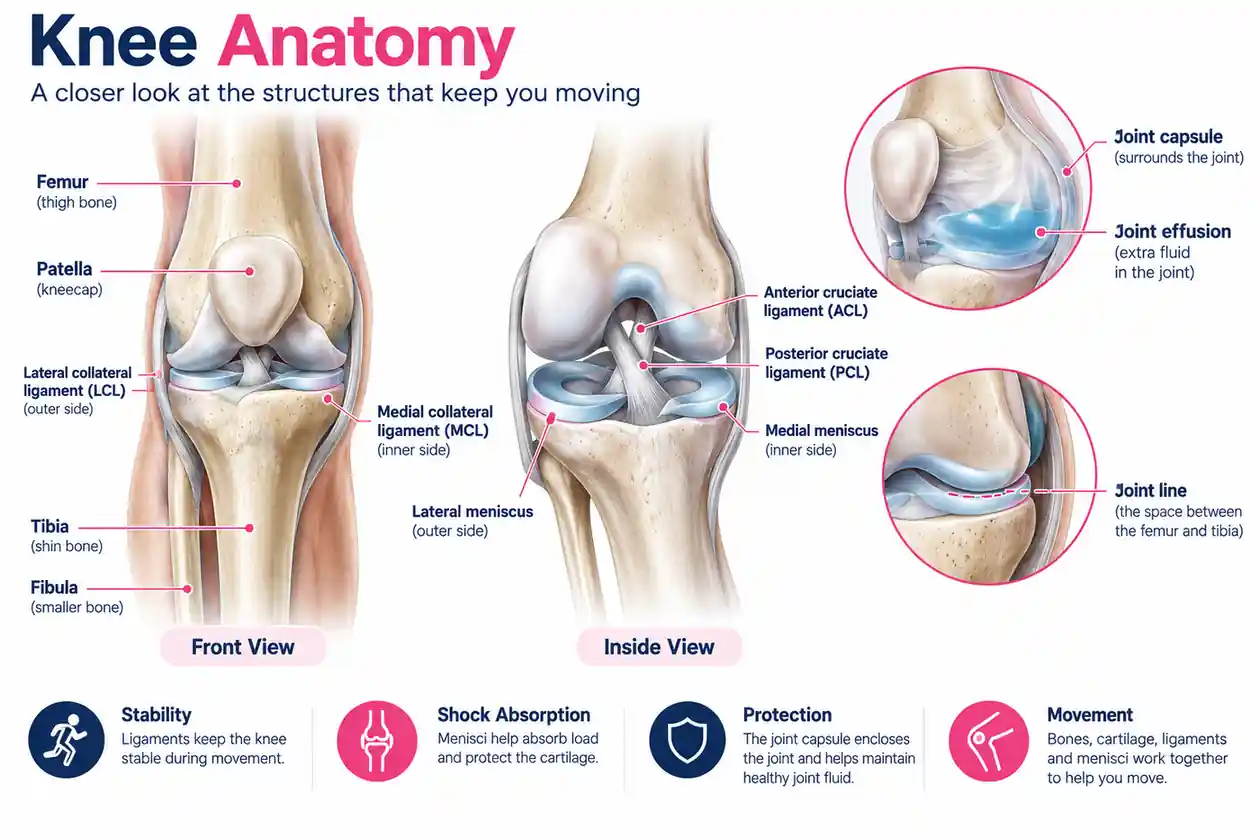
A small amount of swelling can occur after irritation, but swelling that repeatedly returns after ordinary activity deserves attention. It may reflect joint irritation, arthritis, meniscus involvement, or another intra-articular problem. Rapid large swelling after a twist or collision can be more concerning because it may accompany a significant ligament, bone, or cartilage injury.
The important detail is not merely “my knee is swollen,” but when it began, how much there is, what triggered it, and whether it changes movement or weight-bearing.
2. You Cannot Fully Straighten or Bend the Knee
Loss of movement can develop because of swelling, pain, muscle guarding, stiffness, or mechanical blockage. A knee that is gradually stiff from arthritis is different from a knee that suddenly cannot straighten after twisting.
True locking means the joint is physically blocked rather than simply painful or hesitant. That pattern, especially after injury, warrants prompt assessment. WHPT’s Meniscus Tear Rehabilitation page explains why displaced meniscal injuries are treated differently from ordinary aching or clicking.
3. The Knee Gives Way or Feels Unstable
Giving way can mean several things. Sometimes pain briefly inhibits the quadriceps and the leg feels unreliable. In other cases, instability follows a ligament injury. A patient who repeatedly says, “I cannot trust the knee,” needs the mechanism and stability assessed rather than simply strengthening randomly.
After a twisting or landing injury, instability is one reason to consider an ACL rehabilitation assessment or orthopedic review depending on the findings.
4. The Knee Truly Locks or Catches Repeatedly
Occasional harmless clicks are common. Repeated catching associated with pain, swelling, or loss of movement is different. A true locked knee—particularly when it cannot straighten—can indicate a mechanical problem that needs faster evaluation.
Do not repeatedly force the knee into deep bending or twisting to “test” whether it will unlock. The goal is to establish what is happening without turning a potentially irritated joint into a more reactive one.
5. Weight-Bearing Is Becoming Harder, Not Easier
After a mild overload, walking tolerance should usually become more manageable as the irritation settles and activity is adjusted. If standing or walking becomes progressively harder, or you suddenly cannot take several steps after trauma, the knee deserves assessment.
Clinical decision tools such as the Ottawa Knee Rule evidence help medical professionals identify when radiography is appropriate after acute knee trauma. Patients do not need to memorize the rule; the useful takeaway is that inability to bear weight after significant injury should not be dismissed.
6. Pain Followed Significant Trauma
A collision, fall, high-speed twist, or awkward landing changes the risk profile. Even if you can still walk, look for swelling, deformity, instability, reduced range, focal bone tenderness, or neurological symptoms.
This does not mean every sports injury needs an MRI. It means the history should influence the level of caution. A traumatic knee should be screened before someone is encouraged to “walk it off” or start a generic YouTube exercise routine.
7. The Knee Is Hot, Red, and Swollen
A suddenly hot, red, swollen joint—especially with fever, chills, or feeling unwell—is not routine exercise soreness. Infection and inflammatory conditions need medical evaluation. Physiotherapy should not be used to delay urgent medical care.
| Pattern | Usual response |
|---|---|
| Mild soreness after unfamiliar activity, no swelling or instability | Monitor and modify activity if symptoms are improving. |
| Recurring swelling or progressive loss of function | Arrange physiotherapy or medical assessment. |
| Hot red swollen joint with fever/systemic illness | Seek prompt medical evaluation. |
| Major trauma, deformity, or inability to bear weight | Seek urgent medical assessment. |
| Cold/pale foot, major numbness, or absent pulse | Emergency medical assessment. |
8. Pain Is Persistent at Rest or Regularly Disturbs Sleep
Knee pain can certainly ache at night after an active day, and arthritis can be uncomfortable in bed. The concern is a new pattern of persistent rest pain or regular night pain that is unexplained, worsening, or accompanied by systemic symptoms such as fever, unexplained weight change, or feeling generally unwell.
This type of history needs context. It is not a reason to panic, but it is a reason not to reduce every symptom to “tight muscles.” A Comprehensive Physiotherapy Assessment includes screening questions intended to identify when another medical pathway is more appropriate.
9. Your Calf Becomes Swollen, Warm, or Painful
Calf swelling is not the same thing as knee swelling. New unilateral calf swelling, warmth, tenderness, especially after surgery, prolonged immobility, or a period of reduced movement can require urgent medical assessment for a possible blood clot. Chest pain or sudden breathlessness is an emergency.
This is particularly important during Post-Surgical Rehabilitation, where rehabilitation should always remain coordinated with medical status and surgeon instructions.
10. The Problem Keeps Returning or Your Function Is Shrinking
Not every important sign is dramatic. A knee can improve for a week, flare again, and gradually cause a person to stop stairs, reduce walking, avoid prayer positions, give up the gym, or stop sport. Repeated short-term settling without restored capacity is a meaningful pattern.
Recurring symptoms may reflect incomplete rehabilitation, an activity-load mismatch, arthritis flares, unresolved strength loss, or a condition that has not been properly identified. This is where a Knee Pain Physiotherapy assessment can be more useful than another cycle of rest followed by sudden return to full activity.
What Signs Usually Allow a Short Period of Monitoring?
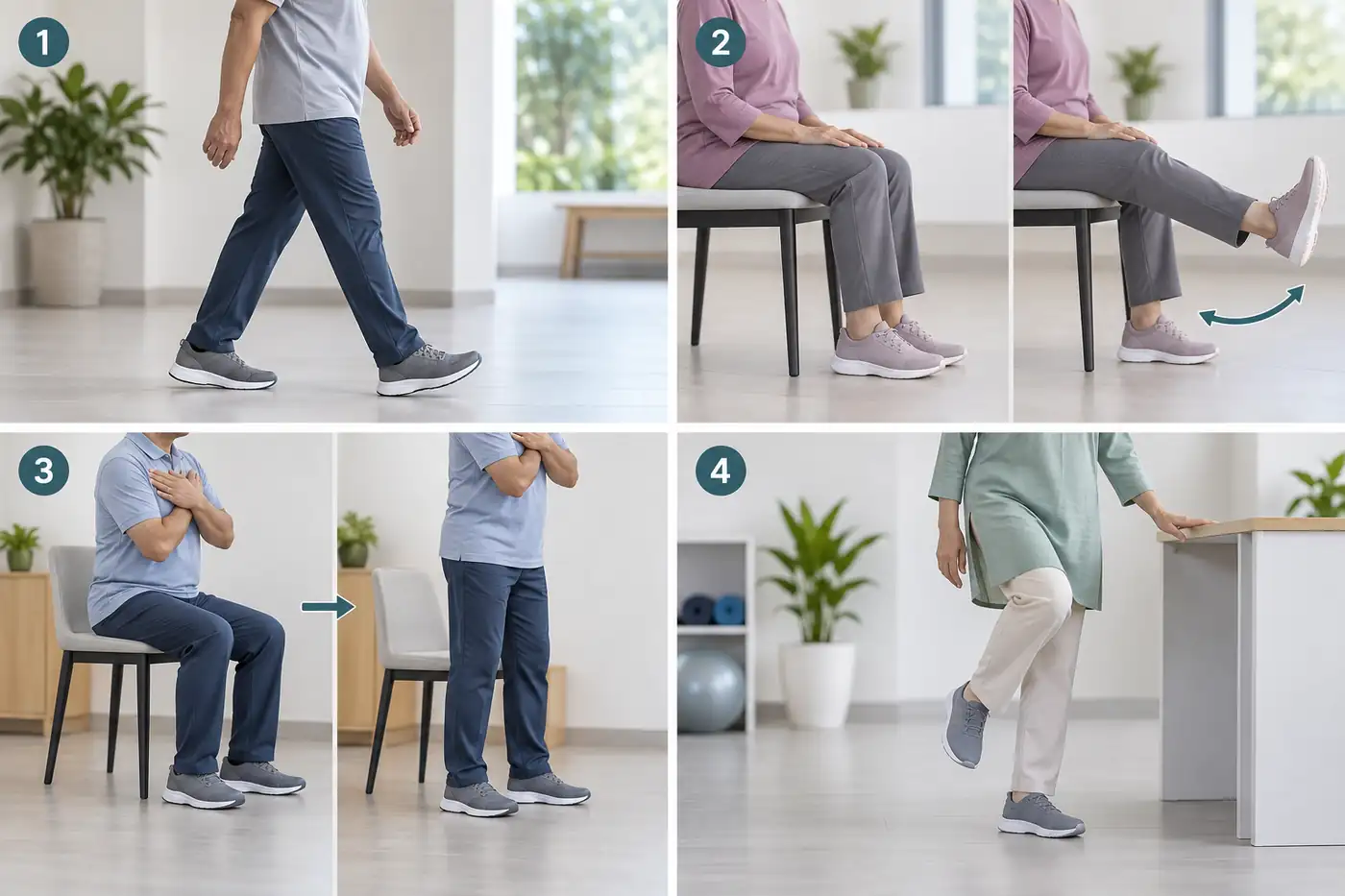
Mild soreness after unfamiliar activity, with no meaningful swelling, no trauma, full weight-bearing, and a clear improving trend may be reasonable to monitor briefly. Comfortable movement, normal daily activity, and temporary reduction of the aggravating load can be appropriate.
The key word is improving. If every attempt to resume normal activity brings the same symptoms back, or if the knee is becoming less capable, the situation has moved beyond simple monitoring.
For stable problems, Therapeutic Exercise may eventually help rebuild strength and load tolerance. Exercise should still match the presentation rather than being selected from a red-flag checklist.
What to Track While You Monitor the Knee
If none of the urgent features above are present and the symptoms are mild enough to monitor, keep the observation simple. Note whether swelling is increasing or settling, whether you can bend and straighten the knee more easily, whether walking distance is improving, and whether ordinary tasks require fewer compensations. The trend over several days is more useful than checking the pain every hour.
Also watch function. If you are progressively using the railing more, avoiding normal stairs, limping farther, or changing how you sit down, stand up, or move into prayer positions, the knee is not truly “fine” just because the pain score is moderate. A Comprehensive Physiotherapy Assessment can help when function is shrinking instead of returning.
Frequently Asked Questions
Is knee swelling always serious?
No. Mild swelling can follow irritation or arthritis, but recurrent, rapidly increasing, or trauma-related swelling provides useful diagnostic information and should not be ignored.
What does a locked knee feel like?
A true locked knee is physically unable to reach part of its normal movement, commonly full extension. This differs from movement that is possible but painful or guarded.
Can a knee ligament injury happen without severe pain?
Yes. Pain intensity does not reliably grade injury severity. Mechanism, swelling, instability, and function are important.
Should I worry about painless knee clicking?
Usually not by itself. Painless clicking is common. Concern increases when clicking comes with pain, swelling, catching, locking, or functional loss.
When is knee pain an emergency?
Major trauma with deformity, a cold or pulseless limb, severe neurological changes, suspected infection, or chest symptoms associated with possible clotting require emergency or urgent medical care.
Can I exercise if my knee is mildly sore?
Often yes, if symptoms are stable and exercise does not produce a significant flare. The appropriate load depends on the cause and current irritability.
What should I tell the physiotherapist when I book?
Share how the problem began, swelling, instability, locking, ability to bear weight, recent trauma or surgery, and the activities you can no longer do. WHPT’s appointment page lists the practical booking information.
When an Early Sign Deserves Assessment
For broader knee-pain information, see WHPT’s Knee Pain Physiotherapy guide. If you decide the symptoms need assessment, use the Book a Physiotherapy Appointment page; you can also review WHPT Pakistan for clinic information.
If knee symptoms are changing how you walk, use stairs, pray, work, train, or trust the leg, an assessment can clarify whether the problem is appropriate for physiotherapy or needs medical investigation first.
WHPT Pakistan provides assessment-led physiotherapy in Bahria Town, Lahore. WhatsApp or call +92 334 8205557 to ask about availability; appointment times are confirmed by WHPT staff.
References
- Bachmann, L. M., et al. (2004). The accuracy of the Ottawa knee rule to rule out knee fractures: a systematic review. Annals of Internal Medicine, 140(2), 121–124. PubMed
- Ghaffari, S., et al. (2023). Diagnostic accuracy of Ottawa Knee Rule for diagnosis of fracture in patients with knee trauma: a systematic review and meta-analysis. Archives of Academic Emergency Medicine. PubMed
- American Academy of Orthopaedic Surgeons. (2024). Clinical practice guideline for the management of acute isolated meniscal pathology. AAOS guideline
- Willy, R. W., et al. (2019). Patellofemoral pain: Clinical practice guidelines. Journal of Orthopaedic & Sports Physical Therapy, 49(9), CPG1–CPG95. PubMed
- Bronstein, R. D., & Schaffer, J. C. (2017). Physical examination of the knee: Meniscus, cartilage, and patellofemoral conditions. Journal of the American Academy of Orthopaedic Surgeons, 25(5), 365–374. PubMed

About Dr Salman Sabir PT
Dr Salman Sabir PT is a consultant physiotherapist, clinical leader and co-founder of WHPT Pakistan. He holds an MS in Orthopedic Manual Therapy and is undertaking doctoral study in Exercise Physiology. His work focuses on assessment-led rehabilitation, patient education, progressive exercise and long-term recovery.
Need Help Applying This to Your Situation?
General information cannot account for your injury history, strength, movement, medical conditions or personal goals.
BOOK ASSESSMENTCall +92 334 8205557