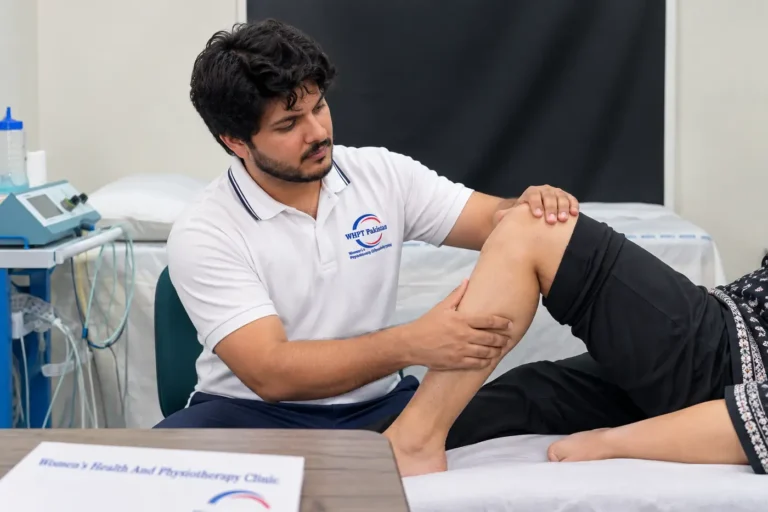
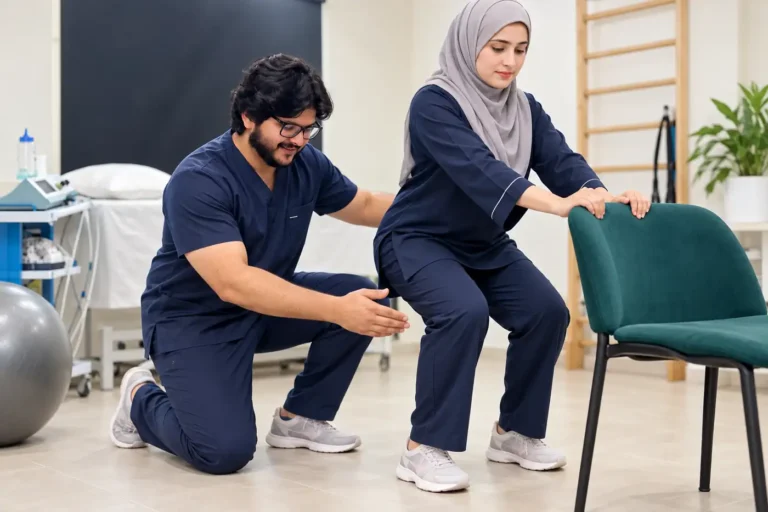
Your knee may crack when you stand up, click on stairs, or make a grinding sound during a squat—even though it does not hurt. For many people, the sound is more worrying than the knee itself.
Joint noises are common, and sound alone does not prove that cartilage is “wearing away.” The useful question is whether the noise is painless and functionally irrelevant, or whether it appears with pain, swelling, locking, instability, or loss of movement.
A knee that clicks, pops, or crackles without pain is often not a sign of injury. Joint sounds can come from normal movement of tissues, pressure changes, tendons moving, or crepitus around the kneecap. Research shows knee crepitus is common even in pain-free people. Assessment becomes more important when noise is new after trauma or is accompanied by pain, swelling, catching, true locking, instability, or declining function.
At a Glance
- Painless knee noise is common in healthy and symptomatic knees.
- Crepitus means a crackling or grinding sensation/sound; it is not a diagnosis.
- Noise alone cannot tell you whether cartilage is damaged.
- Repeated clicking with pain, swelling, locking, or giving way deserves assessment.
- A loud sound during injury is different from long-standing painless cracking.
- You generally do not need to make a silent knee the goal of rehabilitation.
First: Knee Noise Is Common
Knees are moving joints with cartilage surfaces, a kneecap, tendons, ligaments, synovial tissue, and changing pressure inside the joint. It is therefore not surprising that they can make sound. A 2025 systematic review found knee crepitus in pain-free people as well as people with osteoarthritis and other knee conditions. The authors also noted uncertainty in prevalence estimates, which is another reason not to turn a sound into a diagnosis.
The systematic review on knee crepitus is useful because it separates an association from a conclusion. Crepitus can occur with structural findings, but many people with noise do not have pain. A sound therefore needs clinical context.

What Do “Clicking,” “Cracking,” and “Crepitus” Mean?
Patients use several words for knee sounds. “Clicking” may describe one discrete sound as the knee bends. “Popping” may be a single louder event. “Crepitus” usually describes repeated crackling, grating, or grinding that can sometimes be felt as well as heard.
These words describe an experience; they do not identify the tissue. A tendon can move over a bony contour, soft tissues can shift during flexion, and the patellofemoral joint can produce crepitus. Pressure changes within a joint can also create a crack. The meaningful distinction is whether the sound is painless and stable or comes with other symptoms.
Why Can a Painless Knee Make Noise?
Normal Joint and Soft-Tissue Movement
Tissues move relative to each other whenever the knee bends and straightens. Small shifts can create audible or palpable clicks without representing damage. Some people simply have noisier joints than others.
Patellofemoral Crepitus
The kneecap glides along the femur as the knee bends. This movement can produce crackling or grinding sensations. Crepitus can appear in people with patellofemoral pain, but it can also occur in pain-free knees. A study comparing women with and without patellofemoral pain found that crepitus did not automatically translate into worse strength or function across all groups.
Tendon or Ligament Movement
A tendon or soft-tissue band can sometimes move over a nearby structure and create a repeatable snap. If it is painless, stable, and does not limit activity, it may be clinically unimportant. Painful snapping, however, deserves a closer look.

Does Clicking Mean My Cartilage Is Wearing Out?
Not by itself. This is one of the most common fears around knee noise. Osteoarthritis can be associated with crepitus, but a noisy knee does not prove that arthritis is present, and a quiet knee does not rule arthritis out.
If you also have gradual pain, stiffness, reduced walking tolerance, or recurrent swelling, the overall pattern may justify reviewing WHPT’s Arthritis Physiotherapy information. But the decision should be based on symptoms and function rather than sound alone.
Similarly, the goal of physiotherapy is not to chase every crack until the joint becomes silent. A better target is useful function: walking, stairs, sitting and standing, prayer positions, gym training, or sport with acceptable symptoms and confidence.
What If the Knee Clicks During Squats or Stairs?
Squats and stairs place the knee through greater flexion and increase demand around the patellofemoral joint. That can make existing noise more noticeable. If the sound is painless and the knee is otherwise functioning well, it may not require treatment.
If the same movement produces front-of-knee pain, however, the clinical question changes. Patellofemoral pain is commonly aggravated by squatting and stair activity. The JOSPT patellofemoral pain guideline emphasizes history, examination, education, and exercise rather than diagnosing the condition from crepitus.
WHPT’s Knee Pain Physiotherapy page provides the broader knee-pain pathway when sound is accompanied by symptoms.
A useful way to judge a noisy knee is to compare sound with function. If both knees crack during squats but you can walk, use stairs, train, and move through a comfortable range without swelling or instability, the sound itself may have little clinical importance. If noise appears only after a sudden sports incident or begins alongside reduced confidence during running, landing, or direction changes, the context matters more. WHPT’s Sports Injuries and Sports Physiotherapy pathways explain how symptoms are assessed when a new sound follows athletic loading or injury.
When a Click or Pop Deserves More Attention
A painless noise that has been present for years is different from a pop at the moment of injury. The following combinations carry more information:
| Sound pattern | What changes the concern level |
|---|---|
| Long-standing painless crackling | Usually lower concern if movement and function are normal. |
| Clicking plus pain around the kneecap | May fit a patellofemoral pain pattern and can be assessed if persistent. |
| Clicking plus joint-line pain/swelling | Meniscus or other joint irritation may need assessment. |
| Pop during a twist or landing plus rapid swelling | Ligament or other significant injury should be evaluated. |
| Catching or true locking | Mechanical restriction deserves prompt assessment. |
| Noise plus recurrent giving way | Instability or strength/control problems may need evaluation. |
After a twisting injury, WHPT’s Meniscus Tear Rehabilitation and ACL Injury Rehabilitation pages explain why locking, swelling, and instability matter more than the sound itself.
Should You Stop Squats Because Your Knees Crack?
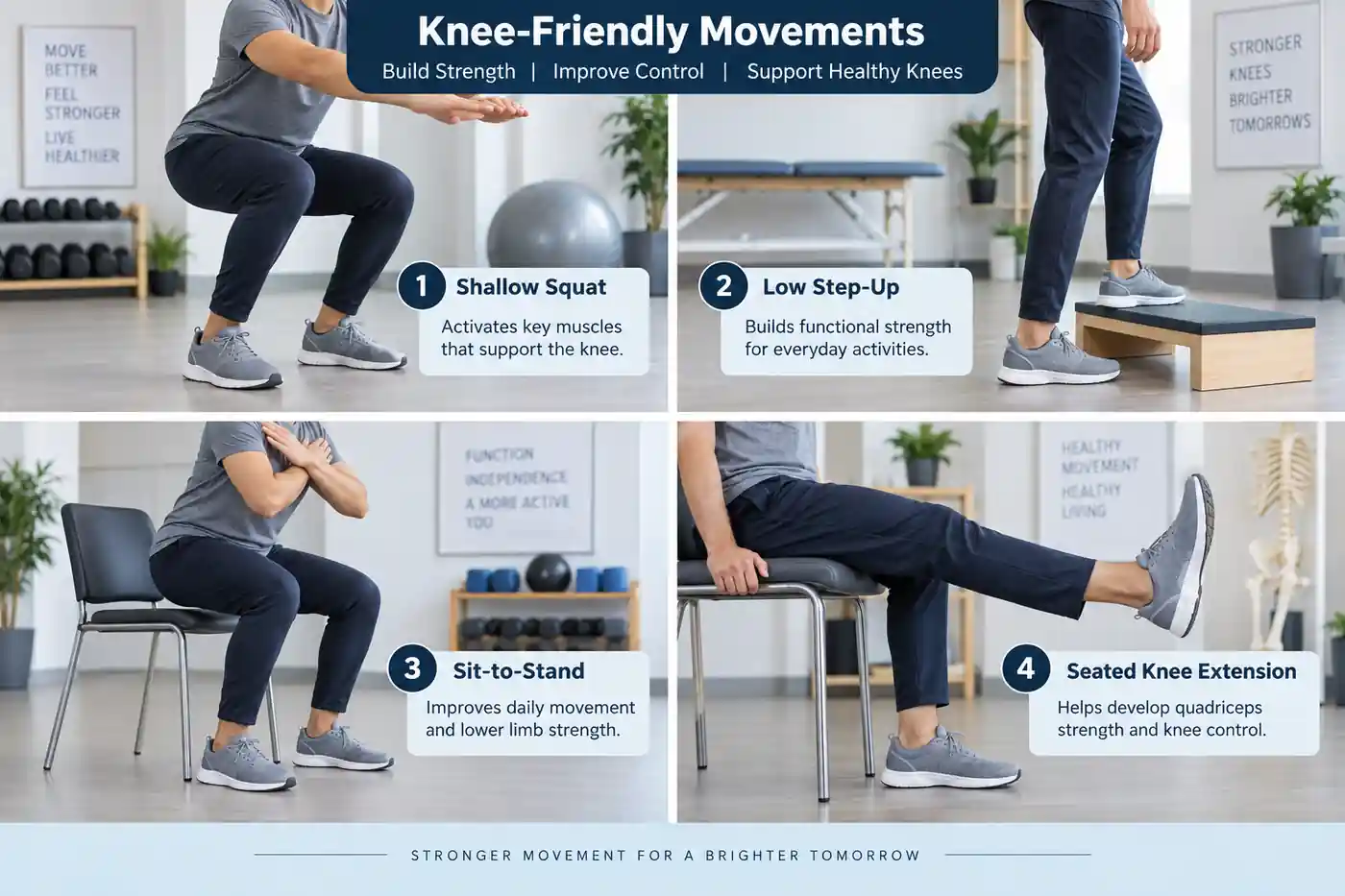
A crack during a squat is not an automatic reason to stop squatting. Exercise decisions should be based on symptoms, control, load, and the person’s goals. For some people, changing depth, resistance, repetitions, or stance makes a movement more comfortable. Others can squat normally with noise and no symptoms.
Research on patellofemoral loading shows that knee-joint demand changes substantially across exercises and generally increases with deeper flexion. That information can help clinicians scale an exercise rather than banning it. WHPT’s Therapeutic Exercise service uses progression and symptom response instead of treating a sound as a danger signal.
Can Physiotherapy Stop Knee Clicking?
Sometimes the sound changes as strength, swelling, movement, or exercise technique changes; sometimes it does not. Neither outcome automatically tells us whether rehabilitation is successful.
If clicking is associated with pain, physiotherapy may address the condition that is actually limiting function—such as patellofemoral pain, arthritis, post-injury weakness, or load intolerance. If clicking is painless, treatment may not be necessary at all.
This is where “assessment before assumptions” matters. A Comprehensive Physiotherapy Assessment can establish whether the noise is clinically relevant or simply an incidental feature of a functioning knee.
Why Does Clicking Sometimes Seem Louder After Rest?
People often notice knee sounds more when they first stand after sitting, start moving in the morning, or return to squats after a period of inactivity. Part of this may simply be that the joint is moving through ranges it has not used recently and you are paying closer attention to the sensation. A louder sound does not automatically mean a larger structural problem.
The useful comparison is not “quiet knee versus noisy knee.” It is “noisy but comfortable knee versus noise accompanied by pain, swelling, loss of movement, locking, or instability.” That second pattern changes the clinical significance and is a reason to look beyond the sound itself.
Three Common Myths About Noisy Knees
- “Every crack means cartilage is being damaged.” Joint noise is common and does not prove ongoing damage.
- “A painless click means I should stop squats forever.” Exercise decisions should be based on symptoms, function, technique, and load tolerance—not sound alone.
- “If one knee is noisier, it must be the unhealthy knee.” Noise can differ between sides even when both knees function well.
If noise becomes painful or starts to alter how you walk, squat, use stairs, or train, the question changes from reassurance about sound to assessment of a symptomatic knee. WHPT’s Knee Pain Physiotherapy page covers that broader pathway.
Frequently Asked Questions
Why do my knees crack every time I stand up?
Repeated painless crackling can come from normal joint and soft-tissue movement or crepitus around the kneecap. If there is no pain, swelling, locking, or loss of function, the sound alone is often not concerning.
Is knee crepitus a sign of arthritis?
It can occur in osteoarthritis, but it also occurs in pain-free people. Arthritis is evaluated from the broader symptom and functional pattern, not the sound alone.
Can a meniscus tear cause clicking?
Yes, some meniscus injuries can produce clicking or catching, but many painless knees click. Meniscus suspicion rises when joint-line pain, swelling, twisting symptoms, or locking are also present.
Is cracking my knee harmful?
Ordinary painless joint cracking has not been shown to mean the knee is being damaged. Avoid repeatedly forcing painful movement merely to produce or eliminate a sound.
Why does my knee click after sitting for a long time?
The knee may feel or sound different after being held in one position. If prolonged sitting also causes anterior knee pain, patellofemoral symptoms may be worth assessing.
Should I get an MRI for knee clicking?
Usually not for painless clicking alone. Imaging may be considered when symptoms, trauma, mechanical restriction, or clinical findings suggest that the result could change management.
When should I see a physiotherapist for a noisy knee?
When noise is accompanied by persistent pain, swelling, instability, recurrent catching, reduced movement, or activity limitation. You can review WHPT’s appointment information if you want the symptom pattern assessed.
When a Noisy Knee Becomes a Symptomatic Knee
If clicking has become painful, start with WHPT’s Knee Pain Physiotherapy guide rather than treating the sound itself. Athletes whose symptoms appear under running, jumping, or training load can also review Sports Physiotherapy. Clinic and booking details are available through WHPT Pakistan and the appointment page.
A knee does not need to be silent to be healthy and useful. If your knee clicks or cracks but remains pain-free, stable, and fully functional, reassurance may be enough. If noise is occurring alongside pain or loss of function, the associated symptoms are what deserve attention.
WHPT Pakistan provides assessment-led physiotherapy in Bahria Town, Lahore. WhatsApp or call +92 334 8205557 to ask about availability; appointment times are confirmed by staff.
References
- Robertson, C. J., et al. (2025). Noisy knees—knee crepitus prevalence and association with structural pathology: a systematic review and meta-analysis. British Journal of Sports Medicine. PubMed
- Silva, D. O., et al. (2018). Implications of knee crepitus to the overall clinical presentation of women with and without patellofemoral pain. Physical Therapy in Sport, 33, 89–95. PubMed
- Kasitinon, D., et al. (2021). Physical examination and patellofemoral pain syndrome: an updated review. Current Reviews in Musculoskeletal Medicine, 14(6), 406–412. PubMed
- Willy, R. W., et al. (2019). Patellofemoral pain: Clinical practice guidelines. Journal of Orthopaedic & Sports Physical Therapy, 49(9), CPG1–CPG95. PubMed
- Song, K., et al. (2023). Patellofemoral joint loading progression across 35 weightbearing rehabilitation exercises and activities of daily living. American Journal of Sports Medicine, 51(8), 2110–2119. PubMed

About Dr Salman Sabir PT
Dr Salman Sabir PT is a consultant physiotherapist, clinical leader and co-founder of WHPT Pakistan. He holds an MS in Orthopedic Manual Therapy and is undertaking doctoral study in Exercise Physiology. His work focuses on assessment-led rehabilitation, patient education, progressive exercise and long-term recovery.
Need Help Applying This to Your Situation?
General information cannot account for your injury history, strength, movement, medical conditions or personal goals.
BOOK ASSESSMENTCall +92 334 8205557