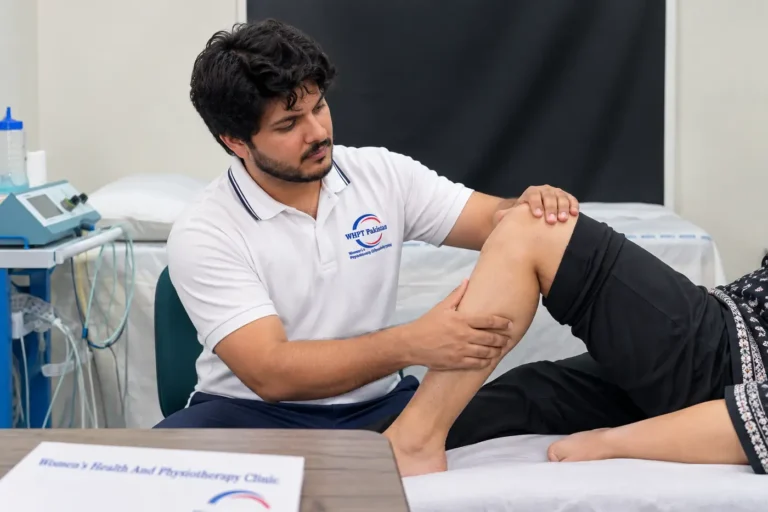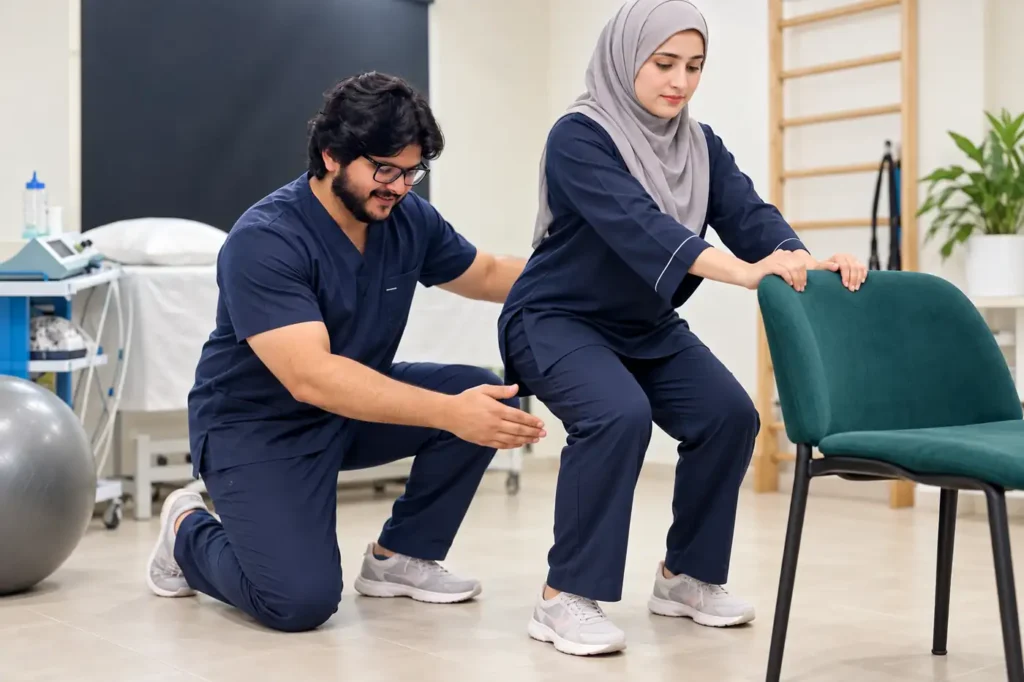
People with knee pain often search for a blacklist: no squats, no stairs, no lunges, no running, no knee extensions. The problem is that an exercise can be too much for one knee today and completely appropriate for the same person later in rehabilitation.
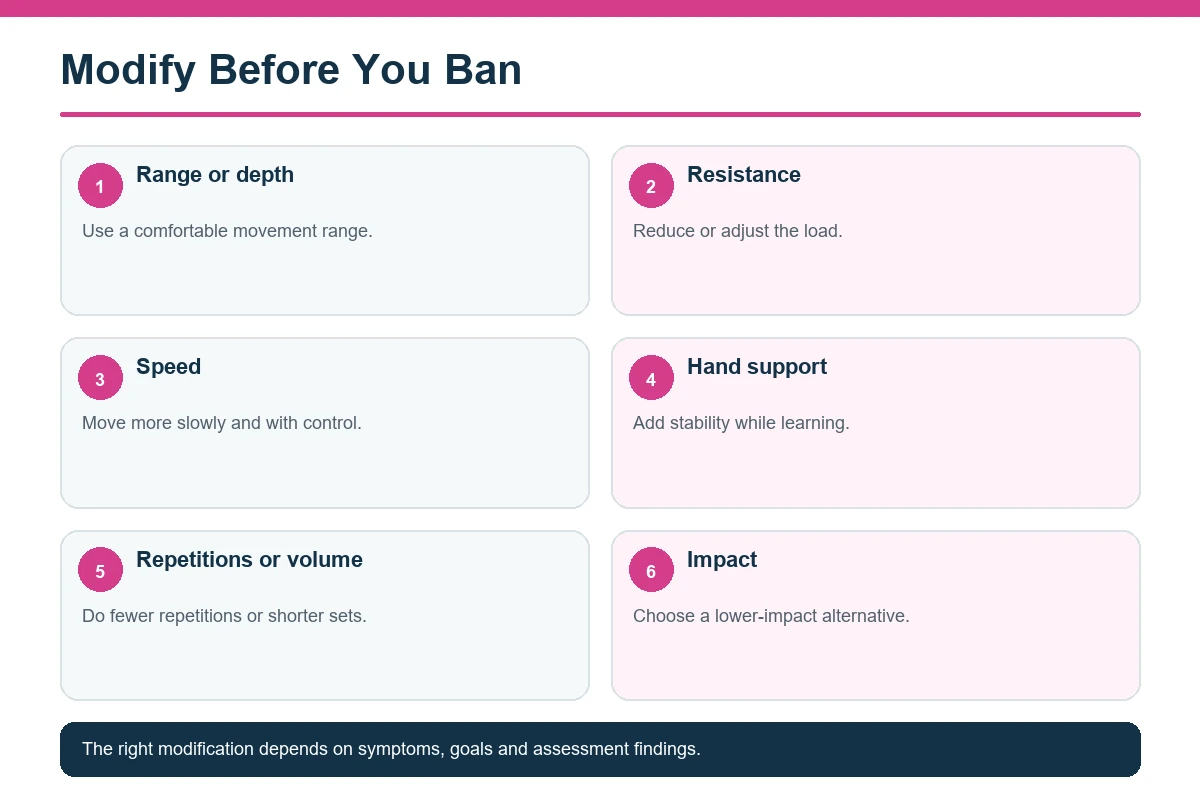
A safer way to think about “avoid” is temporary modification. The goal is not to create fear of knee movement; it is to stop repeatedly using a load, depth, speed, or impact level that clearly exceeds the knee’s current tolerance.
There is no universal list of exercises that everyone with knee pain must avoid. During an irritable phase, deep loaded squats, high-impact jumping or running, heavy knee-dominant training, repeated twisting, or advanced single-leg exercises may need temporary reduction if they clearly worsen symptoms. The exact choice depends on the diagnosis, swelling, stability, surgical restrictions, and current capacity. Modify range, load, speed, support, or volume rather than permanently banning normal knee movement.
At a Glance
- An exercise name does not determine whether it is safe; dose and diagnosis matter.
- Deeper knee flexion usually increases patellofemoral loading.
- Impact and twisting need more caution after acute injury or instability.
- Post-surgical restrictions override generic exercise advice.
- Pain, swelling, and next-day function help judge whether a dose was appropriate.
- The end goal is often to reintroduce useful movements, not avoid them forever.
Why “Never Do This Exercise” Is Usually the Wrong Message
Squatting, lunging, stepping, and running are normal human or sporting movements. A person may need to reduce one of them temporarily because of pain, swelling, injury, or surgery, but permanent avoidance can leave the knee unprepared for the same task in daily life.
WHPT’s Therapeutic Exercise approach therefore changes the dose—range, resistance, repetitions, speed, support, or frequency—before declaring a movement forbidden.
Deep Loaded Squats May Be Too Much During an Irritable Phase
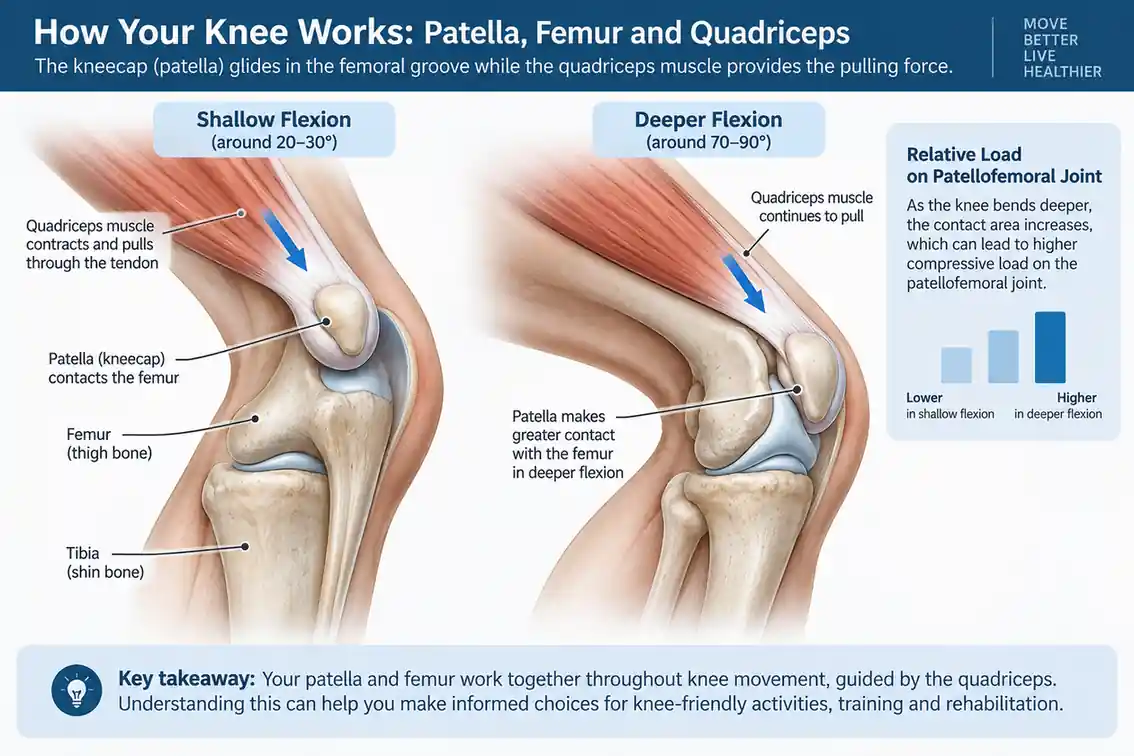
Deeper knee flexion generally increases patellofemoral joint loading. A 2023 study comparing 35 weight-bearing activities found large differences in patellofemoral loading, with deeper-flexion exercises tending to sit higher in the loading spectrum.
This does not mean deep squats damage every knee. It means a painful anterior knee may tolerate a shallower squat first, with depth and load progressed later. The patellofemoral loading study is useful for understanding progression rather than creating a ban.
High-Impact Jumping and Running Can Be Premature
Running and jumping require the knee to tolerate repeated impact and muscle force. If ordinary walking, step-down control, or strength is still limited, high-impact work may simply be ahead of the current stage.
Athletes should rebuild impact in stages. Sports Physiotherapy and Physiotherapy for Athletes can include later running, landing, deceleration, and return-to-sport progressions once the prerequisites are present.
Repeated Twisting or Pivoting Needs Caution After Injury
Cutting, pivoting, and loaded twisting place different demands on the knee from straight-line walking. After a meniscus or ligament injury, repeatedly testing pivots before stability and tissue status are clear can provoke symptoms or create risk.
If there is joint-line pain, locking, or swelling after twisting, review WHPT’s Meniscus Tear Rehabilitation. If the knee gives way after a traumatic mechanism, the ACL Injury Rehabilitation pathway may be more relevant.
Heavy Knee Extension or Leg Press Is Not Automatically Bad—But Load Matters
Machines can be useful because they allow resistance to be measured and progressed. The problem is using a heavy load or painful range before the knee can tolerate it. Open-chain knee extension changes patellofemoral loading across the range, while leg press and squat loading also change with knee angle and resistance.
Rather than labeling a machine “safe” or “dangerous,” the physiotherapist can choose a range and resistance that fits the presentation and then progress it.
Advanced Single-Leg Exercises Can Expose a Capacity Gap
Single-leg squats, step-downs, split squats, hops, and balance tasks reduce the help available from the opposite leg. That makes them useful later in rehabilitation but potentially too demanding early on.
If the knee collapses into pain, the person needs heavy hand support, or swelling rises afterward, scale the task. A lower step, smaller range, lighter resistance, or supported variation can preserve the movement pattern without forcing the full demand.
What About Lunges, Stairs, and Prayer Positions?
These activities all involve knee flexion and load, but they are also meaningful functional tasks. A patient who needs to climb stairs, kneel, or move into prayer positions ultimately needs enough range and strength for those movements if the diagnosis and medical status allow.
During an irritable phase, depth can be reduced, support added, and repetitions lowered. Later, rehabilitation can gradually restore the exact range and control required. The goal is a bridge back to function, not a permanent list of prohibited movements.
Post-Surgical Knees Need Procedure-Specific Restrictions
Generic exercise advice becomes especially unsafe after surgery. A meniscus repair may have bending or weight-bearing restrictions. ACL reconstruction has staged loading and return-to-sport goals. Knee replacement rehabilitation must consider wound status, swelling, range, walking aids, and surgeon guidance.
Use WHPT’s Post-Surgical Rehabilitation and Knee Replacement Physiotherapy pages for the procedure-specific principles. A surgeon’s restriction should not be overridden by a general blog exercise list.
How to Modify an Exercise Instead of Deleting It
| If this is too much… | Try modifying… |
|---|---|
| Deep squat | Use a shallower range, support, slower tempo, or lighter load. |
| High step-down | Lower the step height or use hand support. |
| Running | Reduce distance/speed or use a lower-impact conditioning option if appropriate. |
| Jumping/hopping | Return first to strength and landing preparation at lower intensity. |
| Heavy leg press | Reduce resistance and/or knee-bend depth. |
| Single-leg squat | Use a supported split stance, higher seat, or smaller range. |
The 2024 best-practice guide for patellofemoral pain supports exercise as a primary intervention but emphasizes tailoring to the patient’s presentation. This is the opposite of a universal “avoid squats” rule.
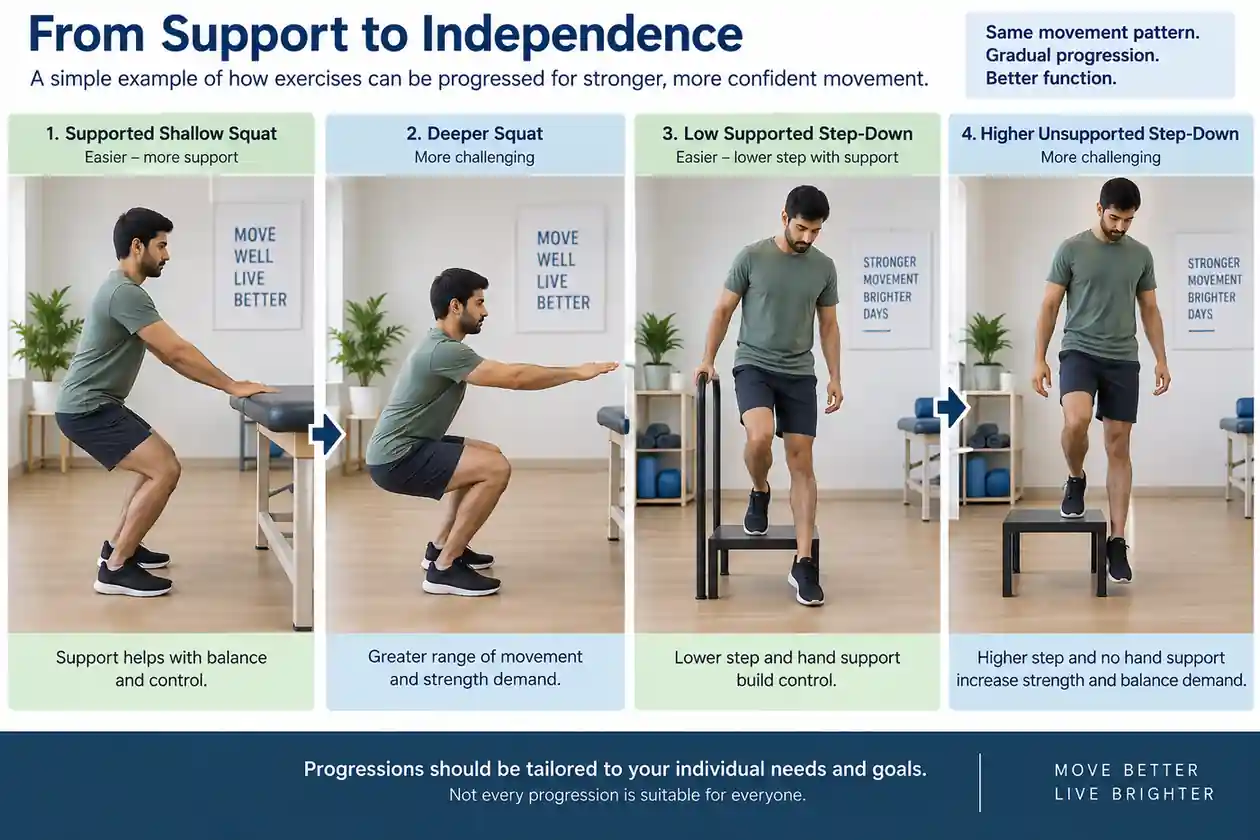
Exercise can usually be modified through more than one variable. You can reduce depth, resistance, speed, repetitions, range, impact, or frequency; use support; or choose a simpler version that trains the same quality. A painful deep squat, for example, does not automatically mean every squat pattern is prohibited. The broader Knee Pain Physiotherapy pathway helps place exercise within the diagnosis and symptom pattern, while Sports Injuries becomes more relevant when exercise pain follows a specific training or traumatic injury. The goal is to preserve useful movement where possible while respecting genuine precautions.
How Do You Know an Exercise Dose Is Appropriate?
Judge more than pain in the moment. Look at swelling, movement quality, confidence, the ability to complete the planned repetitions, and the response later that day and the next morning. A small temporary symptom increase may be acceptable in some stable conditions; a major flare or progressive swelling means the dose likely needs adjustment.
An assessment can also determine whether pain is expected from a sensitive but stable knee or whether instability, locking, trauma, or another finding makes the exercise inappropriate for now. WHPT’s Comprehensive Physiotherapy Assessment is the safest starting point when the diagnosis is unclear.
Modify the Exercise to the Symptom Pattern
The same exercise can be useful for one knee and inappropriate for another at the same moment. A deep squat may be a reasonable long-term goal for a person with patellofemoral pain but too provocative during an irritable flare. A loaded step-down may be valuable later in rehabilitation but unsuitable immediately after a significant injury with swelling and poor control.
| If this happens… | Consider this temporary change |
|---|---|
| Pain rises sharply as knee bend gets deeper | Reduce depth, resistance, or repetitions rather than assuming all squats are forbidden. |
| Knee swells after impact or high-volume activity | Reduce impact/volume and reassess whether the joint is ready for that dose. |
| Knee gives way during single-leg work | Use a safer supported variation and assess stability/control before progressing. |
| A postoperative exercise conflicts with surgeon/protocol restrictions | Follow the operation-specific precautions and rehabilitation pathway. |
| A movement is easy and no longer challenges the goal | Progress it rather than repeating a beginner dose indefinitely. |
Exercise Dose Often Matters More Than the Exercise Name
Patients often ask whether lunges, squats, cycling, or leg extensions are “good” or “bad” for knees. The more useful answer usually depends on range, resistance, repetitions, speed, frequency, symptoms, diagnosis, and current capacity. Even a commonly prescribed exercise can be too much at one dose and appropriate at another.
This is why broad ban lists can be misleading. Rehabilitation should progressively expose the knee to the movements needed for daily life, prayer positions, work, gym training, or sport while respecting relevant precautions. WHPT’s Therapeutic Exercise approach centers progression on function rather than permanently labeling movements as dangerous.
If you are unsure which movement is the problem, change one variable at a time. Reducing depth, load, or volume while keeping the overall movement can reveal whether the issue is the exercise itself or simply the current dose.
Frequently Asked Questions
Are squats bad for knee pain?
No. Squats can be useful, but deeper or heavier versions may be too demanding during an irritable phase. Adjust range, load, support, and volume according to response.
Should I avoid stairs if I have knee pain?
Not permanently in most cases. Temporary modification may reduce irritation, but rehabilitation often needs to restore stair capacity because stairs are part of daily life.
Is running bad for painful knees?
It depends on the diagnosis and current capacity. Running may need temporary reduction when impact exceeds tolerance, then a graded return when prerequisites improve.
Can I do leg extensions with knee pain?
They can be appropriate for some patients when range and resistance are selected carefully. Painful heavy loading should not be forced simply because the exercise is on a program.
Should I avoid lunges with arthritis?
Not automatically. The useful depth and load depend on symptoms, strength, balance, and goals. Arthritis management generally includes tailored exercise rather than blanket avoidance.
What exercises should I avoid after meniscus surgery?
Follow the specific surgical and rehabilitation protocol. Repair procedures can restrict loaded flexion or rotation for a period, while other meniscus procedures follow different progressions.
How can I get a personalized knee exercise plan?
A physiotherapy assessment can identify the starting range, load, and progression that fits your knee. Use WHPT’s appointment page or WhatsApp/call +92 334 8205557.
Modify the Dose, Then Rebuild the Movement
The broader Knee Pain Physiotherapy guide can help place exercise decisions in context. You can also review WHPT Pakistan for clinic information.
The goal of knee rehabilitation is rarely to create a life without squats, steps, stairs, or loaded movement. It is to find a tolerable starting point and progress toward the activities that matter.
WHPT Pakistan provides assessment-led physiotherapy and individualized exercise progression in Bahria Town, Lahore. Appointment times are confirmed by staff.
References
- Song, K., et al. (2023). Patellofemoral joint loading progression across 35 weightbearing rehabilitation exercises and activities of daily living. American Journal of Sports Medicine, 51(8), 2110–2119. PubMed
- Neal, B. S., et al. (2024). Best practice guide for patellofemoral pain. British Journal of Sports Medicine, 58(24), 1486–1495. PubMed
- Willy, R. W., et al. (2019). Patellofemoral pain: Clinical practice guidelines. Journal of Orthopaedic & Sports Physical Therapy, 49(9), CPG1–CPG95. PubMed
- Prill, R., et al. (2025). The formal EU-US Meniscus Rehabilitation 2024 Consensus: Part II. Knee Surgery, Sports Traumatology, Arthroscopy, 33(8), 3014–3024. PubMed
- National Institute for Health and Care Excellence. (2022). Osteoarthritis in over 16s: diagnosis and management (NG226). NICE guidance

About Dr Salman Sabir PT
Dr Salman Sabir PT is a consultant physiotherapist, clinical leader and co-founder of WHPT Pakistan. He holds an MS in Orthopedic Manual Therapy and is undertaking doctoral study in Exercise Physiology. His work focuses on assessment-led rehabilitation, patient education, progressive exercise and long-term recovery.
Need Help Applying This to Your Situation?
General information cannot account for your injury history, strength, movement, medical conditions or personal goals.
BOOK ASSESSMENTCall +92 334 8205557