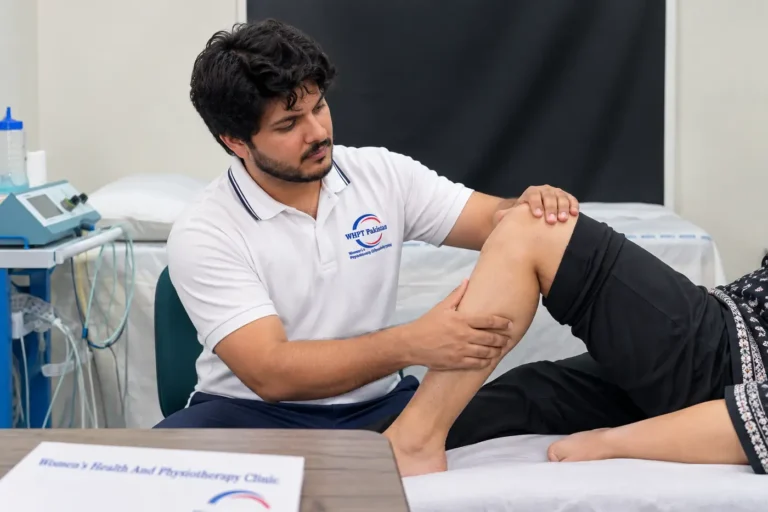
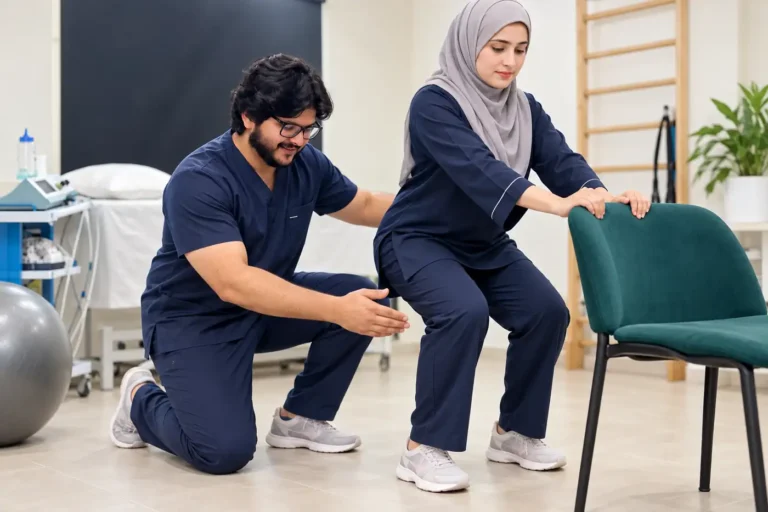
When a knee hurts, two pieces of advice often collide: “Rest it completely” and “Keep moving no matter what.” Neither is a safe universal rule.
A swollen knee after a significant twist may need protection and assessment. A stable arthritis flare may benefit from modified movement. An overuse problem may need reduced training volume without complete inactivity. The right answer depends on what happened and how the knee responds.
For many stable knee problems, complete rest is not necessary and comfortable movement can help maintain mobility and strength. The better strategy is often relative rest: temporarily reduce the activity that clearly aggravates symptoms while keeping tolerable daily movement and gradually rebuilding load. However, major trauma, rapid swelling, true locking, instability, inability to bear weight, or a hot red swollen knee should be assessed before you push through activity.
At a Glance
- “Rest” should usually mean reducing aggravating load, not automatically staying inactive.
- Movement is useful when the knee is stable and the dose is tolerable.
- Pain during movement is not the only variable; swelling and next-day function matter too.
- Some injuries require temporary protection or surgical precautions.
- Arthritis generally benefits from tailored exercise rather than long-term avoidance.
- The goal is to find the amount of movement the knee can tolerate and then progress it.
Why the Rest-vs-Movement Question Is Too Simple
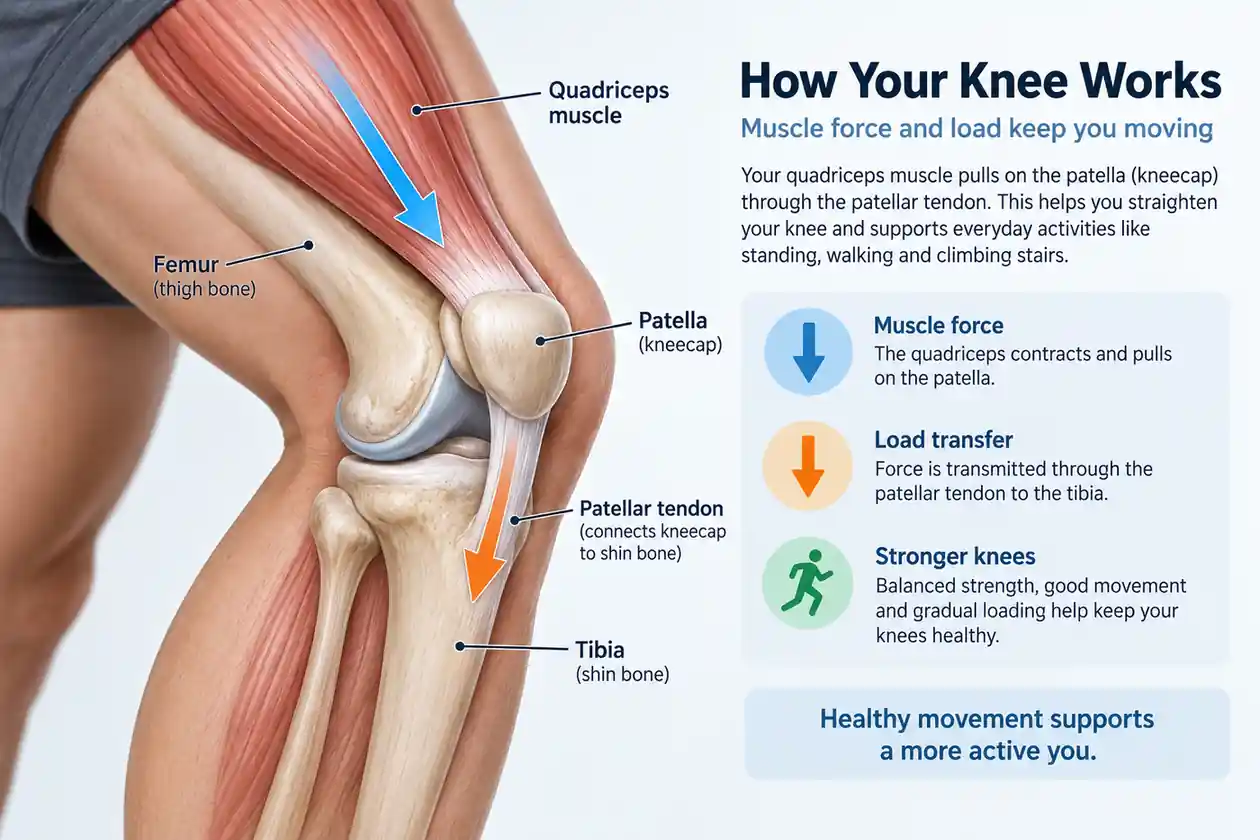
The knee does not respond only to movement; it responds to the amount, speed, depth, resistance, repetition, and recovery around that movement. Walking five minutes and running five kilometers are both “movement,” but they ask very different things of the joint.
That is why a useful plan adjusts load rather than labeling activity as universally good or bad. WHPT’s Knee Pain Physiotherapy page uses symptoms, swelling, movement, strength, and function to decide how activity should change.
When Relative Rest Usually Makes More Sense Than Complete Rest
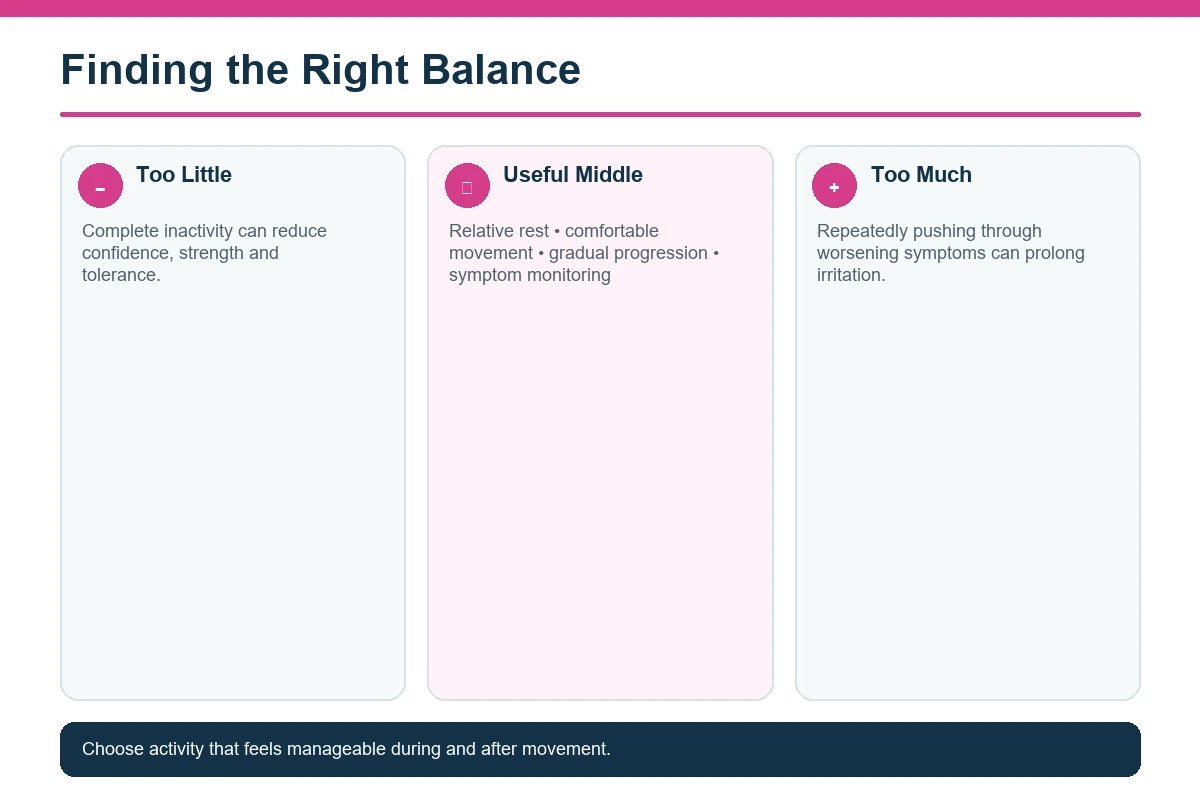
Relative rest means temporarily reducing the specific activity that exceeds current tolerance while maintaining what the knee can handle. A runner may reduce running but continue comfortable walking and strength work. Someone whose knee flares after repeated stairs may reduce unnecessary trips while maintaining ordinary movement.
This approach protects the knee from repeated overload without allowing every aspect of capacity to fall. The exact amount depends on irritability and diagnosis.
When Keeping Moving Is Particularly Important
For knee osteoarthritis, inactivity is not a core treatment. NICE guidance recommends tailored therapeutic exercise and advises that regular exercise can improve pain and function even if some discomfort occurs when exercise begins.
The same general principle applies to many stable musculoskeletal knee problems: maintaining an appropriate amount of movement can reduce deconditioning and make the later return to function easier. WHPT’s Arthritis Physiotherapy pathway combines strength, mobility, balance, and activity rather than teaching patients to permanently protect the knee.
When You Should Protect the Knee More
There are situations where “just keep moving” is poor advice. Significant trauma, suspected fracture, acute instability, a true locked knee, large rapid swelling, or post-surgical restrictions may require temporary protection and medical or orthopedic guidance.
A repaired meniscus, for example, may have specific weight-bearing or flexion restrictions. An ACL injury with instability needs a different plan from a mild overload episode. Review WHPT’s Meniscus Tear Rehabilitation, ACL Injury Rehabilitation, and Post-Surgical Rehabilitation pathways for those distinctions.
How Much Pain Is Acceptable During Movement?
There is no universal pain number that is safe for every knee condition. Some rehabilitation programs allow mild symptoms during exercise if they settle quickly and do not produce a meaningful next-day flare. Other situations—especially acute trauma, surgical precautions, or rapidly increasing swelling—need tighter limits.
Instead of focusing only on pain during the exercise, monitor the whole response: Did swelling increase? Did walking worsen afterward? Is the knee stiffer the next morning? Did function return to baseline within a reasonable period? These observations help the physiotherapist adjust dose.
Use a 24-Hour Response, Not Just the Moment of Exercise
A movement can feel fine during the session and still be too much if the knee becomes substantially more swollen or functionally worse later that day or the next morning. Conversely, a small temporary increase in discomfort does not always mean the exercise was harmful.
This is why load management is a process. The best-practice guide for patellofemoral pain emphasizes education and individualized exercise rather than a rigid “no pain allowed” rule.
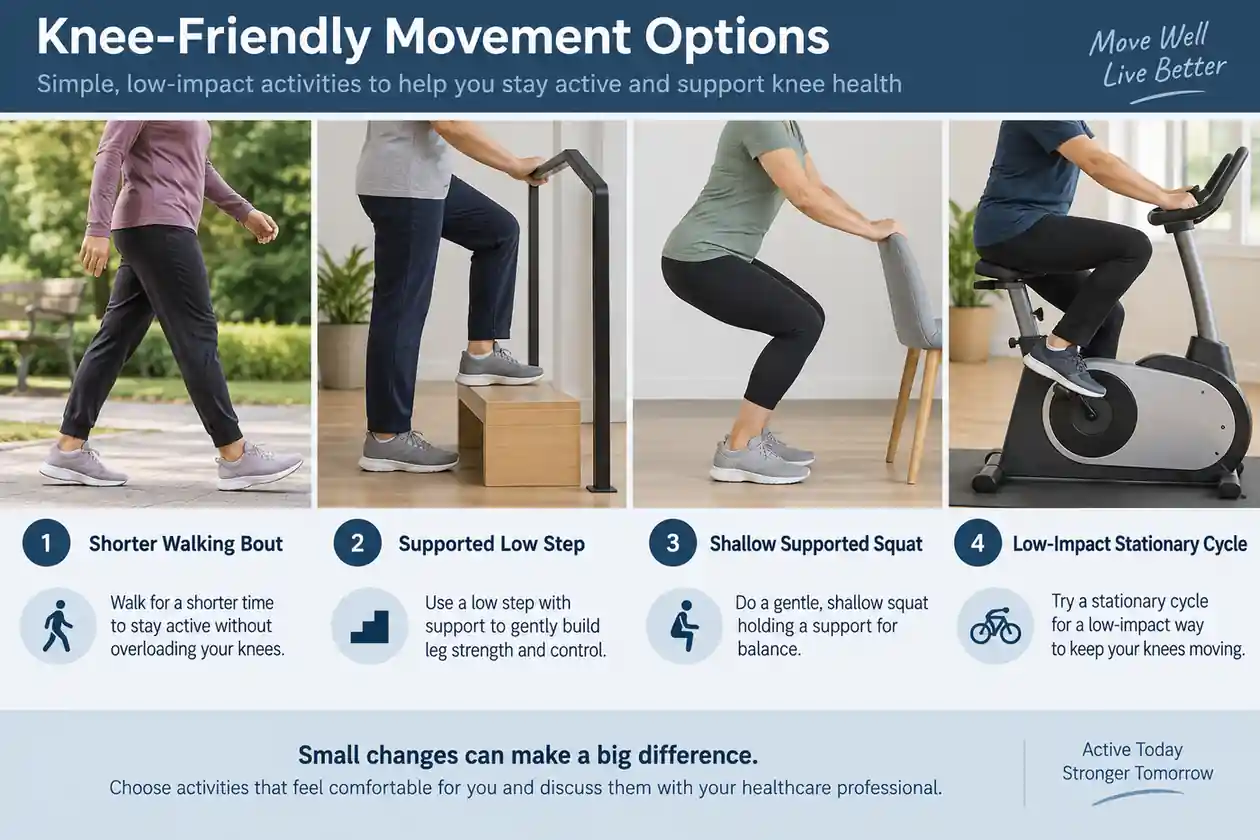
How to Modify Activity Without Becoming Inactive
| Aggravating task | Possible temporary modification |
|---|---|
| Stairs | Use the railing, reduce unnecessary repetitions, or use a lower step during rehabilitation. |
| Walking | Shorten distance or split one long walk into smaller bouts. |
| Running | Reduce volume/speed or temporarily substitute lower-impact conditioning if appropriate. |
| Squatting | Adjust depth, load, tempo, or support rather than automatically removing the movement forever. |
| Gym training | Reduce the most provocative exercises or loads while maintaining tolerable training. |
| Prayer positions | Use temporary support or modification if needed while gradually rebuilding comfortable knee bending. |
These are examples, not prescriptions. The correct modification depends on the problem and the person. A Therapeutic Exercise assessment can help choose a starting point and progression.
What About Ice, Heat, Braces, or Pain Relief While You Keep Moving?
Symptom-relief strategies can make movement easier, but they do not replace the decision about how much load the knee can tolerate. Ice or heat may provide temporary comfort for some people. Braces can have a role in selected conditions. Medication decisions should be discussed with an appropriate medical professional.
The principle is simple: symptom control should support useful movement and rehabilitation, not become a reason to ignore a worsening knee or avoid rebuilding capacity.
Movement can also be distributed across the day instead of concentrated into one difficult session. Someone who struggles after a long continuous walk may tolerate several shorter walks while rebuilding capacity. The same principle can apply to household activity, stairs, gym training, and moving into or out of prayer positions. Active people may need a more specific progression through Sports Physiotherapy or Physiotherapy for Athletes, while selected patients who cannot travel safely may benefit from Home Physiotherapy.
When Movement Should Stop and Medical Care Should Start
Stop treating the issue as an ordinary exercise problem if there is major trauma with deformity, inability to bear weight after significant injury, a very hot red swollen joint with fever, a cold or pale foot, severe neurological changes, or chest pain/sudden breathlessness associated with possible clotting.
A Comprehensive Physiotherapy Assessment can screen many knee presentations, but urgent medical symptoms need the appropriate medical pathway first.
What “Relative Rest” Actually Looks Like
Relative rest means reducing the specific demand that is aggravating the knee while preserving as much comfortable activity as the situation allows. If repeated deep squats provoke symptoms, you may temporarily reduce depth or volume rather than stop all lower-body movement. If long walks cause a flare, shorter walks may be better tolerated while strength is rebuilt. The exact modification depends on the diagnosis and irritability.
| Current response | Practical adjustment |
|---|---|
| Comfortable movement with no meaningful next-day increase | Usually continue and progress gradually when appropriate. |
| Mild symptoms that settle back toward baseline | Keep the task but consider reducing volume, range, speed, or resistance. |
| Symptoms build through the session and remain clearly worse the next day | Reduce the dose and reassess the progression. |
| New swelling, giving way, true locking, or major loss of movement | Pause the loading experiment and seek assessment. |
This is not a universal pain-monitoring formula. It is a practical way to think about dose. Certain injuries, postoperative protocols, or medical conditions require different restrictions, which is why individual assessment matters when the presentation is unclear.
A Simple Movement Ladder
When movement is appropriate, progression can move from easier to more demanding tasks rather than jumping from rest directly back to full activity. A person might begin with comfortable range-of-motion work and ordinary walking, then rebuild sit-to-stand and step tolerance, then resistance exercise, and finally running, jumping, or sport-specific tasks if those are relevant goals.
The ladder should reflect the patient. Someone whose priority is prayer positions may need graded knee flexion and floor-transfer tolerance; someone returning to football needs a very different endpoint. WHPT’s Comprehensive Physiotherapy Assessment can help identify the appropriate starting level when pain, swelling, or uncertainty makes self-progression difficult.
Movement is therefore neither automatically the treatment nor automatically the problem. The useful question is whether the current type and dose of movement are helping the knee regain function without producing an unacceptable response.
Confidence also matters. After a painful episode, people sometimes protect the knee long after the original irritability has settled. A graded return can rebuild confidence alongside physical capacity: start with a task that feels manageable, repeat it consistently, then increase one demand at a time. If fear, instability, or unpredictable symptoms keep blocking that progression, assessment is more useful than forcing the movement or avoiding it indefinitely.
Frequently Asked Questions
Should I rest my knee if it hurts when walking?
If walking produces mild stable symptoms, reducing distance or splitting walks may be enough. If weight-bearing is becoming progressively harder, there was major trauma, or swelling is substantial, get the knee assessed.
Is bed rest good for knee pain?
Prolonged bed rest is rarely useful for routine musculoskeletal knee pain and can reduce strength and general capacity. Specific injuries or medical conditions may still require temporary protection.
Can I keep going to the gym with knee pain?
Often the program can be modified rather than stopped completely. Change the movements, depth, load, volume, or frequency that provoke symptoms while maintaining tolerable training.
Should I stop stairs if my knee hurts?
Not necessarily. Temporary reduction, railing use, or graded step practice may be more appropriate than permanent avoidance, depending on the cause.
Does arthritis need rest during a flare?
A flare may justify temporary reduction of aggravating load, but long-term inactivity is not recommended. Return toward tailored exercise as symptoms permit.
What if movement makes the knee swell?
Repeated or increasing swelling suggests the current dose may be too high or the diagnosis needs review. Do not simply keep adding load.
How can WHPT help me decide how much movement is safe?
Assessment can establish the likely problem, current irritability, strength, movement, and functional limits, then use those findings to guide progression. Use the appointment page or WhatsApp/call +92 334 8205557.
Find the Right Dose, Not an Extreme
For the wider knee symptom pathway, review Knee Pain Physiotherapy. You can also review WHPT Pakistan and the appointment page if the right amount of movement remains unclear.
For many people, the best response to knee pain is neither complete rest nor forcing normal activity. It is a temporary reduction of the load that is too much, continued comfortable movement, and progressive rebuilding.
WHPT Pakistan provides assessment-led physiotherapy in Bahria Town, Lahore. Appointment times are confirmed by staff.

References
- National Institute for Health and Care Excellence. (2022). Osteoarthritis in over 16s: diagnosis and management (NG226). NICE guidance
- Kolasinski, S. L., et al. (2020). 2019 American College of Rheumatology/Arthritis Foundation guideline for management of osteoarthritis of the hand, hip, and knee. Arthritis Care & Research, 72(2), 149–162. PubMed
- Neal, B. S., et al. (2024). Best practice guide for patellofemoral pain. British Journal of Sports Medicine, 58(24), 1486–1495. PubMed
- Rathleff, M. S., et al. (2019). Activity modification and load management of adolescents with patellofemoral pain. American Journal of Sports Medicine, 47(7), 1622–1630. PubMed
- Kraus, V. B., et al. (2019). Effects of physical activity in knee and hip osteoarthritis: a systematic umbrella review. Medicine & Science in Sports & Exercise, 51(6), 1324–1339. PubMed

About Dr Salman Sabir PT
Dr Salman Sabir PT is a consultant physiotherapist, clinical leader and co-founder of WHPT Pakistan. He holds an MS in Orthopedic Manual Therapy and is undertaking doctoral study in Exercise Physiology. His work focuses on assessment-led rehabilitation, patient education, progressive exercise and long-term recovery.
Need Help Applying This to Your Situation?
General information cannot account for your injury history, strength, movement, medical conditions or personal goals.
BOOK ASSESSMENTCall +92 334 8205557