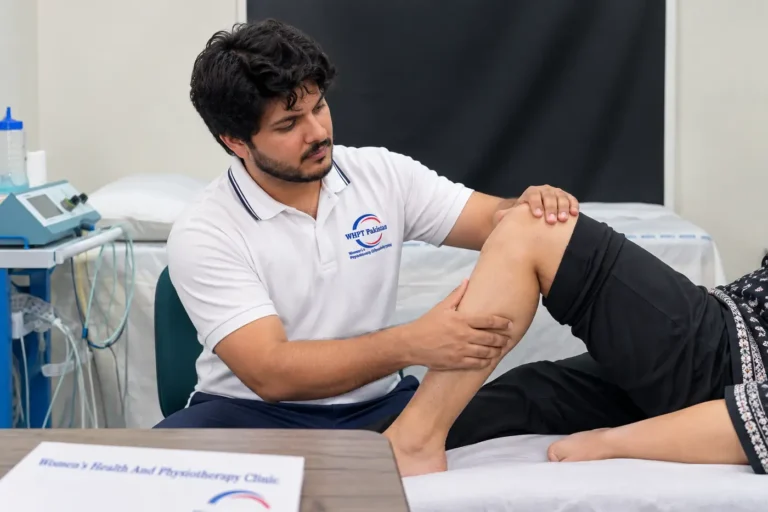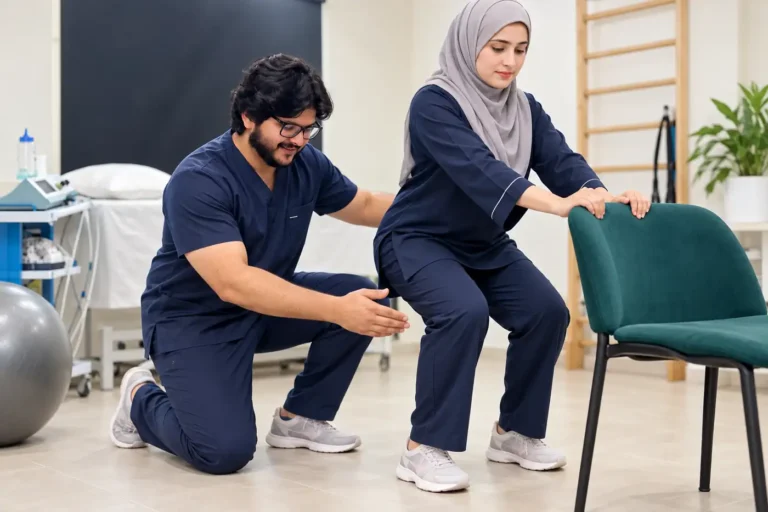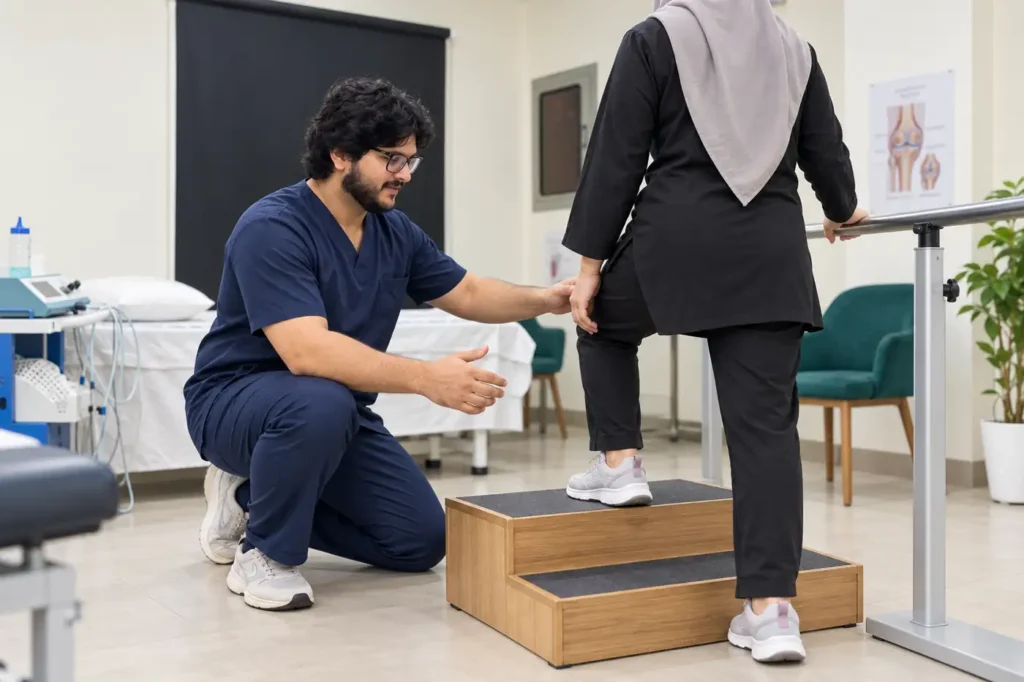
You may walk comfortably on flat ground, then feel knee pain as soon as you climb stairs – or especially when you come back down. This does not automatically mean arthritis or serious damage. Stairs ask more from the knee than level walking, particularly from the kneecap joint and the muscles that control the leg. What matters is where the pain occurs, when it started, what other symptoms are present, and how the knee responds to the movement.
Quick Answer
Knee pain can feel worse on stairs because climbing and descending require greater knee bending, quadriceps activity, and control than ordinary walking. This increases demand on the patellofemoral joint and surrounding tissues. Patellofemoral pain, arthritis, meniscus problems, previous injury, reduced strength, and sudden increases in activity can all contribute. Pain on stairs alone cannot identify the diagnosis, so persistent or worsening symptoms may need a physiotherapy assessment.
Knee Pain on Stairs at a Glance
- Stairs require more knee flexion and muscular control than level walking.
- Pain around or behind the kneecap commonly becomes noticeable during stair climbing or descent.
- Going downstairs can be particularly demanding because your muscles must control your body as you lower yourself.
- Arthritis can cause stair pain, but stair pain does not automatically mean arthritis.
- Meniscus problems, ligament injuries, overload, weakness, and other conditions can produce similar symptoms.
- Complete rest is not automatically the best solution for every stable knee problem.
- Persistent swelling, locking, instability, or difficulty bearing weight deserves closer attention.
- Assessment should identify likely contributors before exercises or treatment are selected.
Why Do Stairs Place More Demand on Your Knees?
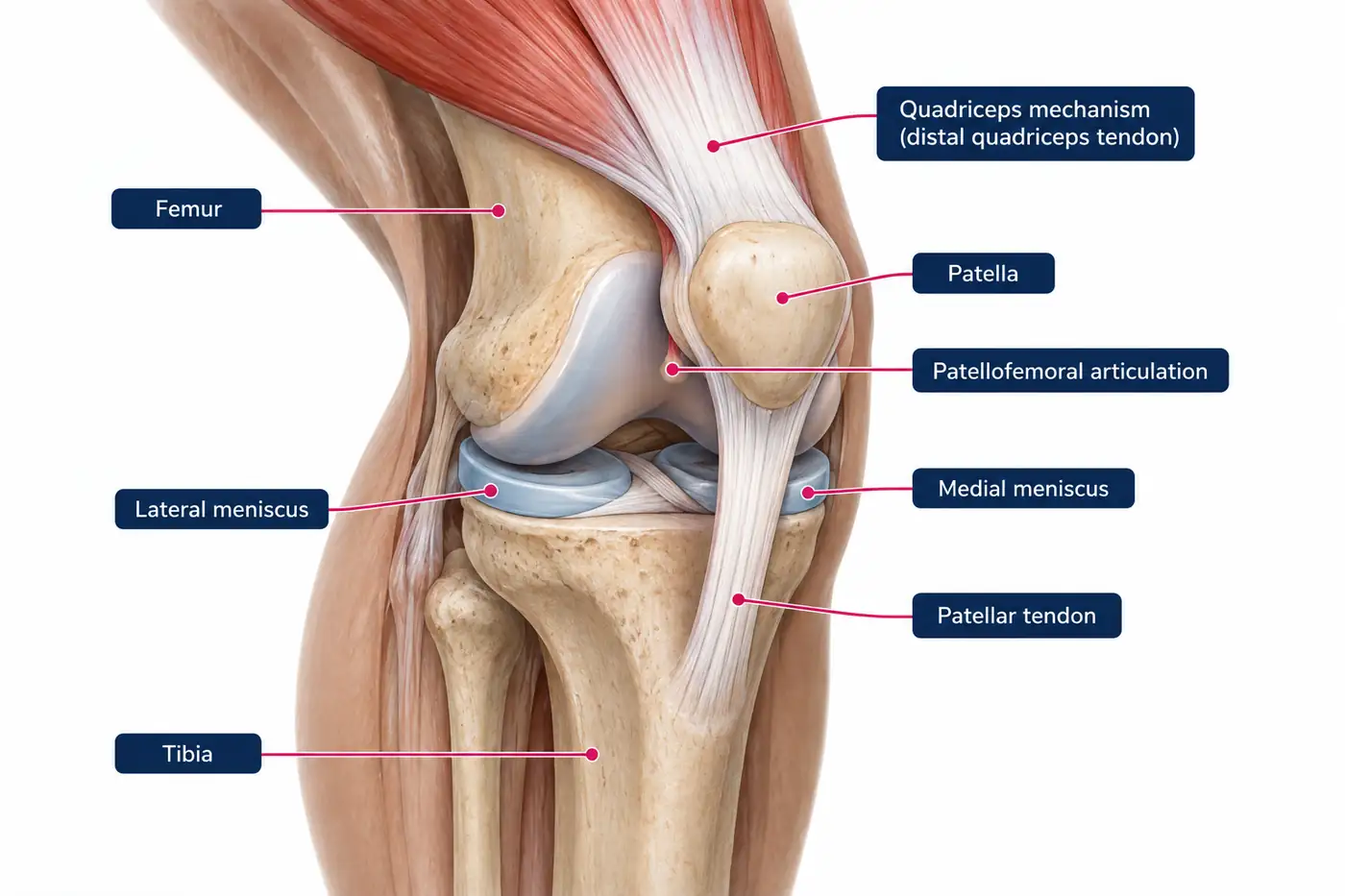
When you step onto a higher stair, your knee bends and your quadriceps must generate force to help raise your body. The kneecap, or patella, interacts with the groove at the lower end of the thigh bone as the knee moves. This relationship forms the patellofemoral joint.
As the knee bends and the quadriceps work harder, pressure around the kneecap joint changes. That pressure is a normal part of movement. Pain may appear when the amount of stair use, exercise, or load is more than the knee can comfortably handle at that time.
This may happen after:
- A sudden increase in walking, stairs, running, or gym training
- A knee injury
- Reduced quadriceps strength
- A flare of an existing knee condition
Patellofemoral pain is particularly associated with activities that load the knee while it is bent, including squatting, running, prolonged sitting, and stair climbing. For a broader explanation of the different problems that may produce knee symptoms, see WHPT Pakistan’s Knee Pain Physiotherapy guide.
Why Can Going Downstairs Hurt More Than Going Upstairs?
Some people can climb stairs reasonably comfortably but hurt more while coming down.
During stair descent, the quadriceps control the body as it lowers against gravity while the knee remains bent. That combination can make descent more demanding for a sensitive knee.
Common Causes of Knee Pain When Using Stairs
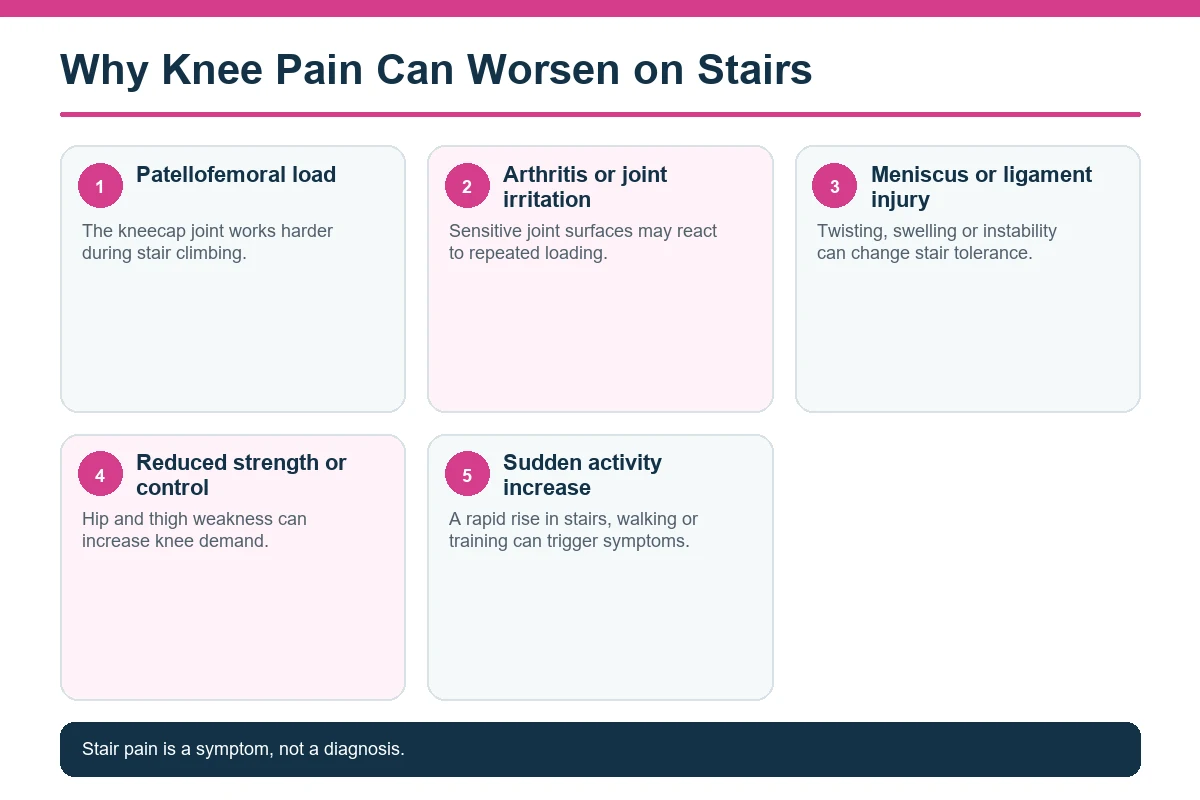
Knee pain on stairs is a symptom, not a diagnosis. Several conditions can produce similar complaints.
These possibilities can overlap. The painful spot, a scan result, or a single test rarely tells the whole story on its own.
| Possible contributor | Common clues | What may need assessment |
|---|---|---|
| Patellofemoral pain | Around/behind kneecap; worse with stairs or squats | Loading, strength, mobility, functional movement |
| Knee osteoarthritis | Pain/stiffness; reduced stair or walking tolerance | Movement, strength, function, overall clinical picture |
| Meniscus problem | Joint-line pain, swelling, twisting pain, catching/locking | History, swelling, mechanical symptoms, function |
| Ligament injury | Often follows twist, landing, or trauma; may feel unstable | Stability, swelling, weight-bearing, mechanism |
| Reduced strength or conditioning | Symptoms rise as task demand increases | Quadriceps/hip capacity, endurance, function |
| Sudden workload increase | Symptoms after more stairs, walking, running, gym, or sport | Recent volume, intensity, and recovery changes |
What Does the Location of Knee Pain Tell You?
Pain at the Front of the Knee
Pain around or behind the kneecap during stairs, squats, running, or prolonged sitting is commonly associated with patellofemoral pain. Stair climbing and descent are useful functional tasks during assessment.
Pain Along the Inner or Outer Joint Line
Pain closer to the joint line may raise different possibilities, including meniscus or joint-related symptoms. If the problem followed a twisting injury or is accompanied by swelling, catching, or locking, a more detailed examination may be appropriate. WHPT has a dedicated guide to Meniscus Tear Rehabilitation for patients with diagnosed or suspected meniscal problems.
Pain Throughout the Knee With Stiffness
More generalized knee pain accompanied by stiffness and reduced walking or stair tolerance may occur with osteoarthritis, particularly in older adults. However, age alone does not establish that arthritis is responsible for the symptoms. WHPT’s Arthritis Physiotherapy page explains how assessment, activity, strength, and function fit into arthritis rehabilitation.
Pain After a Sports Injury
A sudden twisting or landing injury, rapid swelling, or a feeling that the knee gives way requires a different line of assessment from gradual anterior knee pain. Patients recovering from an ACL injury can read more about ACL Injury Rehabilitation at WHPT Pakistan. For a broader injury pathway, see Sports Injury Treatment.
Does Knee Pain on Stairs Mean You Have Arthritis?
No. This is one of the most important misconceptions to avoid.
Knee osteoarthritis can cause pain with stairs and other weight-bearing activities, but stair pain is not specific to arthritis. Imaging changes also do not automatically explain every painful activity.
Symptoms need to be interpreted alongside:
- Age and medical history
- Swelling
- Strength
- Previous injury
- Relevant imaging when indicated
Importantly, an arthritis diagnosis does not mean the knee should never be loaded again. NICE guidance on osteoarthritis recommends therapeutic exercise tailored to the individual and notes that some discomfort can occur when exercise begins. The goal is generally to find an appropriate amount and type of activity rather than assuming that all knee loading is harmful.
Could Weak Muscles Be Making Stairs More Difficult?
Sometimes. But weakness alone is not a complete explanation. Using stairs requires the hip, thigh, knee, ankle, and balance system to work together.
- Your quadriceps help control and extend the knee.
- Hip muscles contribute to pelvic and lower-limb control.
Strength can drop after injury, inactivity, swelling, or repeatedly avoiding the painful leg. Rehabilitation should therefore focus on the specific abilities that are limiting everyday function rather than prescribing one generic knee exercise.
The practical question is: What is limiting this person, and will improving it make stairs and other important activities easier?
When exercise is appropriate, WHPT’s Therapeutic Exercise approach emphasizes exercises selected and progressed from assessment findings rather than a generic list. For active patients, rehabilitation may eventually extend beyond stairs to running, jumping, landing, braking, or sport-specific tasks through Sports Physiotherapy or the Physiotherapy for Athletes pathway.
Should You Stop Using Stairs If Your Knee Hurts?
Not automatically. The appropriate response depends on the cause, severity, irritability, and associated symptoms.
For many stable knee problems, prolonged avoidance may reduce capacity, while repeatedly forcing a highly painful movement is also unhelpful. Temporary modification is often the more practical middle ground.
A temporary middle ground may involve:
- Using a railing when needed for safety
- Maintaining comfortable general movement
- Gradually rebuilding strength and stair tolerance
The aim is to manage how much work the knee is doing, not become afraid of movement. Step height, support, and repetitions can be adjusted first and then increased gradually.
The same principle can apply to other knee-bending tasks, including getting up from a low chair, squatting, or moving into and out of prayer positions.
What Can Help Knee Pain on Stairs?
There is no single treatment that fits everyone. What helps should match the symptoms, examination findings, activity level, and goals.
Activity Modification
Activity modification may temporarily reduce the frequency, depth, speed, or intensity of movements that repeatedly provoke symptoms.
Progressive Strengthening
For appropriate patients, progressive strengthening may rebuild quadriceps and hip capacity and tolerance to loaded knee movement.
Functional Retraining
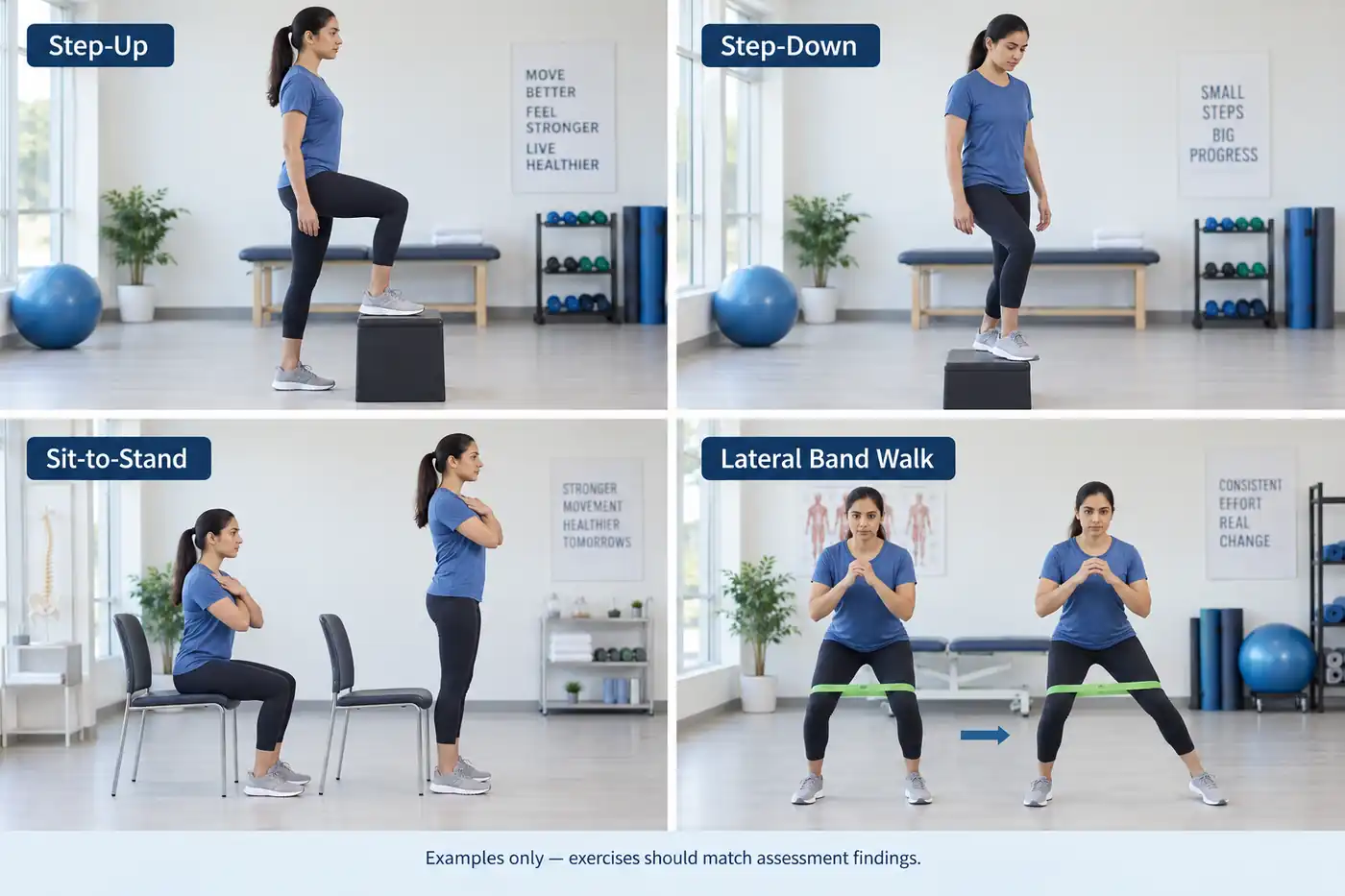
Rehabilitation should eventually reconnect exercise with the task that matters, such as step-ups, controlled step-downs, balance work, or sport-specific loading when relevant.
Education and Load Management
Understanding what aggravates symptoms, what is safe to continue, and how activity can be progressed is often an important part of rehabilitation. Patients whose mobility makes clinic attendance difficult may also be considered for Physiotherapy at Home in Lahore when clinically and practically appropriate.
When Should Knee Pain on Stairs Be Assessed?
Consider assessment when knee pain:
- Persists instead of gradually settling
- Repeatedly returns
- Is increasingly limiting stairs or walking
- Follows a significant injury
- Is accompanied by recurrent swelling
- Includes catching, locking, or giving way
When the diagnosis, contributing factors, or appropriate treatment pathway is uncertain, WHPT Pakistan can begin with a Comprehensive Physiotherapy Assessment rather than assuming the source from one symptom.
When Is More Urgent Medical Attention Appropriate?
Seek prompt medical care rather than trying to exercise through the problem if knee symptoms include concerning features such as:
Clinical responsibility means recognizing when physiotherapy is appropriate and when it is not the first priority.
| Warning sign | Why it matters |
|---|---|
| Major trauma with deformity | Possible fracture or dislocation |
| Inability to bear weight after significant injury | May indicate substantial injury |
| A very hot, red, swollen knee with fever | Possible infection/inflammatory condition |
| A cold, pale, or pulseless lower leg or foot | Possible vascular emergency |
What Will a Physiotherapist Check?
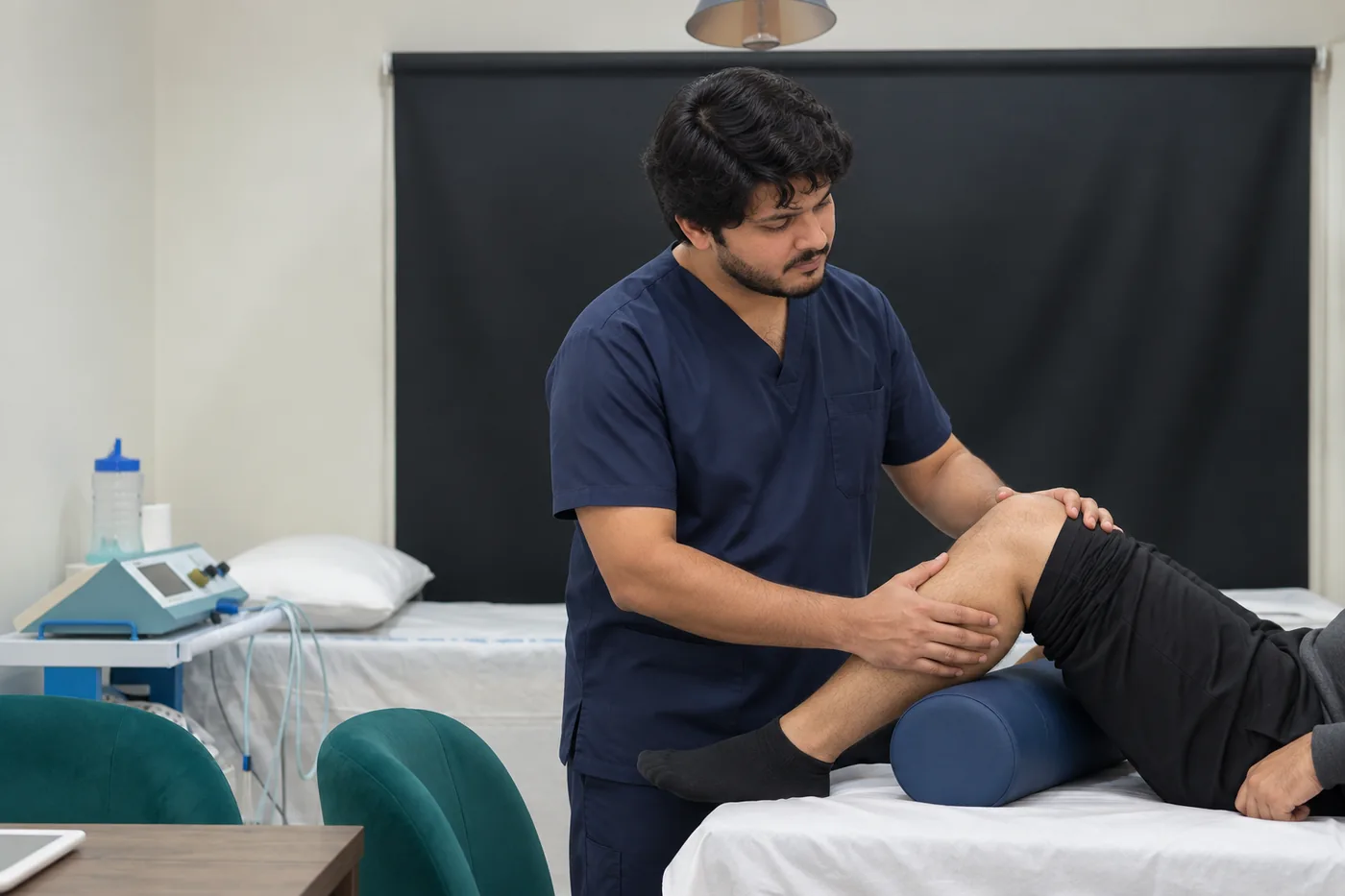
A knee assessment should examine the painful task as well as relevant movement, strength, swelling, history, and function.
At WHPT Pakistan, assessment is intended to answer several practical questions: Is physiotherapy appropriate? What is most likely contributing? What needs to improve? How will progress be measured? That approach is described in more detail on the Comprehensive Physiotherapy Assessment page.
If symptoms followed surgery, rehabilitation must also respect the operation, healing stage, surgeon instructions, and current precautions. See WHPT’s Post-Surgical Rehabilitation pathway.
| Assessment area | What it may help clarify |
|---|---|
| Symptom history | How it began and what changes symptoms |
| Swelling | Whether joint irritation or injury may be present |
| Knee movement | Whether bending/straightening is limited |
| Strength | Relevant lower-limb muscle capacity |
| Step-up or step-down | Symptoms and control during the actual task |
| Functional goals | What the patient needs to regain |
Frequently Asked Questions
Why does my knee hurt going downstairs but not upstairs?
Descending stairs requires the quadriceps to control your body while the knee is bent, so it can provoke a sensitive knee more than ascent. The pattern is useful, but it is not a diagnosis.
Is knee pain on stairs a sign of arthritis?
It can be, but not always. Patellofemoral pain, meniscus problems, previous injuries, reduced strength, and activity changes can also cause stair-related symptoms.
Why does the front of my knee hurt on stairs?
Pain around or behind the kneecap on stairs is commonly seen with patellofemoral pain. Assessment can help determine whether that pattern fits or another source needs consideration.
Should I keep climbing stairs if my knee hurts?
Mild, stable symptoms may allow continued activity with modification. Significant swelling, instability, trauma, severe pain, or worsening function should be assessed rather than pushed through.
Can strengthening help knee pain on stairs?
It can. Hip- and knee-targeted strengthening is commonly used for patellofemoral pain, while therapeutic exercise is also recommended for knee osteoarthritis. The dose should be individualized.
Do I need an MRI for knee pain when using stairs?
Not necessarily. History and physical examination are often enough to guide initial management. Imaging is considered when the clinical picture or treatment decision makes it useful.
Can changing shoes fix knee pain on stairs?
Shoes can influence comfort for some people, but changing footwear alone does not solve every case. Persistent symptoms still need to be considered alongside knee function, activity changes, and previous injury.
When Knee Pain Is Affecting Everyday Life
If knee pain is affecting stairs, walking, prayer positions, work, exercise, or sport, a physiotherapy assessment can help identify what may be contributing to the problem and what the next step should be. WHPT Pakistan provides assessment-led physiotherapy and rehabilitation in Bahria Town, Lahore, with treatment planned around symptoms, movement, strength, function, and individual goals rather than assumptions based on pain alone.
1st Floor, Plaza 82, Block AA Commercial, Bahria Town, Lahore
WhatsApp / Call: +92 334 8205557
Appointment times are confirmed by WHPT staff. Review the Book a Physiotherapy Appointment page or WhatsApp/call the clinic to ask about availability.
References
- Brechter, J. H., & Powers, C. M. (2002). Patellofemoral joint stress during stair ascent and descent in persons with and without patellofemoral pain. Gait & Posture, 16(2), 115–123. PubMed
- Powers, C. M., Ward, S. R., Chen, Y. J., Chan, L. D., & Terk, M. R. (2004). Effect of bracing on patellofemoral joint stress while ascending and descending stairs. Clinical Journal of Sport Medicine, 14(4), 206–214. PubMed
- Willy, R. W., Hoglund, L. T., Barton, C. J., Bolgla, L. A., Scalzitti, D. A., Logerstedt, D. S., Lynch, A. D., Snyder-Mackler, L., & McDonough, C. M. (2019). Patellofemoral pain: Clinical practice guidelines linked to the International Classification of Functioning, Disability and Health. Journal of Orthopaedic & Sports Physical Therapy, 49(9), CPG1–CPG95. DOI
- Waiteman, M. C., Briani, R. V., Pazzinatto, M. F., Ferreira, A. S., Ferrari, D., Silva, D. O., & Azevedo, F. M. (2018). Relationship between knee abduction moment with patellofemoral joint reaction force, stress and self-reported pain during stair descent in women with patellofemoral pain. Clinical Biomechanics, 59, 110–116. PubMed
- National Institute for Health and Care Excellence. (2022). Osteoarthritis in over 16s: Diagnosis and management (NG226). NICE

About Dr Salman Sabir PT
Dr Salman Sabir PT is a consultant physiotherapist, clinical leader and co-founder of WHPT Pakistan. He holds an MS in Orthopedic Manual Therapy and is undertaking doctoral study in Exercise Physiology. His work focuses on assessment-led rehabilitation, patient education, progressive exercise and long-term recovery.
Need Help Applying This to Your Situation?
General information cannot account for your injury history, strength, movement, medical conditions or personal goals.
BOOK ASSESSMENTCall +92 334 8205557