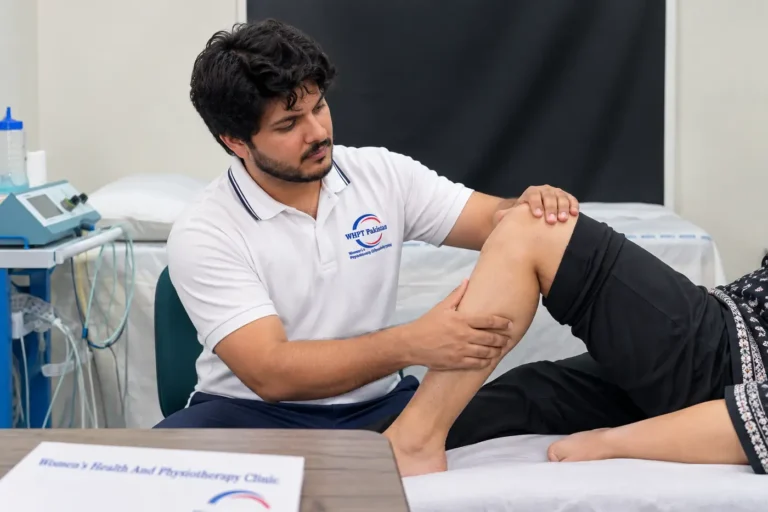
Knee pain often creates an awkward decision: give it a few days and see what happens, or get it assessed now? Going for an appointment too quickly can feel unnecessary, but waiting through repeated swelling, instability, or declining function can also delay the right next step.
The answer is not based on a fixed number of days. It depends on what happened, how the knee is behaving, whether the trend is improving, and whether there are signs that need medical care rather than routine physiotherapy.
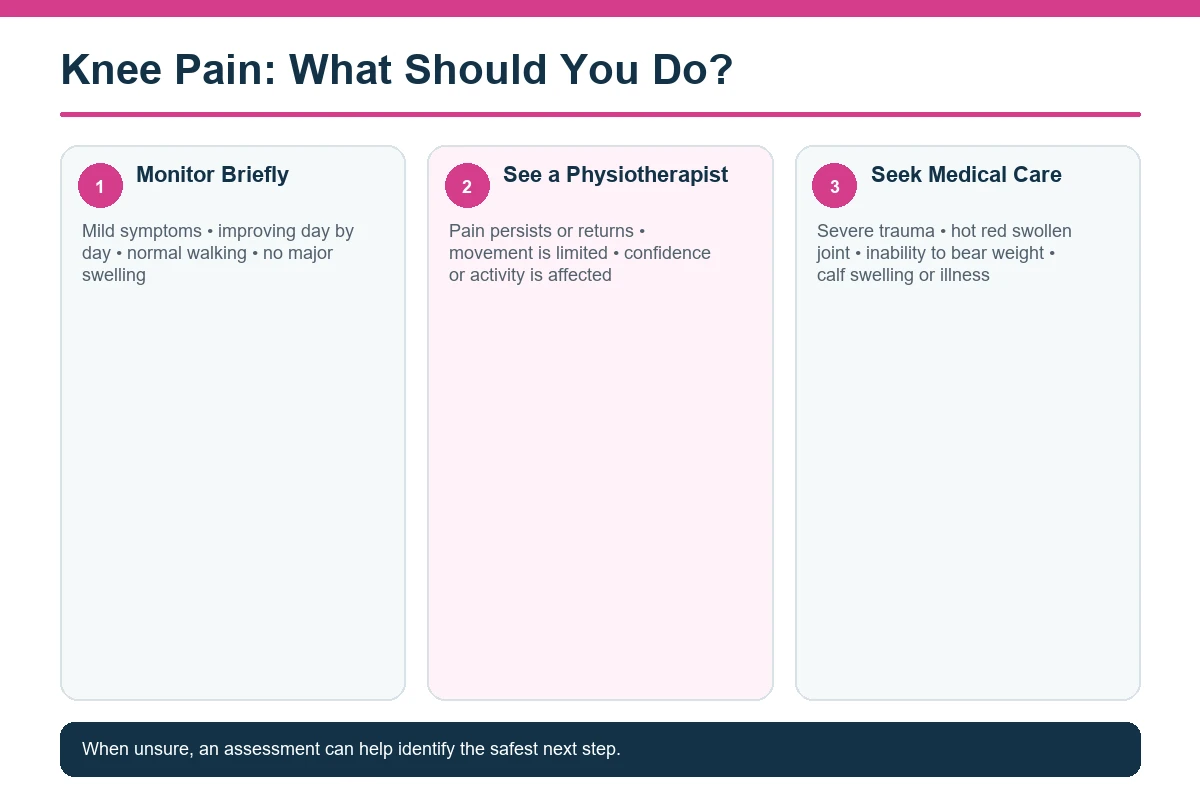
A short period of monitoring may be reasonable for mild knee pain after unfamiliar activity when there is no major trauma, swelling, instability, locking, or loss of weight-bearing and symptoms are clearly improving. See a physiotherapist sooner when pain persists, keeps returning, limits walking or stairs, or is associated with weakness or reduced movement. Significant trauma, a hot swollen joint, deformity, true locking, or inability to bear weight may require urgent medical assessment.
At a Glance
- There is no universal “wait seven days” rule for knee pain.
- Improvement trend matters more than the calendar alone.
- Recurring pain can justify assessment even if each flare eventually settles.
- Trauma, rapid swelling, instability, or locking should lower the threshold for assessment.
- Some red flags need urgent medical review rather than routine physiotherapy.
- Assessment can also tell you when reassurance and self-management are enough.
When It Is Reasonable to Monitor Knee Pain Briefly
Mild knee soreness after an unusual hike, extra gym volume, a long day of standing, or a sudden increase in stairs may settle as the knee adapts. If there was no significant trauma, you can bear weight normally, there is no meaningful swelling or instability, and each day is trending better, a short period of sensible activity modification can be reasonable.
Monitoring does not mean repeatedly testing the painful movement. It means keeping comfortable movement, reducing the specific load that provoked the flare, and watching whether function is returning. WHPT’s Knee Pain Physiotherapy guide discusses this broader load-management approach.
See a Physiotherapist When the Trend Is Not Improving
The calendar matters less than the trajectory. Pain that is slightly better each day is different from pain that is unchanged for weeks or returns every time normal activity resumes. If you keep needing to avoid stairs, shorten walks, stop gym sessions, or change prayer positions because of the knee, the functional limitation itself is useful information.
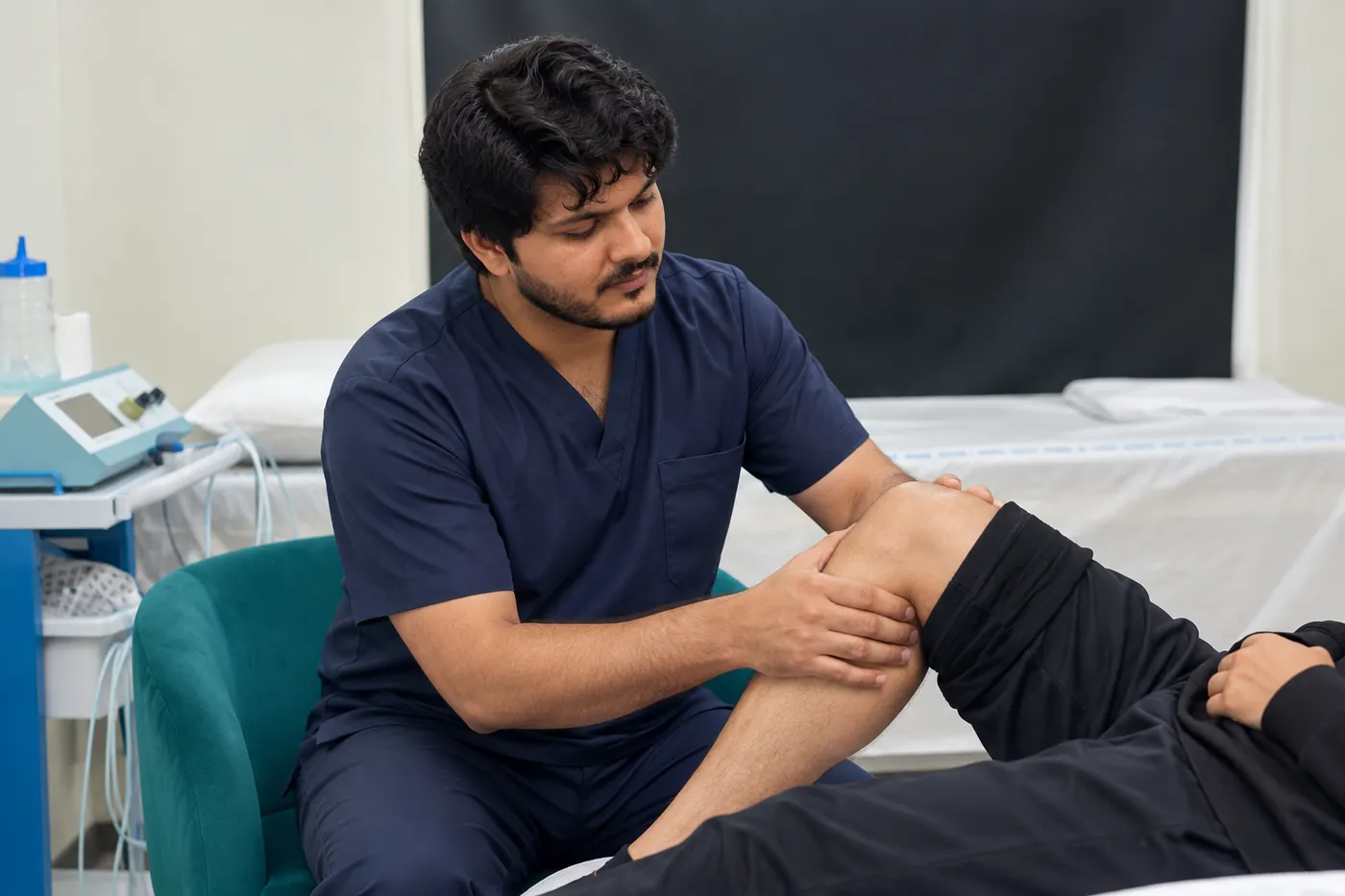
A physiotherapist can assess whether reduced strength, joint irritation, mobility loss, patellofemoral pain, arthritis, a meniscus problem, or another contributor fits the presentation. The purpose is not to give a treatment label quickly; it is to organize the problem and decide what needs to change.
Go Earlier After a Clear Injury
Waiting makes less sense when there was a clear twist, fall, tackle, collision, or awkward landing. Early assessment can help determine whether the knee is stable, whether movement needs temporary protection, whether imaging or orthopedic review is indicated, and what activity is safe.
After traumatic knee injury, medical decision rules such as the Ottawa Knee Rule evidence help clinicians decide when radiographs are appropriate. You do not need to self-apply those rules, but inability to bear weight, focal bony tenderness, deformity, and significant trauma are not symptoms to ignore.
For sport-related mechanisms, WHPT’s Sports Injuries page explains how acute injuries differ from gradual overload problems.
Swelling Changes the Decision
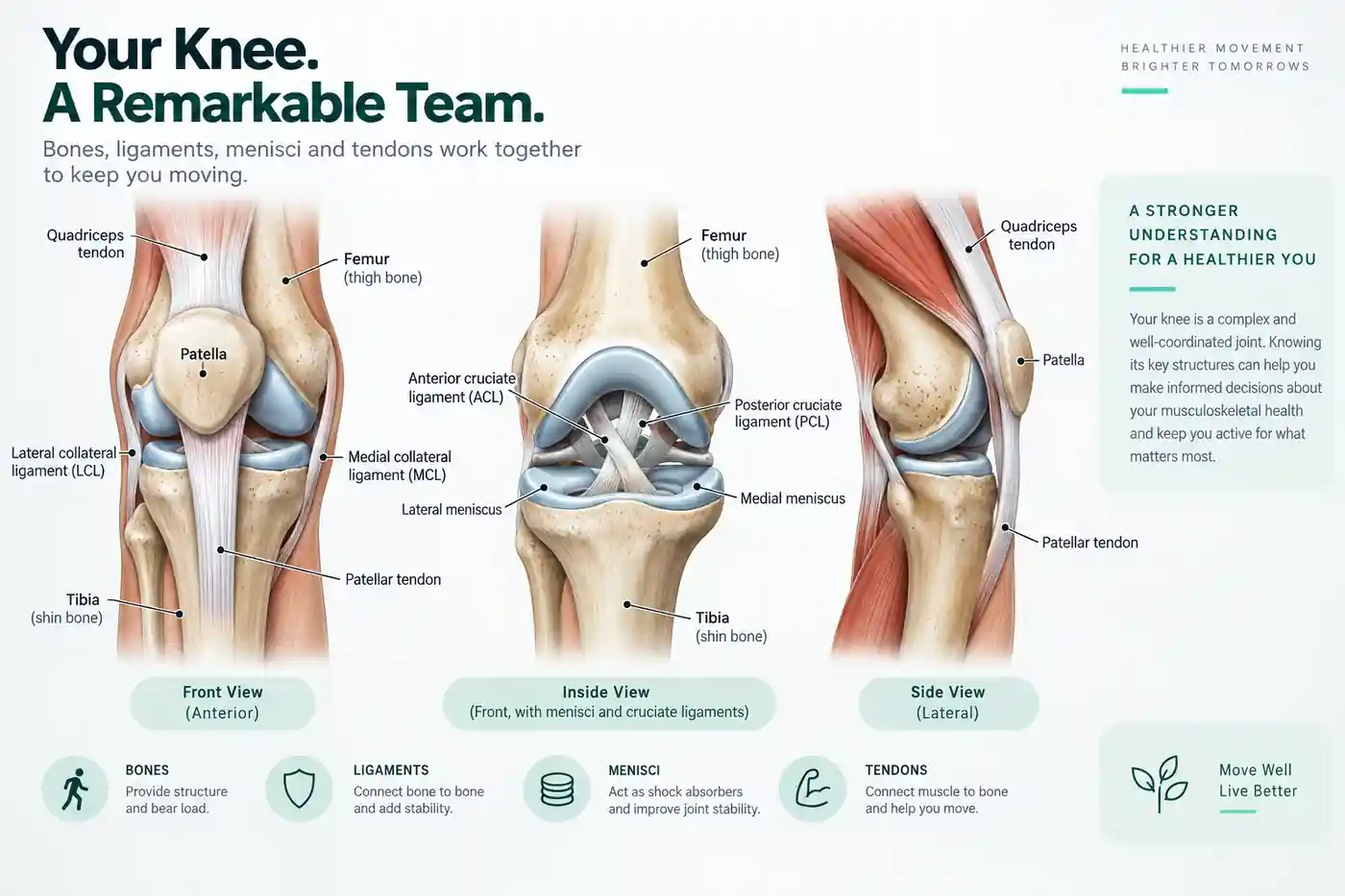
A knee that swells repeatedly or rapidly after injury deserves more attention than one that is simply sore. Swelling can inhibit quadriceps function, restrict bending, change walking, and signal joint irritation or internal injury.
A small reactive swelling after unfamiliar activity may still settle, but recurrent swelling after ordinary walking or exercise is a good reason to be assessed. Rapid large swelling after a twisting injury can occur with significant ligament or intra-articular injury.
Instability, Locking, and Loss of Movement Should Not Be “Waited Out” Indefinitely
A knee that repeatedly gives way, cannot fully straighten, or truly locks has moved beyond a simple pain question. Instability may follow a ligament injury or occur when pain and weakness reduce control. Mechanical locking can occur with certain meniscal injuries.
WHPT’s ACL Injury Rehabilitation and Meniscus Tear Rehabilitation pages outline these condition-specific pathways. The key is that the finding should be assessed before the patient repeatedly tests running, deep squatting, or twisting.
See a Physiotherapist When Pain Keeps Coming Back
Recurring knee pain is one of the clearest reasons not to rely on “it always settles eventually.” If symptoms return every time running volume increases, after each badminton session, or whenever you resume normal stairs, the knee may be settling symptomatically without regaining enough capacity for the task.
Assessment can look at training load, strength, range, balance, movement strategy, recovery, and previous injuries. For active patients, Physiotherapy for Athletes can connect clinical rehabilitation to the real demands of sport.
When Medical Care Should Come Before Routine Physiotherapy
Physiotherapists screen for warning signs, but some presentations should go directly to urgent medical evaluation. A very hot, red, swollen knee with fever, major trauma with deformity, a cold or pale foot, significant neurological change, or inability to bear weight after substantial injury needs medical attention.
| Situation | Likely next step |
|---|---|
| Mild activity-related soreness, improving daily | Short period of monitoring and activity modification may be reasonable. |
| Persistent pain limiting stairs/walking or returning repeatedly | Physiotherapy assessment is reasonable. |
| Twisting injury with swelling, instability, or restricted movement | Earlier clinical assessment; medical/imaging pathway if indicated. |
| Hot red swollen joint with fever | Prompt medical evaluation. |
| Major trauma, deformity, cold/pale limb, severe neurological change | Urgent/emergency medical care. |
What If You Already Know You Have Arthritis?
An arthritis diagnosis does not mean every flare requires a clinic visit. People can often learn how to modify activity, continue appropriate exercise, and manage ordinary fluctuations. But a new pattern—sudden large swelling, major loss of movement, trauma, or symptoms that no longer respond as expected—should be reassessed.
NICE recommends therapeutic exercise tailored to the individual as a core treatment for osteoarthritis. WHPT’s Arthritis Physiotherapy page explains how strength, mobility, balance, and function may be progressed rather than treating arthritis as a reason for permanent rest.
What If You Have Already Tried Exercises at Home?
Trying a generic exercise list is not the same as having the knee assessed. An exercise may be perfectly reasonable but poorly matched to the current irritability, too easy to build capacity, too difficult for the starting point, or irrelevant to the task that hurts.
A Therapeutic Exercise plan should answer practical questions: What are we trying to improve? How much load is appropriate? What response is acceptable? When should the exercise progress? What happens if the next day is worse?
If travel is a genuine barrier because mobility is significantly limited, Home Physiotherapy may be an option depending on clinical suitability and availability.

What Happens If the Physiotherapist Thinks You Need a Doctor or Scan?
A responsible physiotherapy assessment does not try to keep every patient in physiotherapy. If the history and examination suggest fracture, infection, a displaced injury, significant instability, a vascular issue, or another condition outside routine scope, the next step should be medical or orthopedic evaluation.
Likewise, imaging is not a failure of physiotherapy. It is useful when the result is likely to influence management. The Comprehensive Physiotherapy Assessment page explains WHPT’s broader screening and referral approach.
Mild Pain Can Still Be Worth Assessing
Severity is not the only reason to seek help. A pain score of three out of ten that has repeatedly stopped you from running for two months may matter more functionally than a brief six out of ten soreness after an unusually hard session. If the knee keeps changing your behavior, activity choices, confidence, or workload, assessment can be useful even when the pain is not intense.
Earlier assessment does not guarantee a faster recovery, and it is not necessary for every minor ache. Its value is clarity: identifying whether the problem is appropriate for self-management, whether load should be modified, whether a progressive rehabilitation plan is needed, or whether medical review should come first. That can reduce unhelpful cycles of complete rest, repeated testing, and random exercise changes.
If the main issue is uncertainty rather than severe symptoms, the goal of the first visit should be a clear explanation and next-step plan—not automatically a long treatment package. WHPT’s Physiotherapy and Rehabilitation FAQs can also answer practical questions before an appointment.
The direction of change matters more than one isolated good or bad day. A knee that is gradually tolerating more walking, stairs, work, or exercise is behaving differently from a knee that needs progressively more avoidance each week. Looking at that trend can help you decide whether continued monitoring is reasonable or whether an assessment would add useful clarity.
Frequently Asked Questions
How many days should I wait before seeing a physiotherapist?
There is no universal number. Mild symptoms that are clearly improving can be monitored briefly. Earlier assessment is appropriate after significant trauma, recurrent swelling, instability, locking, or meaningful loss of function.
Can I see a physiotherapist without an MRI?
Yes. Many knee problems can be initially assessed from the history and physical examination. Imaging is considered when it is likely to change the plan or when specific concerns are present.
Should I see a doctor or physiotherapist first for knee pain?
Many stable musculoskeletal knee problems are appropriate for physiotherapy assessment. Major trauma, suspected fracture, infection, vascular symptoms, or serious systemic features require medical evaluation.
Is severe pain always a reason to go to emergency?
Pain severity matters, but associated features matter too. Severe pain after major trauma, deformity, inability to bear weight, or a hot swollen joint needs urgent care. Severe pain without those features still deserves timely assessment.
What if my knee pain improves but keeps returning?
Repeated recurrence is a reason to assess why capacity and activity demand are not matching, rather than repeating the same rest-and-return cycle.
Can physiotherapy help if I have been told I have arthritis?
Yes, when appropriate. Physiotherapy may help with strength, mobility, balance, activity, and function while recognizing that arthritis is a medical condition that can require coordinated care.
How do I arrange an assessment at WHPT Pakistan?
Use the Book a Physiotherapy Appointment page or WhatsApp/call +92 334 8205557 with the main symptom, how it started, and your preferred timing. Appointment times require staff confirmation.
Deciding Whether to Wait or Get Assessed
You can also review WHPT Pakistan for clinic information before arranging care.
If your knee is improving steadily and normal function is returning, careful monitoring may be enough. If pain is persistent, recurrent, accompanied by swelling or instability, or reducing what you can do, assessment can prevent weeks of guesswork.
WHPT Pakistan provides assessment-led physiotherapy in Bahria Town, Lahore, with care planned around symptoms, function, medical context, and individual goals.
References
- Ghaffari, S., et al. (2023). Diagnostic accuracy of Ottawa Knee Rule for diagnosis of fracture in patients with knee trauma: a systematic review and meta-analysis. Archives of Academic Emergency Medicine. PubMed
- Neal, B. S., et al. (2024). Best practice guide for patellofemoral pain based on synthesis of a systematic review, the patient voice and expert clinical reasoning. British Journal of Sports Medicine, 58(24), 1486–1495. PubMed
- National Institute for Health and Care Excellence. (2022). Osteoarthritis in over 16s: diagnosis and management (NG226). NICE guidance
- American Academy of Orthopaedic Surgeons. (2024). Clinical practice guideline for the management of acute isolated meniscal pathology. AAOS guideline
- Bronstein, R. D., & Schaffer, J. C. (2017). Physical examination of the knee: Meniscus, cartilage, and patellofemoral conditions. Journal of the American Academy of Orthopaedic Surgeons, 25(5), 365–374. PubMed

About Dr Salman Sabir PT
Dr Salman Sabir PT is a consultant physiotherapist, clinical leader and co-founder of WHPT Pakistan. He holds an MS in Orthopedic Manual Therapy and is undertaking doctoral study in Exercise Physiology. His work focuses on assessment-led rehabilitation, patient education, progressive exercise and long-term recovery.
Need Help Applying This to Your Situation?
General information cannot account for your injury history, strength, movement, medical conditions or personal goals.
BOOK ASSESSMENTCall +92 334 8205557