Knee pain often becomes frustrating not because nothing helps, but because the same cycle keeps repeating: stop everything until it feels better, test the painful movement too soon, return to full activity, flare again, then start over.
Other people make the opposite mistake and push through increasing swelling or instability because they have been told movement is always good. Good rehabilitation sits between those extremes. The knee needs the right amount of protection, loading, and progression for the actual problem.
Common mistakes that can prolong knee pain include complete rest for too long, repeatedly testing painful movements, returning to full activity as soon as pain settles, using generic exercises without progression, ignoring swelling or instability, relying only on passive treatment, increasing several activities at once, and comparing your recovery with someone else’s timeline. The better approach is to identify the likely problem, manage load, rebuild capacity gradually, and reassess when progress stalls.
At a Glance
- Too much rest can reduce capacity; too much loading can keep the knee irritated.
- Pain relief is not the same as restored strength or readiness.
- Exercises need an appropriate starting dose and progression.
- Repeated swelling, locking, or giving way should not be normalized.
- Passive treatment can support recovery but should not replace active rehabilitation.
- A flare is information for adjusting the plan, not proof that all movement is harmful.
Mistake 1: Stopping All Movement Until the Knee Is Completely Pain-Free
Rest can be appropriate after significant injury or during a highly irritable flare, but prolonged complete avoidance can create a second problem: the muscles and movement capacity around the knee begin to decline. Ordinary tasks then represent a larger percentage of what the leg can tolerate.
For stable knee conditions, the goal is usually relative rest—reduce the activity that repeatedly provokes symptoms while maintaining comfortable movement and gradually rebuilding capacity. This principle is reflected in NICE osteoarthritis guidance, which recommends tailored therapeutic exercise rather than long-term inactivity for knee osteoarthritis.
WHPT’s Therapeutic Exercise approach likewise treats exercise dose as something to adjust, not an all-or-nothing choice.

Mistake 2: Repeatedly Testing the Movement That Hurts
If stairs hurt, it is tempting to climb the same flight again every hour to see whether the knee is “fixed.” If deep squatting hurts, people often keep dropping into a full squat to check. This repeated testing can accumulate irritation without giving the knee time to adapt.
A better strategy is to choose a measurable exposure—such as a certain step height, walking duration, or squat depth—then observe the response during and after the activity. Rehabilitation becomes a progression rather than a sequence of constant tests.
Mistake 3: Returning to Full Activity as Soon as Pain Settles
Pain often improves before strength, endurance, balance, and task tolerance fully return. Someone may feel comfortable walking around the house but still be underprepared for a long shopping trip, a football match, repeated stairs, or a heavy gym session.
This gap between symptoms and capacity is a common reason knee pain returns. The Sports Physiotherapy pathway emphasizes rebuilding the specific demands of running, landing, cutting, or training rather than using “it feels okay today” as the only return criterion.

Mistake 4: Doing Generic Exercises Without a Progression Plan
A basic exercise can be useful, but the same three movements repeated for months may stop challenging the qualities that need to improve. On the other hand, starting with advanced single-leg squats or jumping when the knee is irritable can be too much.
Good exercise prescription answers four questions: What ability are we targeting? What dose is appropriate now? How will we know the knee tolerated it? What is the next progression? The 2024 best-practice guide for patellofemoral pain recommends education and knee- and hip-targeted exercise tailored to the person rather than a universal routine.
For readers with front-of-knee pain, the best-practice patellofemoral pain guide is a useful high-authority reference.
Mistake 5: Ignoring Swelling, Locking, or Instability
Not every flare is dangerous, but repeated swelling, true locking, or giving way changes the clinical picture. These signs can indicate joint irritation, meniscal involvement, ligament injury, or another problem that deserves assessment.
The mistake is not exercising at all; it is continuing to progress as though these findings are irrelevant. WHPT’s Meniscus Tear Rehabilitation and ACL Injury Rehabilitation pages explain why protection and progression differ when mechanical symptoms or instability are present.
Mistake 6: Relying Only on Passive Treatment
Massage, manual therapy, taping, heat, cold, or other symptom-relief strategies may be useful in selected cases. The problem comes when temporary relief becomes the entire plan and the knee never regains the strength or task tolerance needed for daily life.
WHPT’s Manual Therapy page describes hands-on treatment as a possible bridge to active rehabilitation rather than a substitute for it. If a treatment helps for a day but the same stair, walk, or training session triggers symptoms again, the missing step may be capacity rather than a stronger passive technique.
Mistake 7: Increasing Several Loads at the Same Time
A common pattern is to restart gym training, add running, increase daily steps, and return to sport in the same week because the knee finally feels better. If symptoms flare, it becomes impossible to know which change was too large.
Load management works better when important variables are changed deliberately. Increase one or two demands, monitor the response, then progress again. Research in patellofemoral pain has shown that structured activity modification and staged return can be useful, particularly when activity levels exceed current tolerance.
The load-management study in patellofemoral pain illustrates the principle of modifying activity first and rebuilding in stages.
Mistake 8: Treating Every Flare as New Damage
Symptoms can increase after an unusual workload, poor sleep, stress, illness, or a sudden return to activity without there being a new structural injury each time. For arthritis and patellofemoral pain especially, symptom fluctuations are common.
That does not mean pain should be ignored. It means the response should fit the pattern. A mild predictable flare may call for temporary load adjustment; rapid swelling after trauma or new instability needs a different response. The skill is learning which type of change you are dealing with.
Mistake 9: Comparing Your Recovery Timeline With Someone Else’s
Two people can both say they have “knee pain” and be dealing with completely different problems. Even the same diagnosis can vary by severity, duration, age, tissue involvement, strength, medical history, surgery, sport, work demands, and adherence.
Someone returning to office work after a mild overload has a different endpoint from an athlete returning to cutting sport or a patient recovering after knee replacement. Use functional milestones, not another person’s calendar, to judge progress.
Mistake 10: Waiting Too Long When Progress Has Clearly Stalled
Self-management is useful when symptoms are improving. But if the knee has not meaningfully changed, repeatedly returns, or keeps reducing what you can do, more waiting is not always more conservative—it may simply extend uncertainty.
A Comprehensive Physiotherapy Assessment can identify whether the plan needs a different exercise dose, another diagnosis should be considered, imaging or medical review is appropriate, or the patient is actually ready to progress more confidently.
| Common mistake | Better replacement |
|---|---|
| Complete rest for weeks | Use relative rest and maintain comfortable movement when appropriate. |
| Testing painful tasks repeatedly | Use planned exposure and monitor the response. |
| Returning at full volume | Rebuild duration, resistance, speed, and complexity in stages. |
| Same exercise sheet forever | Progress exercises toward meaningful functional goals. |
| Ignoring swelling/instability | Reassess the clinical picture before loading harder. |
| Chasing temporary relief only | Use symptom relief to support active rehabilitation. |
Mistake 11: Changing the Plan Every Few Days
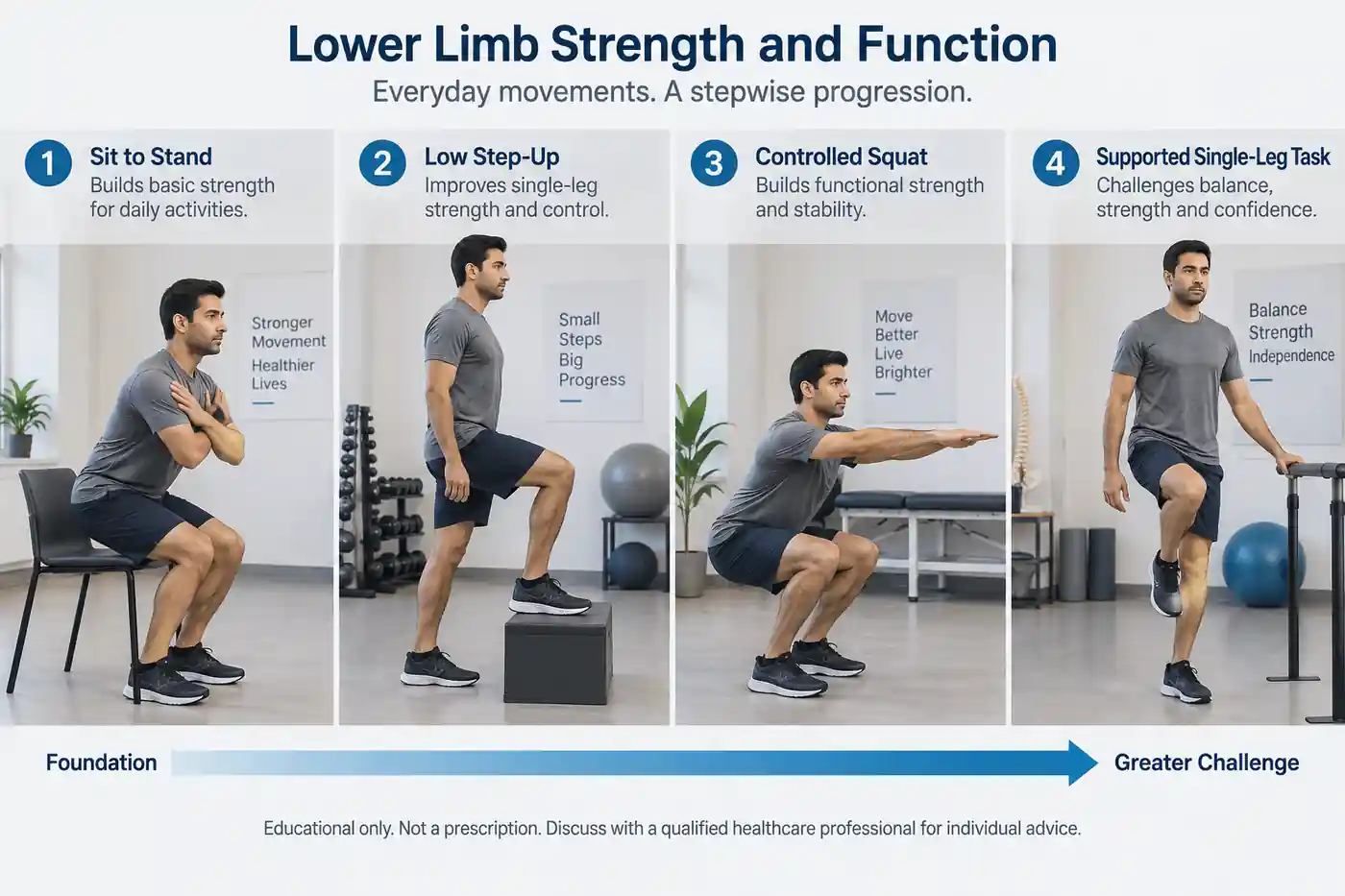
When knee pain is frustrating, it is tempting to chase the newest “best knee exercise” online. One day it is wall sits, the next day backward walking, then stretching, then a completely different strengthening routine. Constant switching makes it difficult to know what the knee actually tolerates and whether capacity is improving.
A better plan uses a small number of relevant measures and gives the program enough consistency to judge the response. Progress might be reflected in easier stairs, more walking, greater resistance, better single-leg control, or less next-day irritability—not simply how many different exercises you have collected.
Mistake 12: Not Tracking the Next-Day Response
What happens during an exercise is only part of the dose. The knee’s response later that day and the following morning can help determine whether the load was appropriate. If every “good” session is followed by a large flare that forces several days of rest, progression may be too aggressive. If nothing is challenging and function never improves, it may be too cautious.
This is where individualized Therapeutic Exercise differs from a generic sheet: the exercise, dose, progression rule, and response are connected to a specific functional goal.
Frequently Asked Questions
Can too much rest make knee pain worse?
Prolonged inactivity can reduce strength and tolerance, which may make normal tasks feel harder. Some injuries still require temporary protection, so the correct amount of movement depends on the diagnosis and stage.
Should I exercise through knee pain?
Not blindly. Mild, stable symptoms may be compatible with appropriate exercise, while increasing swelling, instability, or severe pain may mean the dose or pathway needs to change.
Why does my knee feel better after treatment but hurt again later?
Temporary symptom relief may not have changed the strength, load tolerance, or activity pattern that triggers the problem. Active progression often needs to follow relief-focused treatment.
How do I know when to increase my exercises?
Progression can consider symptom response, movement quality, repetitions, resistance, next-day irritability, and whether the exercise is becoming easy. It should be connected to the function you need to regain.
Is a flare a sign I have damaged the knee?
Not necessarily. Flares can reflect an activity-load mismatch. New trauma, rapid swelling, instability, or mechanical locking deserves separate assessment.
Can I return to the gym when knee pain improves?
Often yes, but returning in stages is safer than restarting every previous exercise and load at once. A Physiotherapy for Athletes assessment can be useful when the goal is demanding training.
What if I cannot travel easily because of knee pain?
Home Physiotherapy may be considered when mobility or transport is a real barrier and the clinical situation is suitable.
Build the Missing Middle of Recovery
WHPT’s broader Knee Pain Physiotherapy guide explains the condition-level pathway, while WHPT Pakistan provides clinic information for patients considering assessment.
Knee rehabilitation is rarely just “rest” or “push through.” It is a process of identifying the problem, reducing unnecessary irritation, maintaining what is safe, rebuilding capacity, and returning to meaningful activity in stages.
If recurring knee pain is affecting walking, stairs, prayer positions, work, or exercise, WHPT Pakistan provides assessment-led physiotherapy in Bahria Town, Lahore. Use the appointment page or WhatsApp/call +92 334 8205557; appointment times require staff confirmation.

References
- Neal, B. S., Lack, S. D., Bartholomew, C., & Morrissey, D. (2024). Best practice guide for patellofemoral pain based on synthesis of a systematic review, the patient voice and expert clinical reasoning. British Journal of Sports Medicine, 58(24), 1486–1495. PubMed
- National Institute for Health and Care Excellence. (2022). Osteoarthritis in over 16s: diagnosis and management (NG226). NICE guidance
- Rathleff, M. S., et al. (2019). Activity modification and load management of adolescents with patellofemoral pain: a prospective intervention study. American Journal of Sports Medicine, 47(7), 1622–1630. PubMed
- Neal, B. S., et al. (2025). Prognosis of patellofemoral pain: a systematic review with evidence- and gap-map. Journal of Orthopaedic & Sports Physical Therapy, 55(10), 661–670. PubMed
- Crossley, K. M., et al. (2020). Patient education for patellofemoral pain: a systematic review. Journal of Orthopaedic & Sports Physical Therapy. PubMed

About Dr Salman Sabir PT
Dr Salman Sabir PT is a consultant physiotherapist, clinical leader and co-founder of WHPT Pakistan. He holds an MS in Orthopedic Manual Therapy and is undertaking doctoral study in Exercise Physiology. His work focuses on assessment-led rehabilitation, patient education, progressive exercise and long-term recovery.
Need Help Applying This to Your Situation?
General information cannot account for your injury history, strength, movement, medical conditions or personal goals.
BOOK ASSESSMENTCall +92 334 8205557