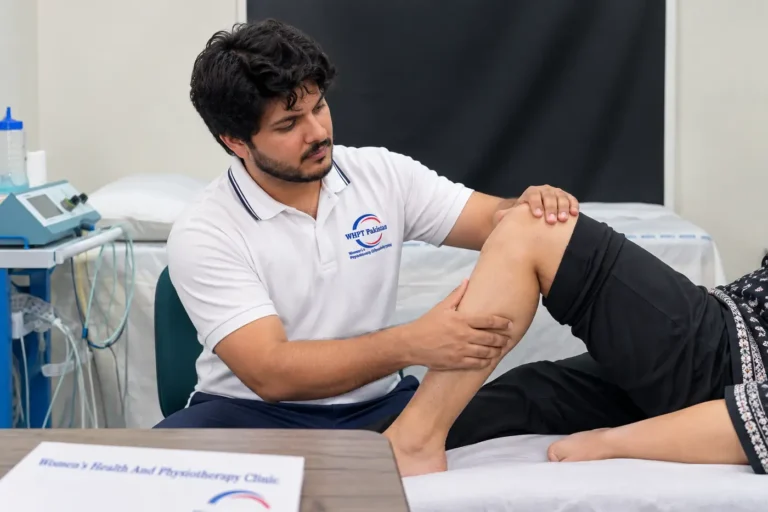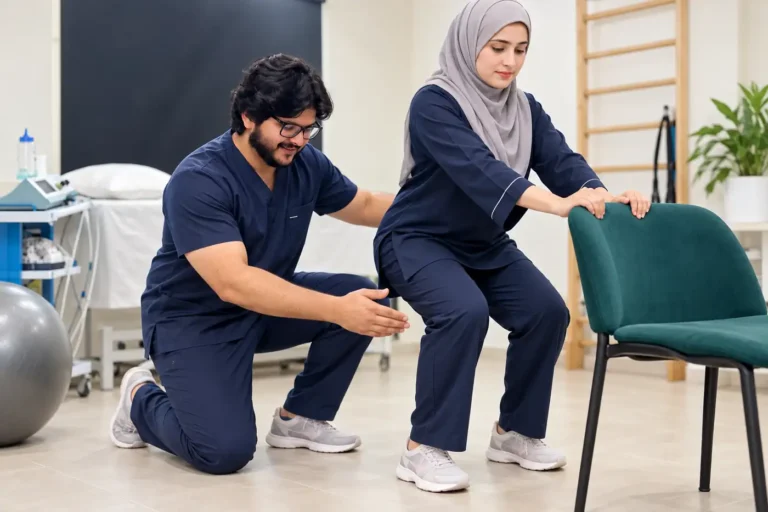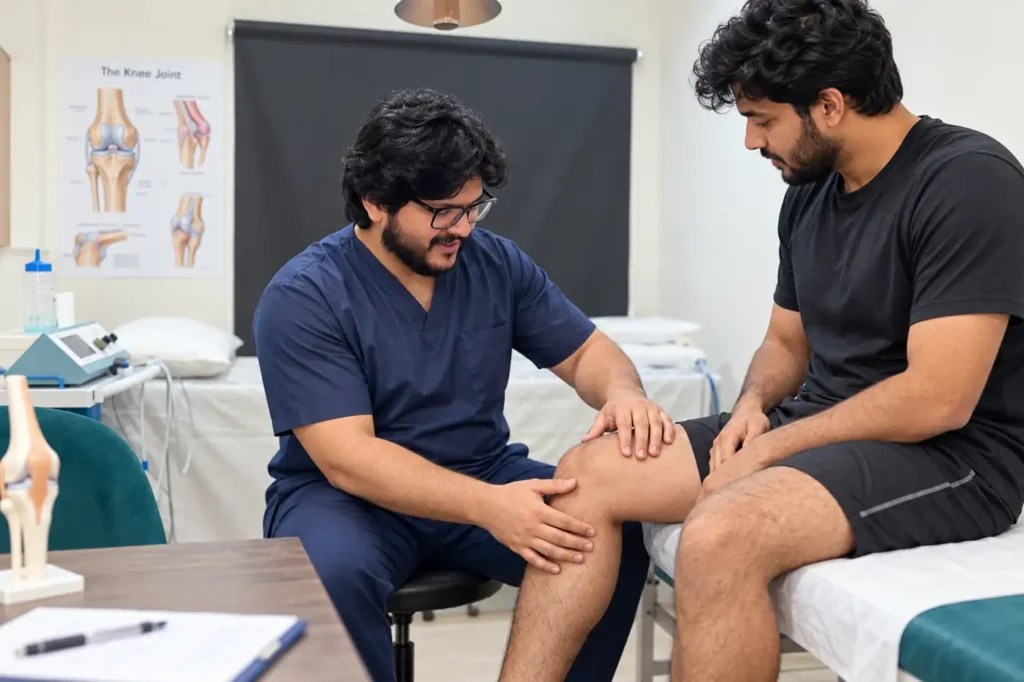
One person wakes with a stiff, aching knee that eases after a few minutes. Another twists during sport and develops swelling along the joint line. A third has pain around the kneecap mainly on stairs. All three may simply say, “My knee hurts,” but the likely contributors are different.
That is why knee pain should not be diagnosed from age, one painful spot, or an MRI sentence alone. The pattern of symptoms, how they began, swelling, movement, stability, and the activities that reproduce pain all help narrow the possibilities.
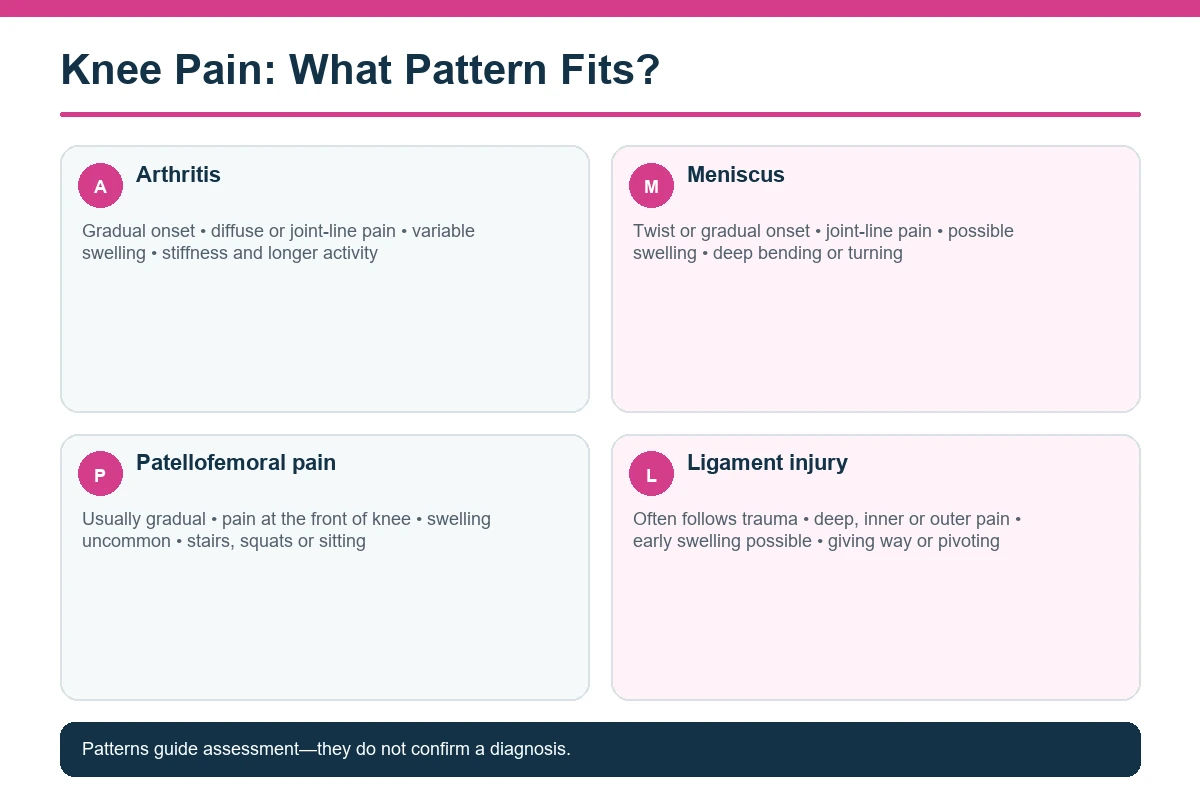
Arthritis often causes gradual pain, stiffness, and reduced tolerance for walking or stairs, while a meniscus injury may follow twisting and can cause joint-line pain, swelling, catching, or locking. Patellofemoral pain, ligament injury, tendon problems, overload, and referred pain can look similar. No single symptom confirms the diagnosis; a physiotherapy assessment can combine history, movement, strength, and clinical tests to identify the most likely pathway.
At a Glance
- Arthritis and meniscus injuries can overlap with other causes of knee pain.
- Gradual stiffness suggests a different pattern from a sudden twist with swelling.
- Clicking alone does not prove a meniscus tear.
- Giving way, true locking, major trauma, or a hot swollen knee deserve closer attention.
- Imaging can be useful, but the result must fit the clinical picture.
- The goal is to identify the most likely contributor before choosing treatment.
Start With the Story of How the Knee Pain Began
The first useful clue is often the timeline. Knee pain that appears gradually over months, becomes stiff after rest, and limits longer walks may fit an osteoarthritis pattern. Pain that begins after a pivot, deep squat, tackle, or awkward landing raises different possibilities, including a meniscus or ligament injury. A sudden increase in running, gym work, stairs, or walking can also overload an otherwise healthy knee without a single dramatic injury.
This is one reason WHPT’s Knee Pain Physiotherapy page treats knee pain as a symptom rather than one diagnosis. The same painful movement can come from different tissues, and two people with the same scan finding can have very different levels of pain and function.
- Gradual onset: consider load-related or degenerative patterns, including osteoarthritis and patellofemoral pain.
- Twisting injury: consider meniscus or ligament involvement, especially with swelling or mechanical restriction.
- Direct trauma: consider fracture, contusion, ligament injury, or other structural damage.
- Recent workload increase: consider an overload problem before assuming a new structural tear.
How Knee Arthritis Commonly Presents
Knee osteoarthritis is not simply “wear and tear.” It is a whole-joint condition in which symptoms and function matter as much as an X-ray description. People may report aching with walking, stiffness after sitting, difficulty rising from a chair, reduced stair tolerance, or a sense that the knee takes time to loosen in the morning.
The pattern can fluctuate. Some days are easier than others, and a flare does not automatically mean the joint has suddenly deteriorated. Current NICE osteoarthritis guidance recommends management according to symptoms and physical function, with tailored therapeutic exercise as a core treatment.
WHPT’s dedicated Arthritis Physiotherapy page covers arthritis rehabilitation in depth. This article only uses arthritis as one part of the differential picture so that a reader does not mistake every painful knee for arthritis.
Clues That May Fit an Arthritis Pattern
- Pain and stiffness that developed gradually rather than after one clear twist.
- Reduced tolerance for walking, stairs, standing from a chair, or prolonged weight-bearing.
- Stiffness after rest or in the morning that improves as the joint gets moving.
- Intermittent swelling or a sense of reduced knee movement.
- Symptoms that vary with overall activity rather than one specific twisting event.
How a Meniscus Problem Can Feel Different
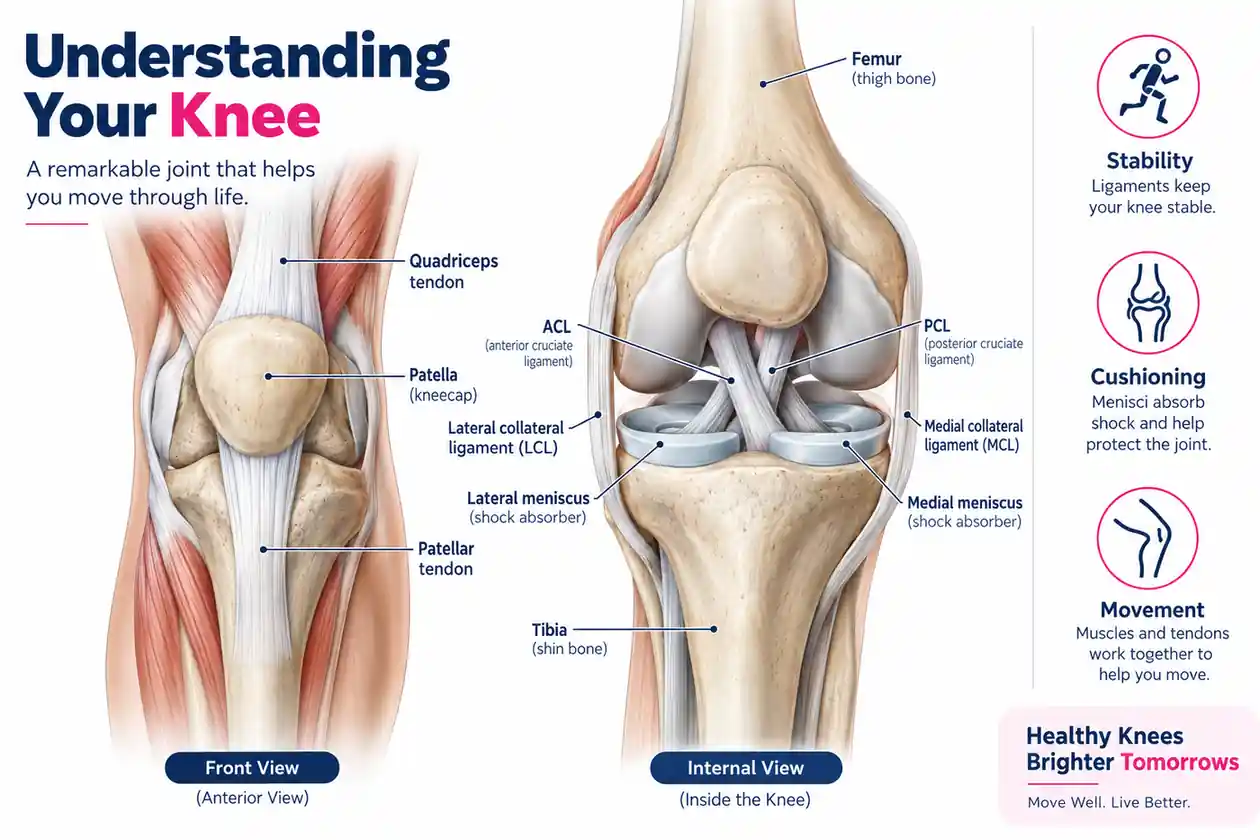
The menisci are two fibrocartilage structures that help distribute load and contribute to knee stability. Acute tears often occur with rotation while the knee is bent, although degenerative meniscal changes can develop gradually and may coexist with osteoarthritis.
A meniscus-related pattern may include pain along the inner or outer joint line, swelling after activity or twisting, pain with deep bending, catching, or a sensation that the knee cannot move freely. A true locked knee—where the knee physically cannot straighten—deserves prompt medical assessment.
Importantly, clicking is not enough to diagnose a tear. Many knees click without pain, and many meniscus tears seen on imaging are not the only reason a person has symptoms. The AAOS guideline for acute isolated meniscal pathology emphasizes diagnosis and management in the context of the actual injury and presentation.
For a more complete pathway, see WHPT’s Meniscus Tear Rehabilitation page.
What Else Can Cause Similar Knee Pain?
Arthritis and meniscus problems are common possibilities, but they are far from the only ones. Pain at the front of the knee during stairs or squatting may fit a patellofemoral pain pattern. A ligament injury may follow a twist or landing and create instability. Tendon-related pain is often more localized and linked to repeated loading. Hip or lower-back problems can occasionally refer symptoms toward the knee.
| Possible pattern | Common clues | Useful next question |
|---|---|---|
| Patellofemoral pain | Pain around or behind the kneecap; stairs, squats, running, or prolonged sitting can aggravate it | Does pain increase mainly with bent-knee loading? |
| Meniscus injury | Joint-line pain, swelling, twisting sensitivity, catching or locking in some cases | Was there a twist, and is movement mechanically restricted? |
| ACL or other ligament injury | Traumatic mechanism, rapid swelling, instability or giving way | Did the knee buckle or feel unstable after injury? |
| Knee osteoarthritis | Gradual pain/stiffness, reduced walking and stair tolerance | Is the pattern gradual and function-limited rather than trauma-led? |
| Load-related irritation | Symptoms after a jump in walking, sport, running, or gym volume | Did activity change before symptoms began? |
If the problem followed a sporting injury, WHPT’s Sports Injuries and ACL Injury Rehabilitation pages explain how traumatic and return-to-sport pathways differ from ordinary activity-related knee pain.
Why Pain Location Helps but Does Not Diagnose the Problem
Patients understandably point to the painful spot and ask, “What structure is there?” Location is useful, but the nervous system does not provide a perfect map of tissue pathology. Front-of-knee pain may involve the patellofemoral joint, but symptoms can also be influenced by tendon load, joint irritation, or the way a task is performed. Joint-line pain can increase suspicion of meniscal involvement, but it still needs to fit the history and examination.
Clinical reviews of knee examination consistently show that individual tests have limitations. A physiotherapist therefore combines multiple findings rather than treating one positive maneuver as proof. WHPT’s Comprehensive Physiotherapy Assessment pathway is designed around this broader reasoning.
Do You Need an X-Ray or MRI to Know the Cause?
Not always. Imaging can be important after significant trauma, when fracture is suspected, when the knee is truly locked, when surgery is being considered, or when the diagnosis remains unclear. But routine imaging is not required for every episode of knee pain.
For osteoarthritis, clinical guidance notes that diagnosis can often be made from the symptom pattern without routine imaging. For meniscus and ligament injuries, imaging can add useful information when the result is likely to change management. The key is to ask what decision the scan is expected to help make.
A scan should be interpreted alongside function. Someone may have an MRI finding yet walk, squat, pray, and exercise comfortably; another person may have substantial symptoms with relatively modest imaging findings. Treatment should respond to the person, not only to the report.
When Symptoms Need Faster Medical Review
Most knee pain is not an emergency, but some patterns should move the patient away from self-management and toward prompt medical evaluation.
| Warning feature | Why it matters |
|---|---|
| Major trauma, deformity, or inability to bear weight | Fracture or significant structural injury may need urgent assessment. |
| Very hot, red, swollen knee with fever or systemic illness | Infection or inflammatory disease requires medical evaluation. |
| True locking after injury | A displaced internal structure may be mechanically blocking movement. |
| Rapid large swelling after a twist or collision | Can accompany significant intra-articular injury. |
| Cold, pale, numb, or pulseless lower leg/foot | Possible vascular or neurological emergency. |
What a Physiotherapy Assessment Adds
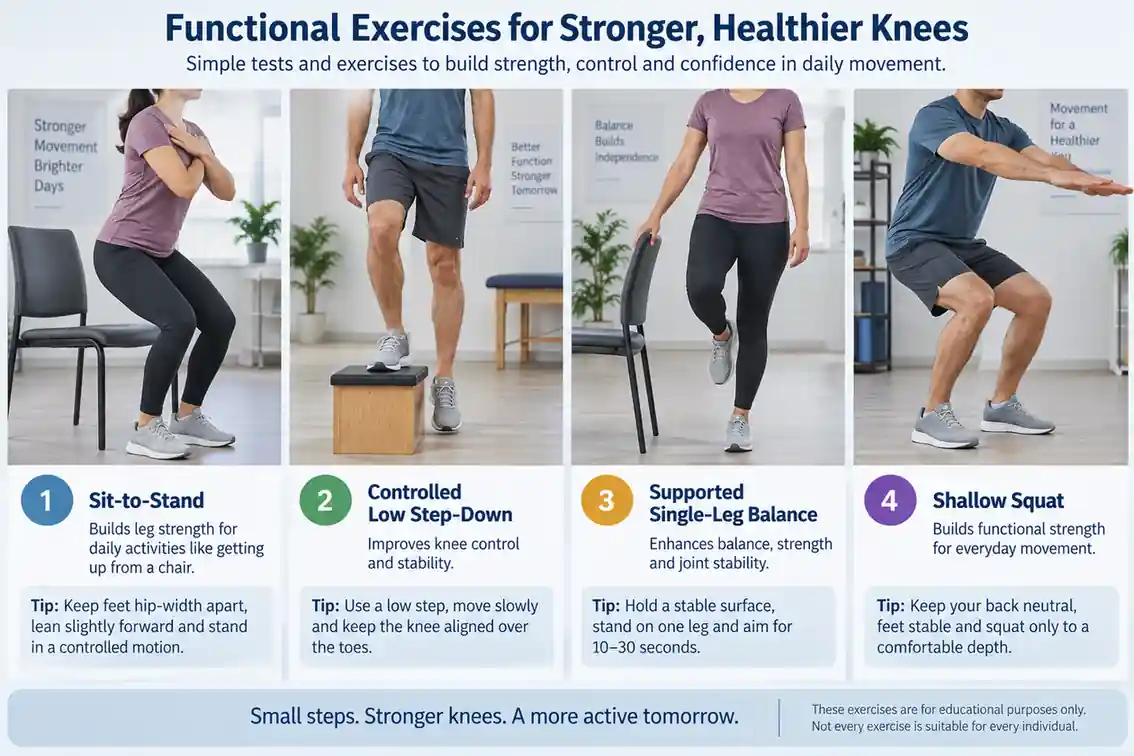
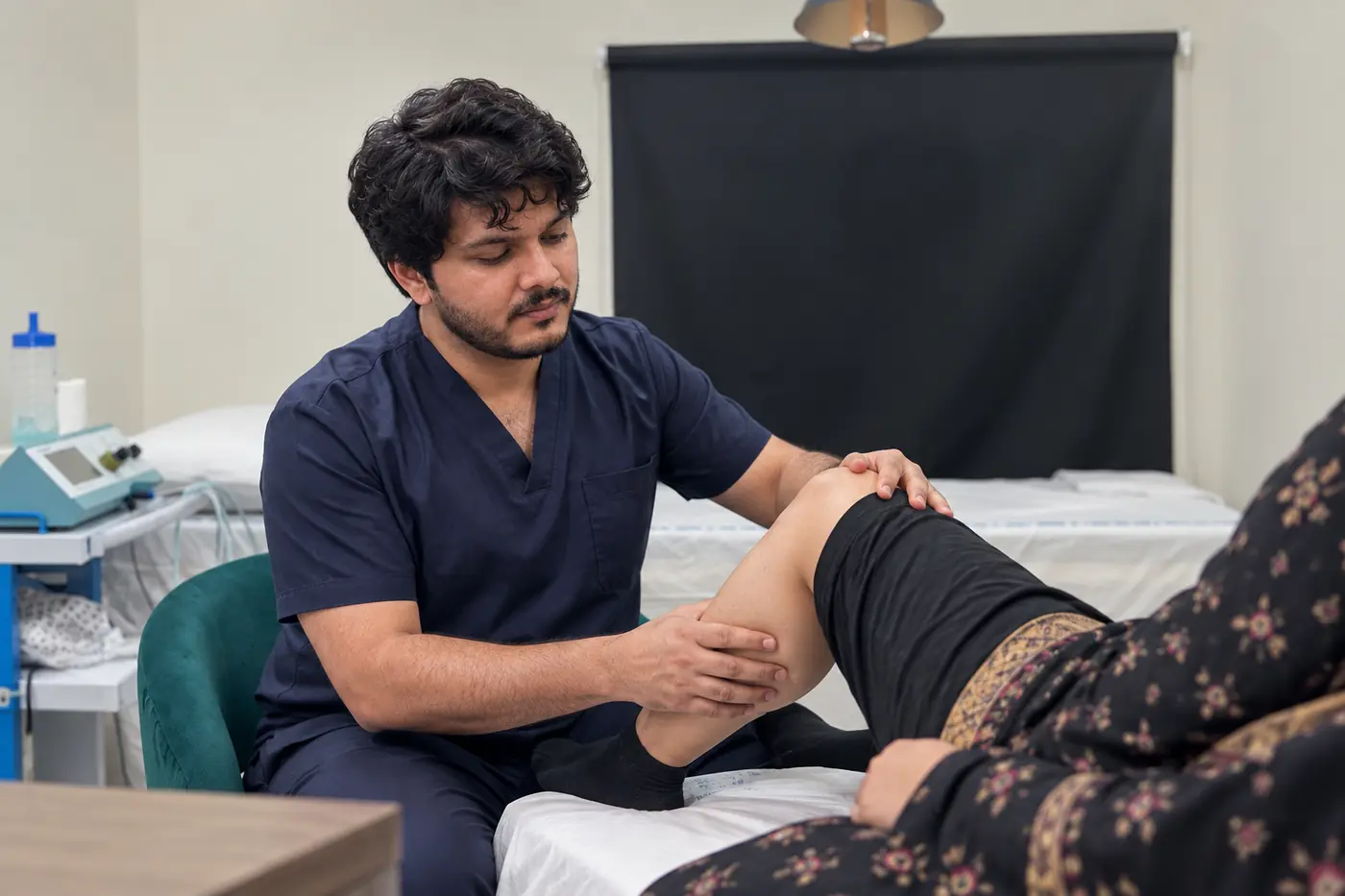
A physiotherapy assessment does not try to label the knee from one test. It looks for a coherent pattern. The physiotherapist may review symptom onset, swelling, previous injuries, medical conditions, medication, range of motion, strength, walking, balance, step-down control, squatting, and selected meniscus or ligament tests when appropriate.
The examination should also reproduce the activity that matters. A patient whose main problem is prayer positions may need deep-bending tolerance assessed differently from a runner whose pain appears after five kilometers. A person returning to football may need later assessment of hopping, deceleration, and direction change through Sports Physiotherapy.
When exercise is appropriate, WHPT’s Therapeutic Exercise approach progresses load according to findings and response rather than giving every knee the same sheet.
Frequently Asked Questions
Can arthritis and a meniscus tear happen at the same time?
Yes. Degenerative meniscal changes commonly coexist with osteoarthritis, especially as people get older. The important question is which findings are actually contributing to the current symptoms and what management is appropriate.
Does joint-line pain always mean a meniscus tear?
No. Joint-line pain can increase suspicion, but it is not diagnostic on its own. Swelling, mechanism, movement restriction, clinical tests, and overall function all contribute.
Can younger people have knee arthritis?
They can, particularly after previous joint injury or in certain medical conditions, but anterior knee pain and overload problems are also common in younger adults. Age should guide reasoning, not replace assessment.
If my MRI says meniscus tear, does that mean I need surgery?
Not automatically. Tear type, displacement, symptoms, age, associated injuries, function, and response to rehabilitation all matter. Some tears require surgical review; others can be managed nonoperatively.
Can knee pain come from the hip or back?
Yes, in some cases. A good knee assessment screens nearby joints and neurological features when the symptom pattern does not fit a straightforward local knee problem.
Should I stop exercise until I know the exact diagnosis?
Not necessarily. Stable symptoms often allow comfortable movement while the problem is assessed, but major trauma, instability, locking, severe swelling, or red flags should not be pushed through.
Who should assess persistent knee pain?
A physiotherapist can assess many musculoskeletal knee problems and identify when medical or orthopedic review is needed. If you are unsure which pathway fits, the Comprehensive Physiotherapy Assessment page explains WHPT’s starting process.
When Knee Pain Needs a Clearer Answer
For the wider symptom pathway, review WHPT’s Knee Pain Physiotherapy guide. You can also learn more about the clinic through WHPT Pakistan before deciding whether an assessment is the right next step.
If knee pain is affecting walking, stairs, prayer positions, work, exercise, or sport and you are unsure whether the problem is arthritis, a meniscus injury, or another knee condition, assessment can help organize the possibilities and choose the next step.
WHPT Pakistan provides assessment-led knee physiotherapy in Bahria Town, Lahore. You can review appointment information or WhatsApp/call +92 334 8205557. Appointment times are confirmed by WHPT staff.
References
- National Institute for Health and Care Excellence. (2022). Osteoarthritis in over 16s: diagnosis and management (NG226). NICE guidance
- American Academy of Orthopaedic Surgeons. (2024). Clinical practice guideline for the management of acute isolated meniscal pathology. AAOS guideline
- Willy, R. W., et al. (2019). Patellofemoral pain: Clinical practice guidelines. Journal of Orthopaedic & Sports Physical Therapy, 49(9), CPG1–CPG95. PubMed
- Bronstein, R. D., & Schaffer, J. C. (2017). Physical examination of the knee: Meniscus, cartilage, and patellofemoral conditions. Journal of the American Academy of Orthopaedic Surgeons, 25(5), 365–374. PubMed
- Kolasinski, S. L., et al. (2020). 2019 American College of Rheumatology/Arthritis Foundation guideline for management of osteoarthritis of the hand, hip, and knee. Arthritis Care & Research, 72(2), 149–162. PubMed

About Dr Salman Sabir PT
Dr Salman Sabir PT is a consultant physiotherapist, clinical leader and co-founder of WHPT Pakistan. He holds an MS in Orthopedic Manual Therapy and is undertaking doctoral study in Exercise Physiology. His work focuses on assessment-led rehabilitation, patient education, progressive exercise and long-term recovery.
Need Help Applying This to Your Situation?
General information cannot account for your injury history, strength, movement, medical conditions or personal goals.
BOOK ASSESSMENTCall +92 334 8205557