
Waking up with lower back pain can make the first few steps of your morning feel far more difficult than the rest of the day. You may need a moment before standing straight, then notice the discomfort fading after breakfast or a short walk. That pattern offers clues, but it does not mean the mattress is definitely responsible, that arthritis is inevitable, or that one overnight position caused permanent harm.
Waking up with lower back pain may reflect temporary stiffness, overnight inactivity, workload from the previous day, sleep disruption, or an underlying spinal or inflammatory condition. Pain that eases with movement is a useful clue but not a diagnosis. Associated leg symptoms, prolonged inflammatory-type stiffness, fever, unexplained night pain or neurological changes affect the appropriate next step.
At a Glance
- Morning stiffness is common but has several possible contributors.
- A mattress is not automatically the main cause.
- Yesterday’s activity can influence today’s symptoms.
- Prolonged inflammatory-type stiffness deserves review.
- Leg numbness or weakness needs assessment.
- Gentle movement is often preferable to forceful early stretching.
Why Does the Back Sometimes Feel Stiffer After Sleep?
During sleep, the spine and surrounding tissues remain relatively still for several hours. After a difficult day or a recent flare, the first movements may feel stiff or sensitive. That does not necessarily mean something slipped out of place overnight. Some people notice that discomfort eases as their body warms up and daily movement resumes.
Getting out of bed feels awkward for five minutes, yet walking to the kitchen becomes progressively easier.
It helps to distinguish an explanation from a diagnosis. In this part of the assessment, movement tolerance and recent changes in activity matter more than a single provocative movement or a phrase from an online search. The clinician looks for several clues that agree with one another, while staying open to alternatives. A temporary symptom increase does not automatically prove that tissue damage is worsening; new loss of strength or other warning signs, however, should not be ignored.
Observe how long the stiffness lasts and whether it changes across days rather than judging your back by the first movement alone.
Morning pain can feel more serious because the first movement is difficult, yet stiffness after a period of stillness is common in many musculoskeletal problems. The important detail is the whole pattern: how long it takes to loosen, what happens after walking, whether the pain returns during the day, and whether it wakes you in the latter part of the night. Someone who feels stiff for a few minutes after an unusually demanding day differs from a person with months of prolonged morning stiffness and other inflammatory clues. Both deserve an explanation suited to their history.
Does Your Mattress Cause Morning Back Pain?
A mattress that is uncomfortable or offers poor support for your preferred position can disturb sleep, but there is no single ideal mattress firmness for everyone. An overly simple mattress diagnosis can overlook workload, stress, exercise changes or symptoms present before bedtime. Sleep quality and positions deserve consideration together.
Someone replaces a mattress but still wakes sore after long work shifts and irregular sleep.
First try a comfortable supported position and consistent sleep routine; choose bedding based on comfort and function rather than an advertised orthopedic label.
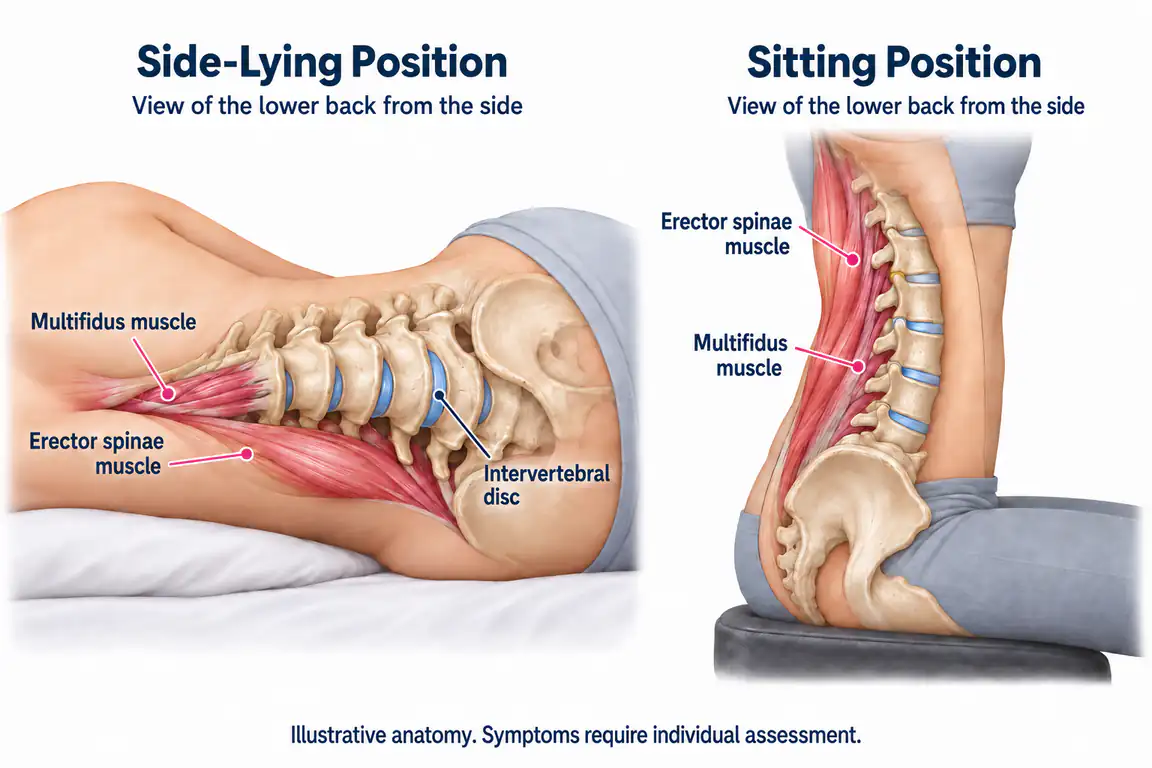
The mattress question has no universal answer. A very soft surface, an unfamiliar hotel bed or a change in sleeping position may alter comfort, but the most expensive mattress is not a treatment for a lumbar condition. Try a comfortable arrangement that allows sleep rather than searching for the single posture everyone should use. A pillow between the knees when side-lying or under the knees when supine may help some people. If the first steps remain difficult despite practical adjustments, do not assume another mattress purchase is the only solution.
Can the Previous Day’s Activities Affect the Next Morning?
Heavy lifting, an unfamiliar workout, a long drive or prolonged static work can influence next-day symptoms. Sometimes discomfort appears hours after the activity, making its source less obvious. This response may reflect temporary load sensitivity rather than a new severe injury. Repeatedly exceeding current capacity can also prolong symptoms.
Weekend furniture moving leads to morning stiffness on Monday even though the task did not hurt much at the time.
Track the previous day’s walking, lifting, sitting and sleep; a simple pattern often guides more practical changes than blame directed only at the bed.
The previous day's dose of activity can influence the next morning. Someone who returns to long-distance driving, heavy gardening or gym work after a break may notice delayed stiffness rather than immediate pain. This does not automatically signify injury; the workload may exceed what the tissues and nervous system currently tolerate. Compare mornings after more and less demanding days, and consider whether sleep duration, stress or illness changed. A short log can reveal whether modifying one task helps more than changing every element of the sleep environment at once.
A practical comparison
| What you notice | Why it may matter |
|---|---|
| Short-lived stiffness after unusual activity | Track workload and comfortable movement. |
| Months of stiffness, night waking, improving with motion | Consider inflammatory screening and medical referral. |
| Morning leg numbness or weakness | Consider neurological examination; progressive weakness urgent. |
When Might Inflammatory Back Pain Be Relevant?
Inflammatory back conditions may involve prolonged morning stiffness and pain that improves with movement rather than rest, often with other history clues. This is different from claiming that all morning pain is inflammatory. Age at onset, night symptoms, alternating buttock pain, family history and related conditions can inform medical evaluation.
A person has persistent symptoms for months, prolonged morning stiffness and pain that wakes them in the second half of the night.
Discuss sustained inflammatory-type features with a doctor rather than assuming a stronger mattress or extra stretching will resolve them.
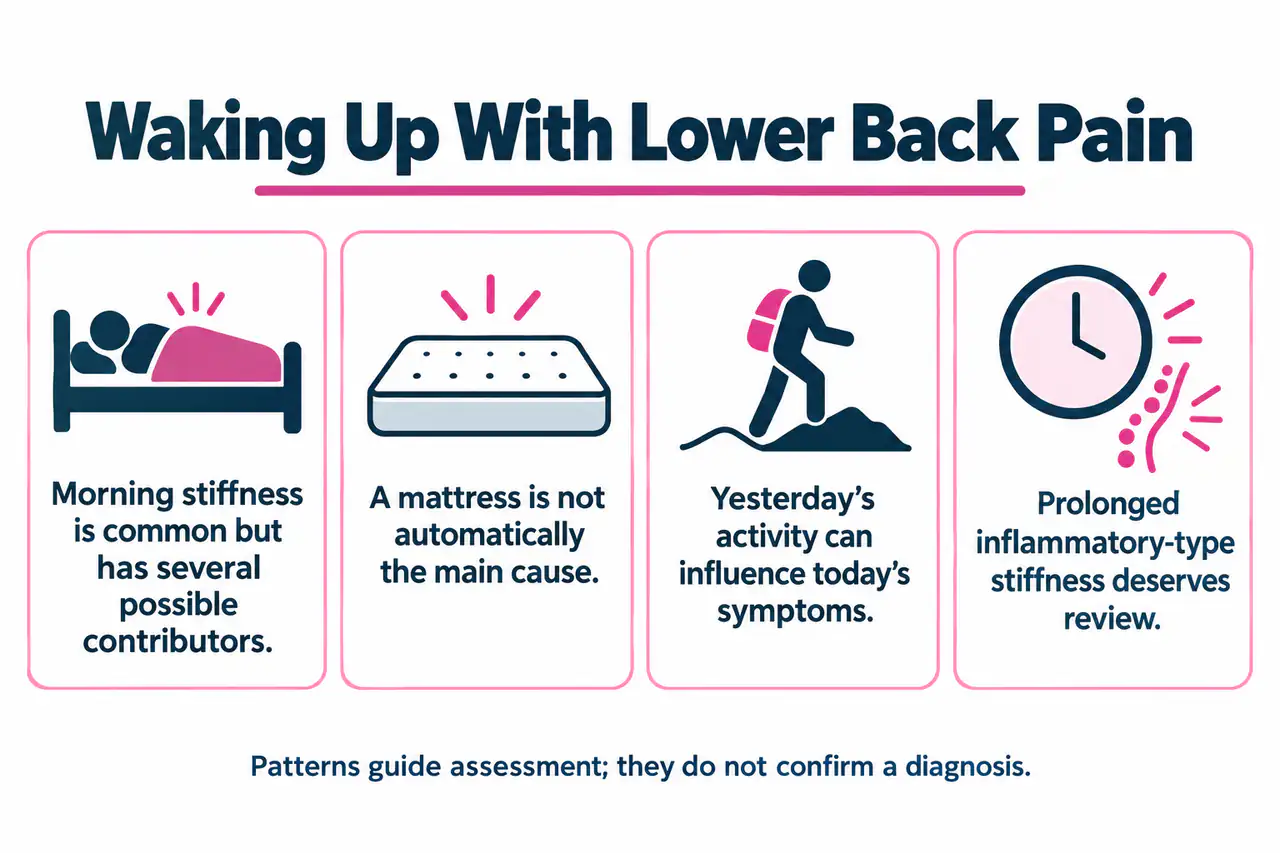
Inflammatory back pain is a distinct consideration when symptoms begin in younger adulthood, last for months, disturb the second half of the night, improve with activity rather than rest, or coexist with alternating buttock pain. A history of psoriasis, inflammatory bowel disease, eye inflammation or relevant family conditions strengthens the reason for medical screening. These clues are not diagnostic by themselves, and inflammatory disease can be missed when people are told to simply improve posture. NICE guidance on spondyloarthritis provides criteria for referral to a rheumatologist; a physiotherapist should recognize when that assessment is appropriate.
For guidance on possible inflammatory spinal symptoms, see NICE NG65: Spondyloarthritis recommendations. This guidance is useful when prolonged stiffness has inflammatory features, not as a reason to assume every morning ache is inflammatory.
What If There Is Morning Leg Pain or Numbness?
Sciatic-type leg symptoms can coexist with morning back pain. Tingling, altered sensation or weakness changes the assessment, particularly when symptoms spread or progress. A feeling of stiffness alone does not establish nerve compression, and routine morning soreness is not equivalent to neurological loss.
Someone wakes with back pain and pins and needles in the foot that persist through the morning.
A clinician should clarify whether the leg symptoms are positional, neurological or due to another contributor, particularly if weakness develops.
Morning leg tingling or pain travelling below the knee requires a different check from local stiffness. A person's sleeping position may change neural sensitivity temporarily, but worsening numbness or new weakness must not be explained away as a mattress problem. Note whether the leg symptoms settle after standing, return during sitting and follow a particular distribution. If the foot begins dragging, the toes cannot lift normally or bladder and bowel function change, urgent medical assessment may be needed. The presence or absence of night discomfort alone cannot distinguish these conditions.
Daytime task demands and position variety may also matter; WHPT’s postural problems information provides that broader functional context.
Should You Force Stretching Before Getting Out of Bed?
For some people, light comfortable movement may reduce stiffness. Others with irritable symptoms may find deep forward bending, forceful stretching or repeated twisting unpleasant first thing in the morning. There is no universally safe sequence that everyone must perform before standing up.
A gentle roll to the side followed by a comfortable sit-to-stand may be easier than aggressively reaching for the toes.
Choose movements that improve function and do not produce progressive leg symptoms; progress later when the back tolerates more activity.
Aggressive stretching in the first moments after waking can provoke a sensitive back, especially if the person forces a long forward bend despite radiating symptoms. Instead, pause before standing, roll to the side if comfortable, and use the arms to assist if that reduces pain. Begin with easy steps or gentle movements that do not produce a persistent flare. These are comfort strategies, not proof that the back is unstable. If a person needs considerable assistance to stand, has experienced trauma or has worrying neurological signs, the priority is professional assessment.
What Can Make Mornings Easier?
Experiment with a comfortable sleeping position, enough sleep time and an unhurried transition out of bed. Some people prefer rolling to one side before sitting; others do well standing in their usual way.
A short walk and gradual return to everyday tasks may be useful once awake. Avoid turning one stretch or posture into a compulsory routine that produces more irritation.
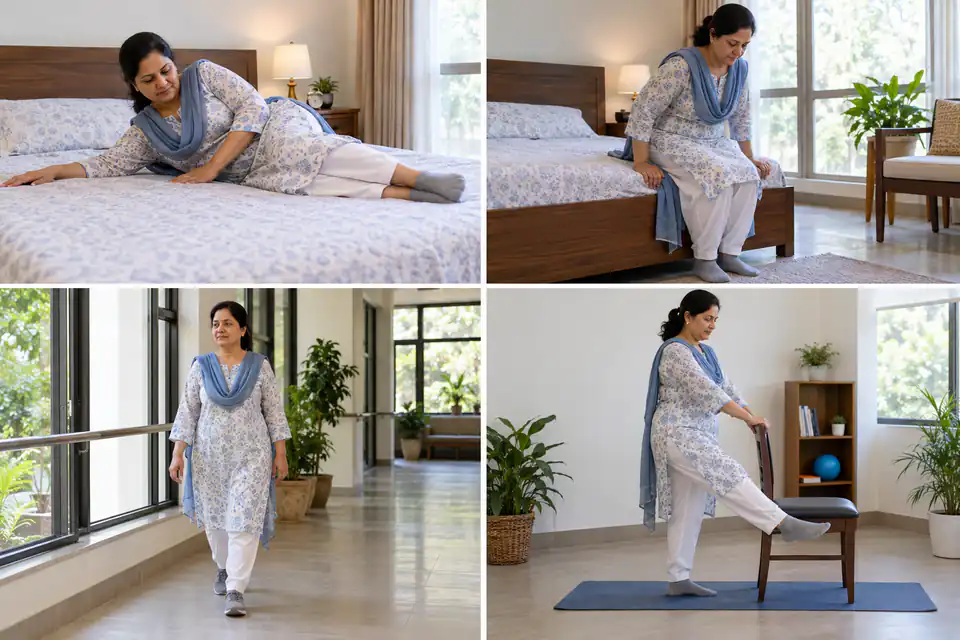
A practical morning routine should be judged by function rather than by completing a fixed number of repetitions. One person may benefit from a short walk and a warm shower; another may prefer gentle pelvic or hip movements while seated. Prepare commonly used items at a convenient height if bending immediately after waking is the hardest task. Progress can mean getting dressed with less delay, walking to the kitchen more confidently or reaching work without a long pain flare. Exercise dose should be modified if it drives symptoms farther down the leg.
When an assessment identifies a suitable mechanical presentation, therapeutic exercise can be adjusted to morning stiffness and the person’s daily schedule.
How Is Recurring Morning Back Pain Assessed?
A physiotherapist or doctor may ask about stiffness duration, night symptoms, inflammatory disease, sleep, daytime activity, medicines, leg symptoms and general health. Examination can evaluate spinal motion and neurological signs when indicated.
The management route differs when there are signs of inflammatory disease or systemic illness, so persistent morning symptoms should not simply be labeled poor posture.
Assessment explores sleep disruption, symptom duration, morning stiffness length, previous episodes, recent training changes and any associated systemic features. When the history suggests an inflammatory disorder, medical referral is appropriate rather than insisting on a routine mechanical diagnosis. When symptoms clearly respond to daily workload changes, graded activity and strength may be emphasized. Neither conclusion can be reached from the mattress brand or one position photograph. The goal is to explain why mornings are difficult and how the correct clinical pathway can improve them.
When Does Morning Pain Need Closer Attention?
Get medical advice for persistent severe night pain, fever, unexplained weight loss, significant injury or inflammatory-type features. Saddle numbness, progressive weakness and bladder or bowel changes require urgent assessment.
Seek urgent medical assessment for new difficulty passing urine, loss of bowel or bladder control, numbness around the groin or saddle area, rapidly worsening or significant weakness in one or both legs, or new symptoms affecting both legs. These can signal serious nerve involvement. Back pain after significant trauma, pain with fever or marked illness, or unexplained symptoms alongside a serious medical history also requires prompt medical attention rather than trial-and-error stretching.
If the pain repeatedly disrupts sleep or work, book a review even when no emergency signs are present; a structured plan may be more useful than endlessly changing pillows.
Pain that wakes someone with fever, significant illness, major unexplained weight loss, progressive neurological signs or a serious medical history deserves assessment. New bladder or bowel dysfunction and saddle sensory changes are emergency concerns. More persistent inflammatory-sounding back pain without emergencies still deserves timely medical review, particularly with psoriasis, eye inflammation or bowel disease. By contrast, ordinary stiffness that improves and allows daily activity can often be approached with careful monitoring and comfortable movement. The context, not the time on the clock, determines concern.
Frequently Asked Questions
Is morning lower back pain always arthritis?
No. Short-lived stiffness can occur for several reasons. Persistent inflammatory-type features or other worrying symptoms need clinical evaluation.
Could sleeping on my stomach cause morning pain?
It may be uncomfortable for some individuals, but no sleeping position explains all back pain. Comfort, sleep quality and the wider pattern matter.
How long should morning stiffness last?
There is no single cutoff that diagnoses a condition. Prolonged stiffness, especially with other inflammatory features, warrants discussion with a clinician.
Should I change my mattress first?
Not necessarily. Review sleep comfort, activity and other contributors before assuming an expensive mattress is the solution.
How can I distinguish morning stiffness from inflammatory pain?
One morning is not enough to decide. Long-lasting symptoms beginning in younger adulthood, night waking, improvement with movement and other inflammatory conditions may justify medical or rheumatology assessment.
Can a hard workout make my back feel stiff the next morning?
Yes. An unfamiliar training session, lifting volume or long day of physical work can temporarily increase sensitivity the next morning. The trend matters: stiffness that settles with gentle movement is different from prolonged, progressive stiffness with other inflammatory symptoms.
Is it okay to move before I feel fully loose?
For a stable episode without warning signs, gentle comfortable activity is often appropriate. Avoid forcing stretches into radiating symptoms and seek review if significant weakness or other concerning signs appear.
Look Beyond the Mattress
Recurring morning stiffness deserves a closer look when simple activity changes do not help or when an inflammatory pattern is possible.
For relevant assessment and rehabilitation options, explore WHPT Pakistan’s back pain physiotherapy. Contact the clinic by WhatsApp or phone if you need help choosing the appropriate appointment.
Morning back pain becomes easier to manage when the nighttime pattern, previous day’s workload and morning response are considered together. The goal is comfortable mornings and steady daily function, not a rigid rule about one ideal posture.
A successful plan does not promise that the first morning movement will become instantly painless. It looks for less hesitation getting out of bed, shorter stiffness periods, more reliable walking and fewer restrictions at work. If a change of mattress brings relief but symptoms recur after demanding days, address activity tolerance as well. If fatigue, morning stiffness and night pain remain disproportionate to ordinary loading, reconsider the diagnosis. Sleep disruption and inflammatory warning signs deserve specific attention rather than being dismissed under the broad label of ordinary back pain.
References
- NICE. Spondyloarthritis in over 16s: diagnosis and management (NG65).
- NHS. Back pain: self-care and symptoms requiring medical advice.
- NICE. Low back pain and sciatica in over 16s: assessment and management (NG59).
- AOPT/APTA. Interventions for acute and chronic low back pain: clinical practice guideline. JOSPT. 2021.
- NHS. Sciatica: symptoms and when to seek help.

About Dr Salman Sabir PT
Dr Salman Sabir PT is a consultant physiotherapist, clinical leader and co-founder of WHPT Pakistan. He holds an MS in Orthopedic Manual Therapy and is undertaking doctoral study in Exercise Physiology. His work focuses on assessment-led rehabilitation, patient education, progressive exercise and long-term recovery.
Need Help Applying This to Your Situation?
General information cannot account for your injury history, strength, movement, medical conditions or personal goals.
BOOK ASSESSMENTCall +92 334 8205557