Lower back and hip pain often blurs the boundary between the spine and the joint beside it. You may feel a deep ache in the buttock after a long drive, stiffness when getting out of a chair, or pain while putting on shoes. Is the problem your hip, your back, or both? The honest answer is that the location of discomfort cannot decide that question on its own.
Lower back and hip pain may come from the lumbar spine, hip joint, surrounding muscles, sacroiliac region, or overlapping contributors. Groin stiffness and limited hip rotation may suggest a hip contribution, while radiating pain with numbness or weakness may raise concern about nerves. A clinical assessment compares movement, function and neurological signs rather than relying on pain location alone.
At a Glance
- The hip and lumbar spine share movement demands.
- Groin pain and restricted rotation may point toward the hip.
- Leg tingling or weakness calls for nerve screening.
- Sacroiliac-region pain is not a diagnosis by location.
- Walking and dressing tasks provide functional clues.
- Scans should agree with the clinical picture.
Why Do the Back and Hip Feel So Connected?
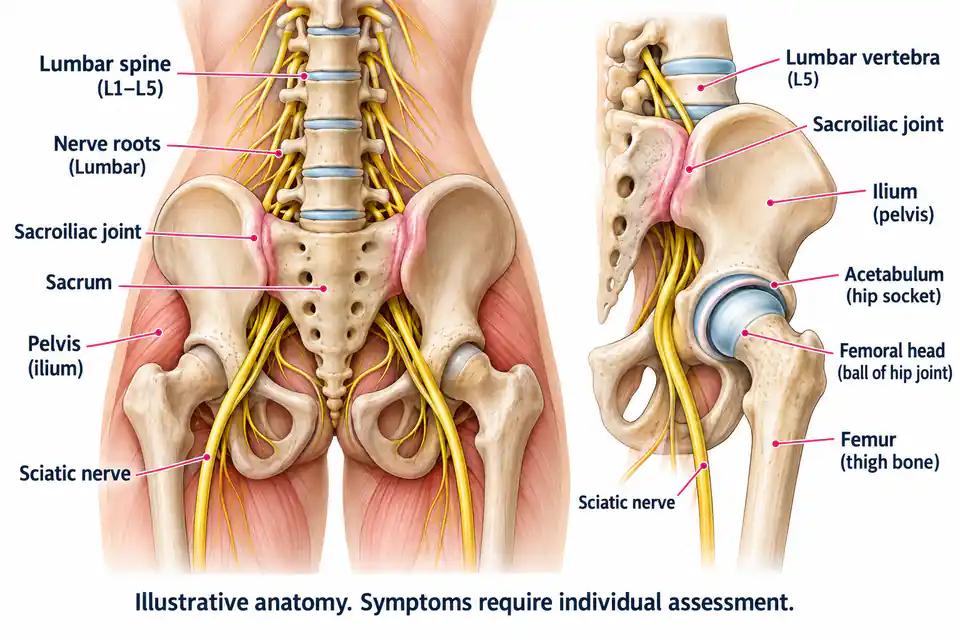
The lumbar spine, pelvis and hips work together during walking, bending, standing up and climbing stairs. Muscles spanning the pelvis can influence how force is distributed. Pain from the back may be felt near the hip, while hip problems can create discomfort in the buttock or low back. This overlap is ordinary anatomy, not evidence that one body part has moved out of place.
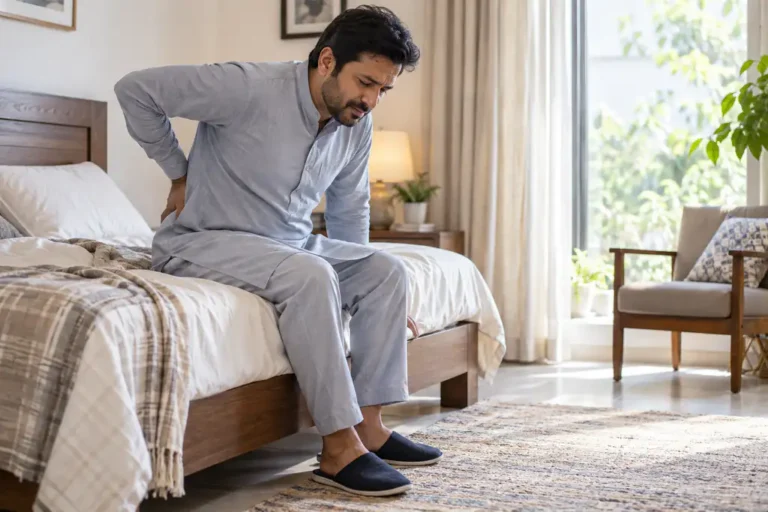
A patient may point to the back pocket area and call it hip pain, though the painful area is not the hip joint itself.
It helps to distinguish an explanation from a diagnosis. In this part of the assessment, patterns across the spine, pelvis, hip and nearby tissues matter more than a single provocative movement or a phrase from an online search. The clinician looks for several clues that agree with one another, while staying open to alternatives. A temporary symptom increase does not automatically prove that tissue damage is worsening; new loss of strength or other warning signs, however, should not be ignored.
Describe which exact tasks reproduce symptoms and whether the groin, buttock or leg is involved before choosing a diagnosis.
The lower back, pelvis and hip move together when standing up, walking and bending. Someone may point to the back pocket yet be experiencing hip irritation; another may describe groin discomfort that is referred from a neighboring structure. A simple body-location label therefore leaves important questions unanswered. Ask whether the painful area is the groin, outer hip, buttock or central lower back; whether symptoms radiate down the leg; and which ordinary task is hardest. The purpose is to identify competing explanations, not to convince every reader that the hip is the sole culprit.
Which Symptoms Suggest More of a Hip Contribution?
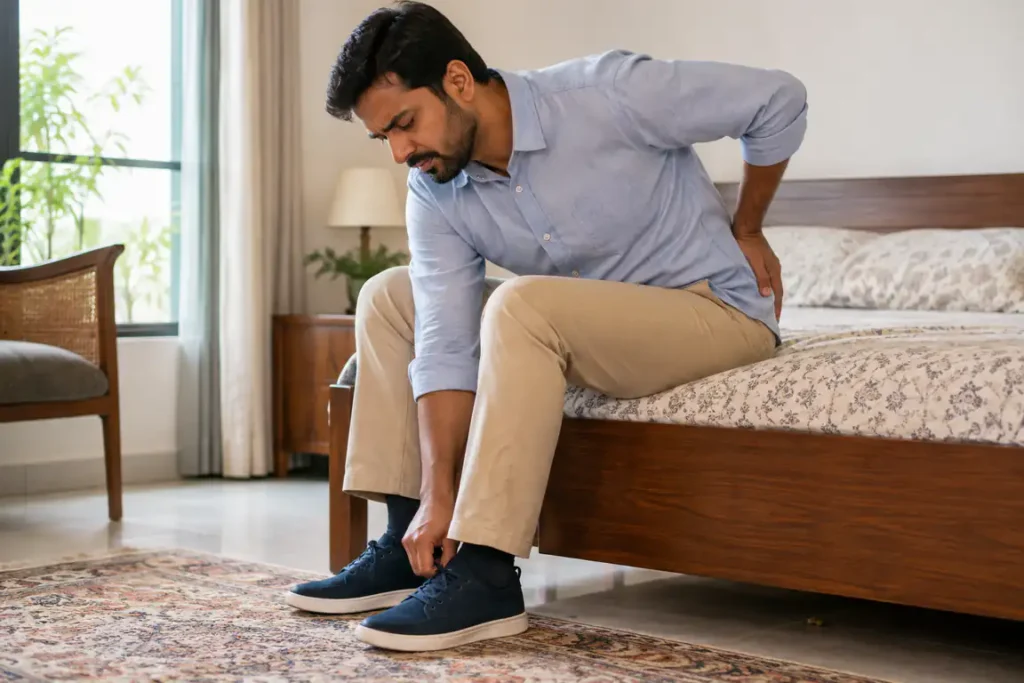
Hip joint problems can cause discomfort in the groin or front of the hip, sometimes with stiffness when turning the leg inward, tying shoes or getting into a car. These are clues rather than certainties; several conditions can create similar sensations. Age, sport, previous injury and the history of symptom onset add useful context.
Someone notices they can walk forward but struggle to rotate the hip enough to put on socks.
A comparison of hip rotation, walking, balance and loading can help determine whether the hip is contributing more than the spine.
For an assessment-led explanation of related symptoms, see WHPT Pakistan’s hip pain assessment resource. It explains what an individualized assessment and rehabilitation pathway may involve.
Groin pain, limited hip rotation and difficulty putting on shoes or getting into a car can increase suspicion of a hip-joint contribution. That is not a definitive diagnosis: hip conditions and referred pain may coexist. Someone with stiffness when rising from a low chair might find that a slightly higher seat changes the task, whereas a person with lumbar pain might have greater difficulty with repeated bending. A clinician can compare hip mobility, strength and functional tests. In adults with persistent hip-related symptoms, the examination and medical history help determine whether imaging or medical review is needed.
Which Clues Suggest a Lumbar Spine Contribution?
Pain that changes with repeated bending or sitting, or spreads into the buttock or leg, may point toward a lumbar contribution. Tingling, numbness, burning pain and muscle weakness deserve neurological screening. The absence of those features does not automatically exclude the back, and a deep buttock ache does not always mean a nerve is trapped.
A person feels buttock pain after a long commute and relief after short walking breaks, while hip rotation remains comfortable.
Check the whole symptom pattern, including leg sensation and strength, rather than labeling pain as sciatica because it sits behind the hip.
Lumbar symptoms are more plausible when familiar pain changes with spinal movement, radiates below the knee or involves numbness and tingling. Pain provoked by coughing or prolonged sitting may add context, but no single behavior proves a disc problem. The same person can have a sensitive hip and a lumbar nerve issue. A careful history therefore notes both regions rather than treating the first positive test as the entire explanation. Neurological signs such as new foot weakness should be assessed promptly and are not typical features of an isolated hip-joint ache.
A practical comparison
| What you notice | Why it may matter |
|---|---|
| Groin pain, limited hip rotation | Hip assessment becomes important. |
| Below-knee tingling or foot weakness | Lumbar nerve screening becomes important. |
| Pain near back-pocket/SI region | Several nearby structures can contribute; no single-point diagnosis. |
Where Does the Sacroiliac Region Fit?
The sacroiliac joints sit between the sacrum and pelvic bones. Some people experience pain around the posterior pelvis, but a painful point near that joint does not establish sacroiliac dysfunction. Clinicians use the history and combinations of tests where appropriate, while also screening lumbar and hip contributors.
A parent may notice pain when rolling in bed or transferring weight from one leg to the other.
Avoid self-diagnosis from a single thumb-sized pain location; a movement comparison is more informative than a diagram alone.
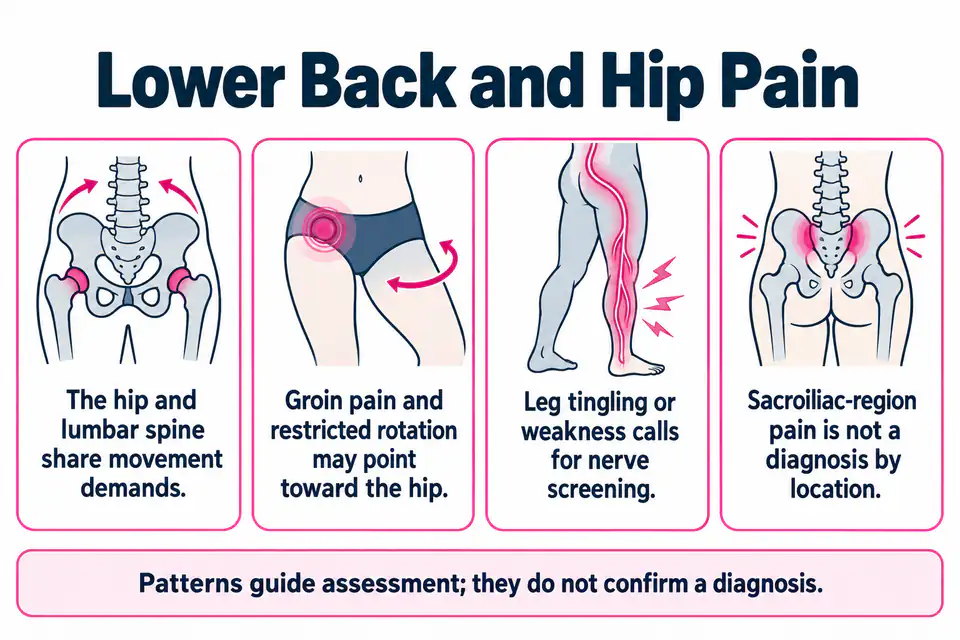
The sacroiliac region sits where the pelvis meets the spine, and it is often named when discomfort is felt near a dimple at the back of the pelvis. However, a finger pointed at that area cannot prove the joint is the pain source. Clinicians may use clusters of tests and consider pregnancy-related pelvic pain, hip function and lumbar causes where appropriate. Patients should be cautious about claims that the pelvis is repeatedly 'out of alignment' based on a home test. More useful outcomes include improved walking, stair climbing and tolerance for carrying or lifting.
For causes of hip-region pain and symptoms that warrant assessment, see NHS: Hip pain in adults. A symptom map by itself cannot distinguish the hip joint from the lumbar spine.
Can Walking Patterns Offer Clues?
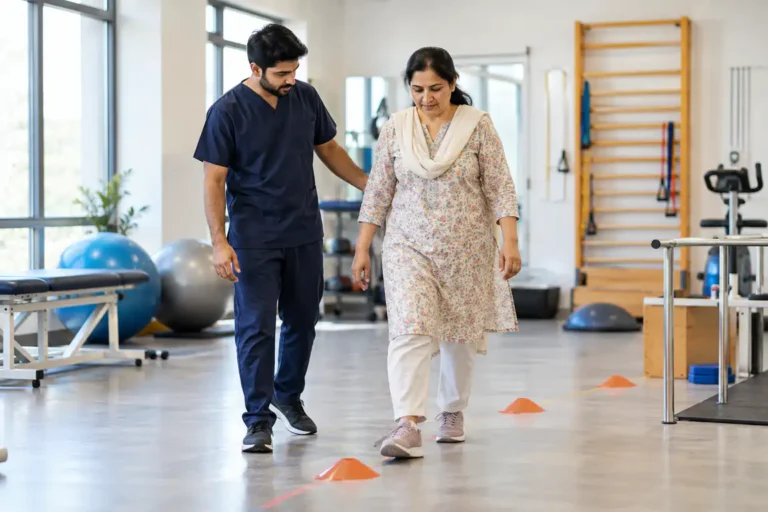
Walking, stairs and single-leg activities require the hip and trunk to coordinate. Reduced strength, temporary guarding or a painful joint may change a person’s stride. Sometimes the change is a protective response to pain, not the original cause. Comparing walking with sitting and hip rotation is therefore more useful than assessing gait in isolation.
Pain starts after fifteen minutes of walking but not during sitting, or the opposite happens; those differences should shape the examination.
Track distance, stairs and specific tasks to identify the functional problem the plan must address.
Walking provides an everyday comparison. A hip problem may become more noticeable with longer steps, hills or getting into a vehicle, while a lumbar pattern may be affected by sustained positions or spinal movement. These trends are not exclusive. Watch whether a limp appears, how quickly symptoms begin and whether resting briefly changes them. A person who cannot comfortably bear weight after a fall needs urgent evaluation rather than an exercise trial. For stable symptoms, an assessment may compare gait, hip range and the spine before choosing which area should be addressed first.
If hip and buttock symptoms extend down the leg, WHPT’s sciatica service page outlines the signs that may justify a neurological examination.
Why Is Imaging Sometimes Misleading?
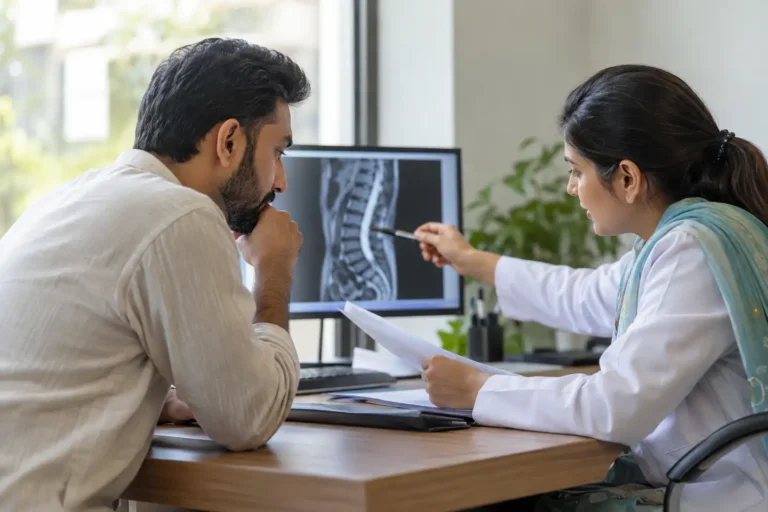
Lumbar scans often show age-related changes in people without symptoms, while hip imaging may also reveal findings that need clinical interpretation. A report cannot always identify whether the spine or hip generates the main problem. Imaging is most useful when examination raises a question whose answer could change medical management.
One MRI mentions a disc bulge, yet the strongest symptom trigger is restricted hip rotation; chasing the MRI alone may miss an important contributor.
Discuss imaging in the context of findings rather than assuming the most dramatic term on the report is responsible.
Imaging can add valuable information when a clinician suspects fracture, advanced joint disease or neurological compression, but a scan may also reveal abnormalities unrelated to symptoms. A lumbar MRI showing a mild bulge does not explain every painful hip, just as hip X-ray changes do not prove that the spine has no role. Before arranging multiple scans, ask what diagnosis is being investigated and how the result would change management. The best test is not always the one with the most detailed picture; it is the one that answers the relevant clinical question.
What Can You Modify Without Guessing the Diagnosis?
For stable symptoms, reduce the particular task that produces a prolonged flare without stopping all movement. A smaller walking distance, a higher chair, or modified lifting may be more practical than strict bed rest.
Pay attention to whether symptoms come from hip rotation, trunk bending, standing on one leg or prolonged sitting. Simple activity notes are useful to bring to an assessment.
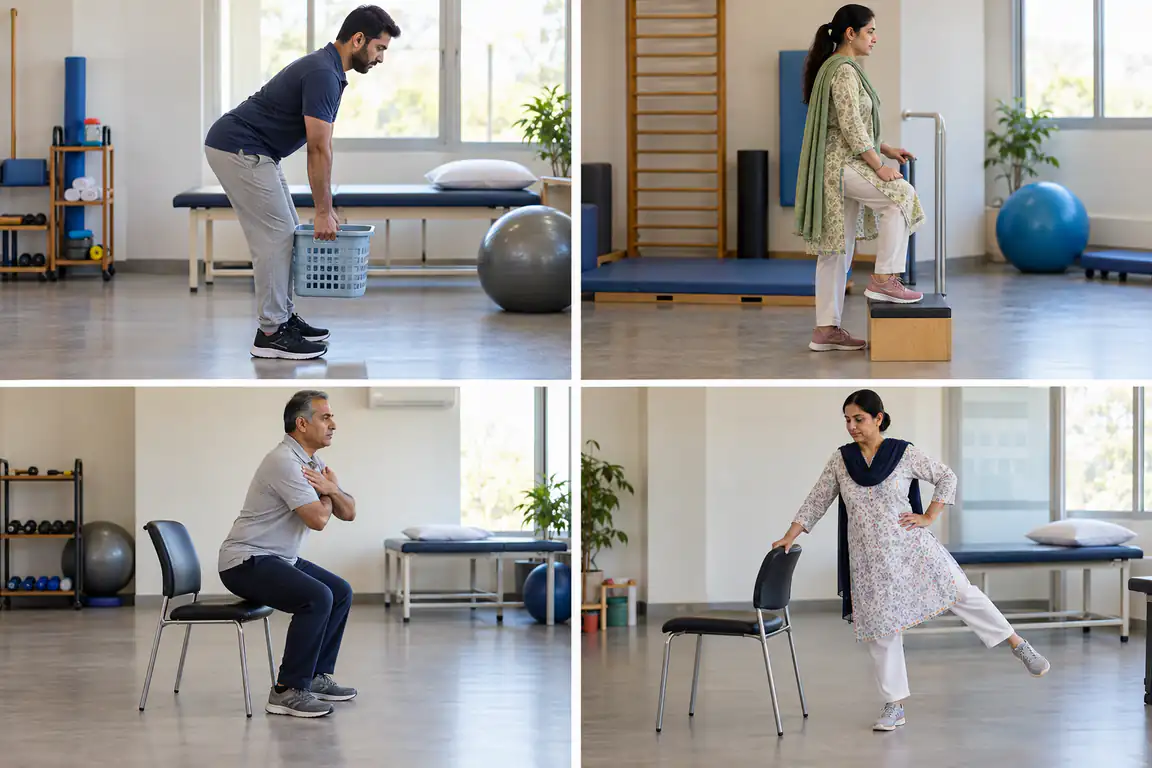
Modify the activity that makes the diagnosis most difficult to ignore. If climbing stairs hurts the groin, change step height or pacing temporarily rather than pushing through sharp pain. If bending the spine to lift objects triggers leg symptoms, reduce repeated bending and adjust load. Short walks, comfortable position changes and graded strength work may be suitable for stable symptoms, but the exact plan depends on examination. Avoid copying both hip and spine exercise lists at maximum intensity; two overlapping problems do not justify double the exercise dose.
How Does a Clinician Distinguish Back From Hip Pain?
The examination compares hip range of motion, lumbar movements, leg strength, balance, walking, neurological findings and possibly sacroiliac-region tests. It also considers medical causes and red flags.
An individualized plan can then address the important limiting task instead of treating the spine and hip as competing diagnoses that cannot coexist.
A combined assessment will often compare active lumbar movement, hip rotation, single-leg tasks, walking tolerance and strength. Neurological checks are useful when symptoms radiate down the leg. Sometimes the findings are mixed and the clinician must trial a cautious plan while monitoring the response. If symptoms suggest a fracture, infection, significant neurological change or another medical cause, medical assessment takes priority. The patient should leave knowing which clinical findings support the working explanation and which uncertainties still need review.
Where both regions are involved, a therapeutic exercise plan may address walking, bending and hip control together after assessment.
When Should You Seek Medical or Physiotherapy Input?
Sudden major weakness, saddle numbness, changes in bladder or bowel control, fever, major trauma or inability to bear weight after injury need urgent assessment.
Seek urgent medical assessment for new difficulty passing urine, loss of bowel or bladder control, numbness around the groin or saddle area, rapidly worsening or significant weakness in one or both legs, or new symptoms affecting both legs. These can signal serious nerve involvement. Back pain after significant trauma, pain with fever or marked illness, or unexplained symptoms alongside a serious medical history also requires prompt medical attention rather than trial-and-error stretching.
If the pain persists, walking distance falls or everyday dressing and transfers remain difficult, seek a structured assessment rather than trying unrelated exercises for both areas.
Severe groin or hip pain following trauma, inability to bear weight, fever with a painful joint or progressive neurological problems can require urgent care. Long-standing pain that makes ordinary walking difficult merits non-urgent but timely assessment, even without an emergency. In pregnant or postpartum patients, pelvic and hip symptoms have additional considerations that should be addressed by the appropriate clinician. The purpose of this comparison is to help a person choose a sensible next step, not to diagnose themselves from one tender spot.
Frequently Asked Questions
Can hip arthritis feel like lower back pain?
Yes. Hip disorders may be experienced in the buttock and near the lower back. Groin pain and reduced hip rotation can add clues, but examination is needed.
Is lower back and hip pain always sciatica?
No. Sciatica generally suggests nerve-related leg symptoms; many hip and back problems remain local without those neurological features.
Why does my hip hurt when I sit?
Sitting loads the hip and lower back differently, and several tissues can become sensitive. The pain’s precise location, duration and associated symptoms help narrow the question.
Should I stretch my hip flexors or hamstrings?
Not automatically. Stretching may or may not address the main contributor. If symptoms include nerve-related leg pain or marked irritability, choose movements more carefully.
Does groin pain always mean hip arthritis?
No. Groin pain can arise from several hip and nearby problems. Hip rotation, walking, age, health history and sometimes imaging are considered together rather than diagnosing arthritis from location alone.
Can the back and hip both be involved?
Yes. The regions share loading during walking and bending, and two contributors can coexist. Rehabilitation may therefore address both areas while monitoring which task produces meaningful improvement.
Why does putting on socks hurt more than walking?
That task requires considerable hip flexion and rotation as well as spinal movement. The pattern is useful for examination but cannot establish a diagnosis without other findings.
The Better Question Is Which Tasks Are Limited
When groin and lower-back symptoms overlap, an assessment of both regions can clarify which everyday limitations deserve attention first.
For relevant assessment and rehabilitation options, explore WHPT Pakistan’s hip pain physiotherapy. Contact the clinic by WhatsApp or phone if you need help choosing the appropriate appointment.
Lower back and hip pain is rarely solved by looking at a pain diagram alone. Clinical reasoning connects movement findings to your life, whether the aim is comfortable walking, stairs, work or dressing.
Progress might look like putting on socks without twisting awkwardly, walking through a grocery store without limping, or stepping out of a car with more confidence. Those outcomes reveal whether treatment is reaching the correct task. If back-focused exercises do not change a groin-dominant problem, recheck the hip. If hip strengthening does not explain worsening below-knee tingling, reassess the lumbar nerves. A successful plan is flexible enough to adjust when the pattern points elsewhere, while changing treatment when new examination findings justify a different approach.
References
- NHS. Back pain: self-care and symptoms requiring medical advice.
- NHS. Hip pain in adults: causes and when to get help.
- AOPT/APTA. Interventions for acute and chronic low back pain: clinical practice guideline. JOSPT. 2021.
- NICE. Low back pain and sciatica in over 16s: assessment and management (NG59).
- MSD Manual Professional. Symptoms of common radiculopathies by nerve-root level.

About Dr Salman Sabir PT
Dr Salman Sabir PT is a consultant physiotherapist, clinical leader and co-founder of WHPT Pakistan. He holds an MS in Orthopedic Manual Therapy and is undertaking doctoral study in Exercise Physiology. His work focuses on assessment-led rehabilitation, patient education, progressive exercise and long-term recovery.
Need Help Applying This to Your Situation?
General information cannot account for your injury history, strength, movement, medical conditions or personal goals.
BOOK ASSESSMENTCall +92 334 8205557