
Middle back pain may appear after carrying something heavy, twisting awkwardly, or sitting through a long day, but it can also arrive without an obvious trigger. People often call any ache behind the chest or between the ribs “middle back pain.” That description is useful for locating symptoms, not for deciding whether the cause is muscular. Because the thoracic spine shares movement with the ribs, medical screening is part of a responsible explanation.
Middle back pain often involves thoracic muscles, joints, ribs, or activity-related sensitivity, but pain in this region can sometimes reflect medical conditions. Movement patterns, breathing effects, injury history and accompanying symptoms help distinguish a stable musculoskeletal presentation from one needing medical attention. Treatment decisions should follow an appropriate assessment rather than a posture label alone.
At a Glance
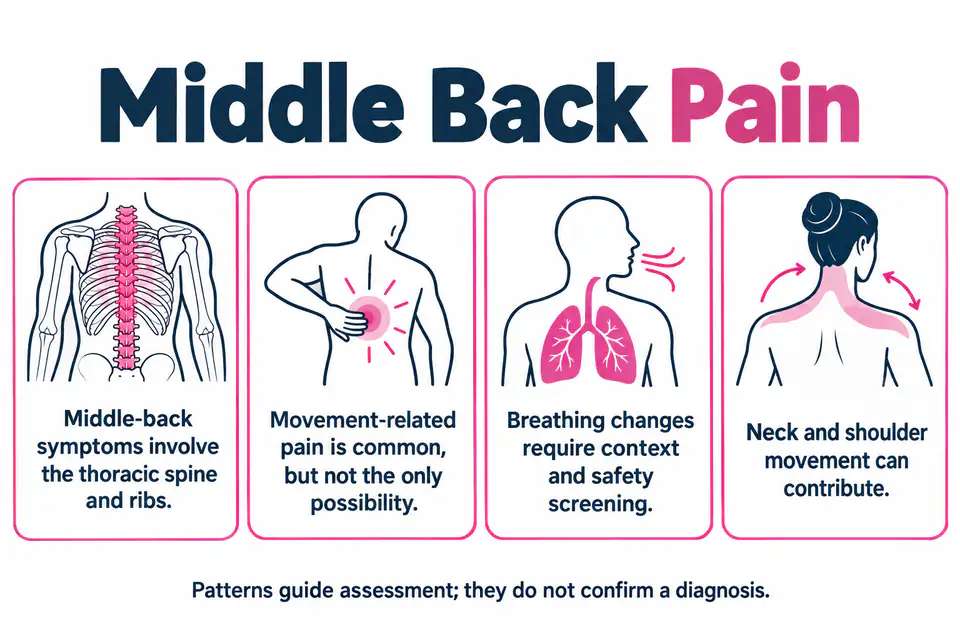
- Middle-back symptoms involve the thoracic spine and ribs.
- Movement-related pain is common, but not the only possibility.
- Breathing changes require context and safety screening.
- Neck and shoulder movement can contribute.
- An MRI finding is not an automatic diagnosis.
- Progressive neurological symptoms need urgent evaluation.
What Area Counts as the Middle Back?
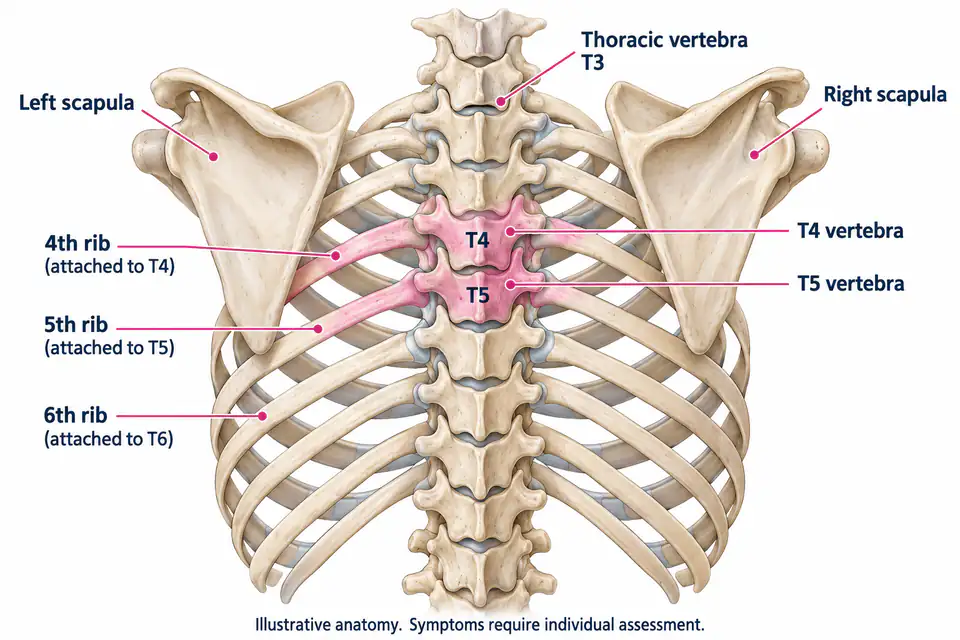
The thoracic spine is the section between the neck and lower back. Its joints connect with the ribs and allow rotation, bending and chest-wall movement during breathing. People may feel symptoms centrally, beside the spine or along a rib. The place that hurts does not always identify the structure responsible.
Pain near a bra strap or the middle of the shoulder blades may be called middle-back pain even though the patterns can differ.
It helps to distinguish an explanation from a diagnosis. In this part of the assessment, associated medical symptoms and their timing matter more than a single provocative movement or a phrase from an online search. The clinician looks for several clues that agree with one another, while staying open to alternatives. A temporary symptom increase does not automatically prove that tissue damage is worsening; new loss of strength or other warning signs, however, should not be ignored.
Describe the precise region and what changes the sensation, then compare those clues with an examination.
The middle back generally refers to the central thoracic spine, below much of the upper shoulder girdle and above the lumbar waistline. People sometimes point near the lower shoulder-blade tips or bra-strap level; that description is more precise than simply saying 'back pain.' The thoracic vertebrae connect with ribs and are designed for coordinated rotation and breathing-related movement. Central or mid-thoracic discomfort should be distinguished from pain primarily at the neck-shoulder junction, because the likely contributors differ. Accurate location helps frame an examination but never establishes a structural diagnosis by itself.
Can Lifting or Twisting Irritate the Thoracic Region?
Unfamiliar reaching, lifting, a sudden pull or repeated rotation may overload muscles and joints in the middle back. Temporary stiffness or muscle guarding may follow. The aim is not to ban bending or rotation but to understand the load change that preceded the flare and whether daily movement is gradually becoming easier.
A person may feel pain the morning after rearranging furniture or an unusually demanding training session.
In a stable presentation, scale the task down temporarily and rebuild tolerance rather than avoiding all spinal movement permanently.
For an assessment-led explanation of related symptoms, see WHPT Pakistan’s neck pain physiotherapy resource. It explains what an individualized assessment and rehabilitation pathway may involve.
Twisting to reach into a car, repetitive stock handling, carrying uneven loads or returning to cricket after a break may irritate the mid-back region. Local stiffness can be uncomfortable when rotating or getting out of bed. Ask whether symptoms arise during a particular movement, follow a higher-than-usual activity volume, and settle with movement breaks. Severe pain does not automatically prove a disc injury. The most useful plan may begin with temporary modification of the activity that provoked symptoms and a gradual return once ordinary movements become less reactive.
Why Can Middle Back Pain Increase With Breathing?
The ribs move as the chest expands, so irritated muscles or rib-related joints may become noticeable on a deep breath. However, breath-related pain is not always musculoskeletal. Chest pain, breathlessness, fainting, fever or sudden severe symptoms require medical evaluation, even if a movement also hurts.
Someone with an obvious chest-wall strain has a different story from someone with unexplained sharp pain and shortness of breath.
Breathing symptoms should first be screened for urgency; do not rely on a stretch or self-palpation to rule out serious causes.
Because ribs attach to the thoracic spine, taking a deep breath can shift uncomfortable tissues around the mid-back. But this mechanical possibility must not become a blanket diagnosis. New chest pain, shortness of breath, coughing blood, fever or feeling faint are reasons for medical evaluation; a back stretch is not the next step. If those concerns are absent and the pain is a familiar localized ache related to reaching or twisting, a clinician can evaluate rib and thoracic movement. Sudden shortness of breath or chest discomfort needs an urgent medical pathway rather than routine mid-back exercise advice.
Can the Neck, Shoulder or Lower Back Be Connected?
The thoracic spine functions between the neck and lumbar region and shares muscular connections with the shoulders. Sometimes pain around the shoulder blade reflects neck-related symptoms or a change in shoulder use. Treating every middle-back ache as an isolated vertebra misses this wider movement system.
Reaching overhead may aggravate one person’s discomfort, while looking down at a screen provokes another’s.
Compare neck and shoulder motion as well as thoracic rotation before deciding what the main movement limitation is.
The NHS guidance on chest pain explains why serious chest symptoms deserve urgent medical attention. Movement-related pain should not be used as a home test to rule out medical causes.
Middle-back pain can also change how someone moves the neck or shoulder. People who limit thoracic rotation may turn more through the lumbar region, while shoulder discomfort can alter arm positions during work. These are observations about movement, not proof that one area has caused another. Compare ordinary tasks: turning to reverse a car, reaching for a high shelf, carrying a schoolbag or sitting through a lecture. When the exact task that triggers pain is known, rehabilitation can target the relevant capacity instead of prescribing a generic upper-body stretch routine.
For advice on back-pain warning signs and when to seek medical help, see NHS: Back pain — when to seek medical advice. New chest symptoms, marked illness or breathing problems need medical assessment, not a posture exercise trial.
Should You Worry About a Disc Problem in the Middle Back?
Thoracic disc problems can occur, but not every central ache is caused by a disc. Serious neurological symptoms are uncommon but important to recognize. Progressing weakness, walking difficulty or bowel/bladder changes need medical evaluation rather than a self-directed exercise experiment.
An MRI report can contain changes that do not explain the pain, particularly if symptoms and neurological findings do not correspond.
Consider the clinical pattern and whether imaging would change management before giving a scan finding a central role.
Thoracic disc herniations are less common than lumbar disc conditions. A report describing thoracic degeneration does not automatically explain everyday mid-back pain, and serious neurological changes may require specialist assessment. Worsening leg coordination, altered walking, weakness or unusual sensory findings are not symptoms to solve by self-manipulating the spine. Most uncomplicated mid-back aches are managed without an immediate scan; imaging should be chosen when examination and medical context make it useful for a specific question.
Why Does Pain Sometimes Persist After the Original Strain?
Even when an initial strain settles, sleep disturbance, reduced movement confidence and repeatedly testing the sore area can sustain discomfort. Work demands or training routines may also return too quickly for current capacity. That does not mean pain is imagined or that it must be permanent.
Someone avoids all turning for weeks and then experiences a flare during a routine household task because the movement is unfamiliar again.
A gradual return to normal rotation, lifting and conditioning may be more useful than chasing a single perfect posture.
Symptoms may linger after the initiating task is no longer present. A worker can resume full lifting volume before local tissue tolerance has rebuilt, while someone else may stop all activity because they fear re-injury. Both extremes can make the return to normal work difficult. A graded plan might begin with lighter objects close to the body, shorter periods of repetitive rotation and recovery breaks. Look for improvements in work duration and sleep rather than expecting every movement to be painless immediately.
How Can You Move More Comfortably?
After serious causes have been screened, gentle movement in tolerable ranges may help restore confidence. Try a short walk, easy thoracic rotation or gradual return to household tasks, adjusting the dose to your response.
People whose work involves long sitting may benefit from more movement opportunities; those doing heavy lifting may need a temporary reduction in weight or frequency rather than total inactivity.

Comfortable thoracic rotation can be explored with a small seated turn, an easy arm reach and gentle walking. These are examples of movement options, not prescriptions for someone with unexplained chest symptoms or suspected fracture. Begin below the intensity that causes sharp or lasting discomfort, then gradually restore range or workload. Excessive twisting to 'crack' the back is unnecessary. If rib-related pain consistently worsens with inhalation or coughing, clinical assessment should determine whether a medical investigation is needed before exercises are emphasized.
If prolonged desk work is a trigger, the postural problems service page explains how work tolerance can be developed without blaming one static posture.
What Would a Middle Back Physiotherapy Assessment Cover?
The history should include breathing-related symptoms, trauma, general health, thoracic and rib movement, neck and shoulder function and neurological changes. The physical examination depends on those findings and may recommend medical referral when appropriate.
If the story fits stable musculoskeletal pain, rehabilitation can focus on the task that provokes symptoms and progress strength and movement gradually.
A mid-back assessment may include the precise pain area, symptom onset, active trunk rotation, shoulder and neck contributions, breathing-related symptoms and functional lifting tolerance. The clinician will also ask about trauma, fever, respiratory symptoms, bone health and relevant medical history. Mid-back pain is not interchangeable with low-back pain, so its investigation should not automatically follow a lumbar disc template. A practical outcome is a clear plan for the task the person needs to regain, whether that means driving, housework, desk work or returning to a sport.
When Is Middle Back Pain a Medical Concern?
Chest pain, major breathing difficulty, fainting, fever, unexplained severe pain or significant trauma should be assessed medically. Do not assume thoracic pain is a simple spasm merely because pressure over the muscles reproduces it.
Sudden chest pain, major breathlessness, fainting or severe pain related to breathing should be treated as a possible medical emergency rather than a simple muscle spasm. Pain reproduced with movement can still coexist with medical conditions; don't use a home movement test to exclude them. Follow local emergency-service guidance if breathing difficulty or chest-related warning signs are present.
Persistent night pain, worsening symptoms or new weakness are additional reasons to seek review rather than relying indefinitely on home treatment.
New neurological problems, substantial injury, persistent fever or systemic illness, chest pain and breathing difficulty demand medical attention. Particularly after trauma or in a person with osteoporosis, pain at the mid-spine can occasionally indicate fracture. More routine discomfort that continues for weeks despite adjustments should still be reviewed, especially if it disrupts sleep or work. A responsible article must neither exaggerate common strains nor minimize atypical middle-back symptoms that fall outside the expected musculoskeletal pattern.
Frequently Asked Questions
Can middle back pain be caused by sitting?
Prolonged sitting may make muscles and joints feel uncomfortable, especially when there are few movement breaks, but posture alone does not establish a diagnosis.
Is pain between the shoulder blades the same as middle back pain?
The areas can overlap, but interscapular pain may also come from the neck or shoulder. Precise location and functional testing help clarify the pattern.
Can a rib joint cause middle back pain?
Rib-related joints move with breathing and rotation and can be a possible musculoskeletal contributor. Breathing-related pain still needs medical screening when other concerning symptoms occur.
When is an MRI useful for middle back pain?
Imaging may be considered when red flags, significant neurological findings or clinical questions would change management. It is not routine for every uncomplicated movement-related episode.
Is middle-back pain usually a slipped disc?
No. Thoracic disc problems are less common than lumbar problems, and many episodes have other musculoskeletal contributors. Progressive walking or neurological changes require assessment, however.
Why does twisting to reverse my car hurt?
The thoracic region rotates during that task. Sensitivity after unfamiliar loading, rib mechanics and nearby shoulder movement may all contribute. A clinician can compare movements without assuming which tissue is responsible.
Can I exercise with central mid-back soreness?
After medical concerns are excluded, comfortable movement may be reasonable. Reduce movements that produce sharp or lasting discomfort and rebuild gradually; unexplained chest or breathing symptoms warrant medical review.
Understanding the Middle Back Without Guessing
If middle-back discomfort limits your daily rotation, breathing comfort or work, WHPT can help decide whether the presentation is suitable for physiotherapy.
For relevant assessment and rehabilitation options, explore WHPT Pakistan’s back pain physiotherapy. Contact the clinic by WhatsApp or phone if you need help choosing the appropriate appointment.
The best next step is to match the pain pattern, breathing and movement response, and medical history to an appropriate assessment. This protects against both unnecessary fear and missed warning signs.
The most useful description of progress is personal: you can rotate to check traffic, hang washing overhead or lift a manageable bag with less guarding. If treatment only provides a few hours of relief while those tasks remain impossible, reconsider the loading plan and diagnosis. Central thoracic pain often needs a different exercise emphasis from upper shoulder-girdle fatigue or lumbar nerve pain. A tailored plan should address the actual rib-linked movement and daily tasks involved, rather than prescribing a generic back routine.
References

About Dr Salman Sabir PT
Dr Salman Sabir PT is a consultant physiotherapist, clinical leader and co-founder of WHPT Pakistan. He holds an MS in Orthopedic Manual Therapy and is undertaking doctoral study in Exercise Physiology. His work focuses on assessment-led rehabilitation, patient education, progressive exercise and long-term recovery.
Need Help Applying This to Your Situation?
General information cannot account for your injury history, strength, movement, medical conditions or personal goals.
BOOK ASSESSMENTCall +92 334 8205557