
Left side back pain can make you wonder whether you pulled a muscle, irritated a joint, or have a problem with an internal organ. The location is worth noting, but it rarely supplies an answer by itself. A familiar ache after lifting behaves very differently from flank pain accompanied by fever, urinary changes or marked illness. Comparing the whole symptom pattern helps keep the next decision proportionate.
Left side back pain is commonly musculoskeletal, but the painful side alone cannot identify a diagnosis. Movement-related strain, lumbar joints, hip problems and referred symptoms are possibilities; urinary, abdominal or other medical causes also matter when associated features are present. Duration, location, symptoms outside the back, and functional changes determine whether self-care, physiotherapy or medical assessment makes sense.
At a Glance
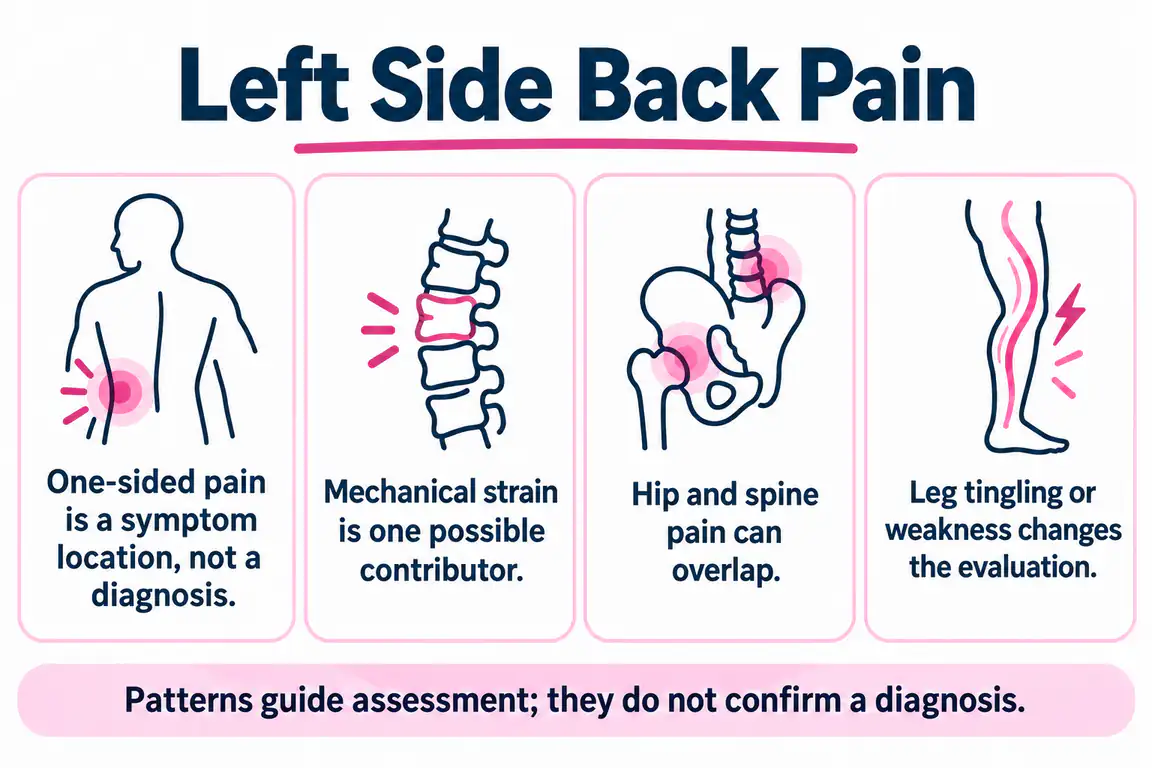
- One-sided pain is a symptom location, not a diagnosis.
- Mechanical strain is one possible contributor.
- Hip and spine pain can overlap.
- Leg tingling or weakness changes the evaluation.
- Urinary or fever symptoms need medical care.
- Separate left/right diagnoses are often misleading.
Does Pain on the Left Always Mean a Different Condition?
The spine is built with paired muscles and joints, yet they are not loaded equally during every task. One-sided symptoms may reflect local sensitivity or how someone bends, reaches or carries weight. The distinction between left and right does not establish that a particular vertebra, disc or kidney is responsible.
A parent carrying a child on one hip may notice symptoms on that side after a demanding day.
It helps to distinguish an explanation from a diagnosis. In this part of the assessment, patterns across the spine, pelvis, hip and nearby tissues matter more than a single provocative movement or a phrase from an online search. The clinician looks for several clues that agree with one another, while staying open to alternatives. A temporary symptom increase does not automatically prove that tissue damage is worsening; new loss of strength or other warning signs, however, should not be ignored.
Think in terms of task patterns and associated signs rather than interpreting left-sided pain as a named disease.
Left-sided pain is a useful location description, not a diagnosis. Lumbar muscles, joints, pelvis and hips can be loaded differently when carrying a child, turning repeatedly at work or playing sport. The right side may feel completely normal during the same activity. That asymmetry does not prove a disc bulge on the painful side. Instead, compare which motions consistently reproduce symptoms, whether the pain crosses the middle, and whether leg sensations or urinary symptoms accompany it. The relationship between workload and pain is often more informative than the word 'left' alone.
Could a Back Muscle or Joint Be Responsible?
Strain or irritation of muscles and spinal joints can create a concentrated ache on one side, especially after repetitive lifting, unfamiliar exercise or a sudden twist. Local pain often changes with movement and may ease as the workload becomes manageable. Muscle guarding can feel alarming without implying major damage.
Turning to lift shopping bags from a car may reproduce a localized ache, whereas a short walk may reduce stiffness.
Observe whether the same mechanical tasks reliably influence symptoms and whether normal function is returning over several days.
For an assessment-led explanation of related symptoms, see WHPT Pakistan’s hip pain assessment resource. It explains what an individualized assessment and rehabilitation pathway may involve.
A local muscular ache may feel easier when you change position and sharper after a new lifting or twisting task. Guarding can make one side feel hard or tight without any bone being 'out of alignment.' Someone may repeatedly press or stretch the sore point hoping to locate the damaged tissue; this can maintain irritability. A better experiment is to reduce the provoking task for a short period, move within comfort and check whether daily activities gradually improve. A clinician can examine whether lumbar movement and trunk strength fit that mechanical pattern.
What If Pain Travels Into the Buttock or Leg?
Pain extending beyond the lower back can arise from several sources, including the lumbar spine, hip or nerve roots. Burning pain below the knee, tingling, numbness or weakness raises greater concern for neurological involvement than a local ache alone. It is possible to have leg symptoms without severe back pain.
Someone may report left-sided pain down the calf after sitting, while another has only tenderness beside the spine.
Map how far symptoms travel and whether leg strength or sensation has changed; do not assume every side pain is sciatica.
A symptom that leaves the lower back and travels into the left calf or foot warrants different questions. Tingling, burning, numbness or new weakness may point toward nerve involvement. A small patch of ache confined to the left buttock is not automatically sciatica, and pain around the outer hip can imitate back-related referral. Note the farthest point reached by symptoms and whether coughing, sitting or walking changes their distribution. Progressive weakness is a stronger reason for timely care than pain staying on the left rather than moving to the right.
A practical comparison
| What you notice | Why it may matter |
|---|---|
| Side pain after repeated carrying | May reflect muscular or joint load; assess function. |
| Left back pain with leg tingling | Consider neurological assessment. |
| Flank pain with fever or urinary changes | Consider urinary or other medical causes promptly. |
Could the Hip or Sacroiliac Region Contribute?
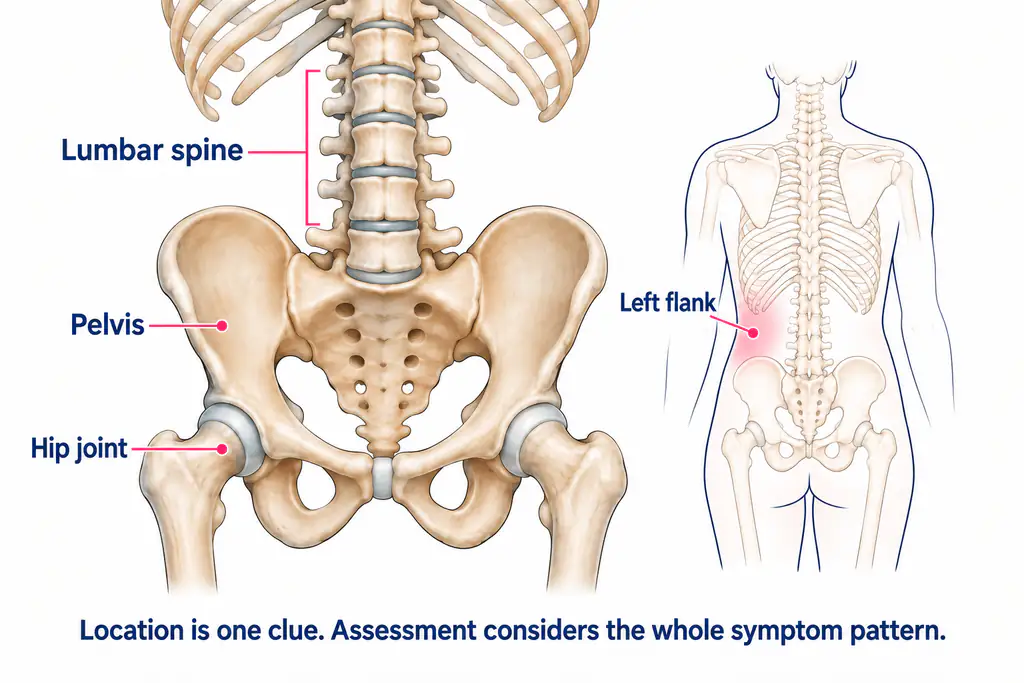
The hip joint, surrounding gluteal muscles and sacroiliac region can be felt near the same part of the lower back. Hip-related problems may change walking, turning or getting in and out of a vehicle. The sore point may be misleading because pain can be referred away from its source.
Pain when putting on shoes may reveal limited hip movement, while turning in bed may reproduce a different local pattern.
A clinician compares hip motion, spinal movement, strength and function to avoid deciding the diagnosis from the side alone.
Left hip and sacroiliac-area symptoms overlap with lumbar pain because people describe both as 'lower back' or 'back pocket' pain. Groin pain, difficulty putting on shoes and restricted hip rotation make a hip contribution worth checking. Discomfort with single-leg loading may suggest several possibilities, including hip or lumbar structures. No one test is a perfect separator. A combined spine-and-hip assessment can avoid treatments aimed at the wrong region, particularly when the complaint has continued despite generic back stretches.
For guidance on back symptoms and reasons to seek further medical help, see NHS: Back pain — when to seek medical advice. Pain location alone cannot reliably distinguish a spinal source from other medical conditions.
When Should Kidney or Urinary Problems Be Considered?
Pain near the flank can sometimes be linked with urinary tract or kidney problems, especially when accompanied by fever, urinary burning, blood in urine, vomiting or feeling very unwell. These features need medical assessment; they are not problems that physiotherapy should try to diagnose through home stretches.
Left flank pain plus high fever and urinary symptoms differs from an ache that appears only after carrying luggage.
Seek appropriate medical care promptly for systemic or urinary warning signs, rather than applying heat and waiting indefinitely.
Pain toward the flank rather than the spine can have non-musculoskeletal explanations. Fever, painful urination, blood in urine, nausea or marked illness raises questions about urinary tract or kidney problems that should be assessed medically. Sudden severe flank pain can have several causes and is not something to resolve by repeated twisting or using a foam roller. Conversely, isolated mild pain that clearly follows an unfamiliar lifting task is often musculoskeletal. History and associated signs help decide which path is more appropriate; side alone cannot make that decision.
Pain that spreads into the leg may need a different assessment; the sciatica pathway explains nerve-related symptoms without assuming every one-sided ache is sciatica.
Does Right-Side Back Pain Need a Different Assessment?
Clinically, side matters as part of the history, but many causes and assessment principles overlap. Dividing every symptom into left- and right-sided diagnoses can overstate how predictive location really is. The severity, onset and associated neurological or medical features are more informative.
Two people with pain on opposite sides may have nearly identical movement-related patterns and benefit from a similar assessment approach.
Use the full symptom picture to guide care; location describes where to investigate, not a final conclusion.
There is no separate treatment algorithm simply because pain is on the left. What changes management is the combination of location, symptom behavior, general health and functional loss. A person whose pain shifts from side to side during an otherwise improving episode may be experiencing changing load tolerance. Someone with persistent unilateral pain, night disturbance and systemic symptoms deserves a different assessment. The useful next step is to describe the location, triggers, associated symptoms and changes over time accurately to a healthcare professional.
What Can Help a Stable One-Sided Back Ache?
For clearly movement-related symptoms without red flags, moderate your heaviest tasks and keep comfortably active. Try changing how long you hold a position or spreading demanding lifting across the day.
Avoid repeatedly poking the painful point or twisting sharply to test recovery. Use ordinary tasks such as getting up from a chair and walking as gentler indicators of progress.
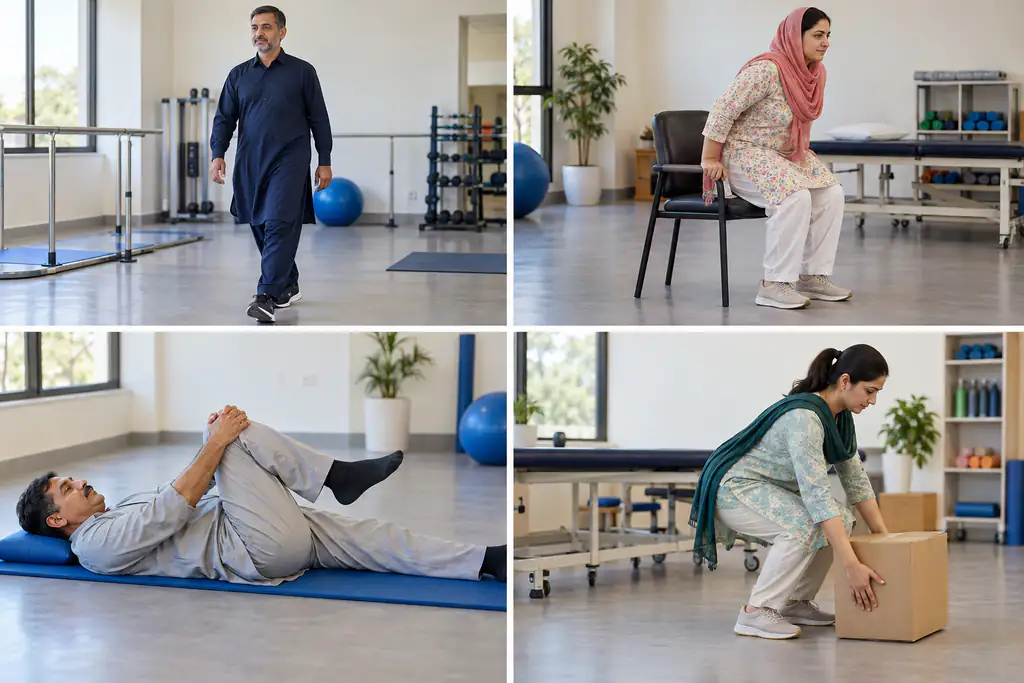
If no concerning features are present, make a simple plan around the movement that bothers you. For example, if bending left to pick up laundry hurts, bring the basket closer and divide the load rather than permanently avoiding that direction. Try comfortable walking and movement variety instead of forcing asymmetrical stretches. Monitor whether the ache becomes less sensitive over several days and whether activities return. Exercises should be adjusted if they create spreading leg symptoms, increased numbness or a significant delayed flare.
For people whose symptoms build during long tasks, WHPT also explains posture and task tolerance as part of individualized movement planning.
How Is One-Sided Back Pain Assessed?
Assessment compares lumbar movement, hip function, possible sacroiliac or muscular contributions, and neurological signs when there are leg symptoms. A clinician also asks about urinary and systemic symptoms that would require medical care.
The goal is not to name an isolated muscle from a finger-pointed location; it is to explain the overall pattern and choose safe next steps.
Clinical examination looks beyond the tender spot. The physiotherapist may compare lumbar flexion and rotation, hip range, neurological signs when relevant, and strength while standing on one leg. Sometimes the first useful result is reassurance that the pattern is stable; at other times the findings indicate a medical referral. Imaging decisions depend on suspected pathology and whether a result would change care, not on whether one side hurts. A clear explanation should identify what will be monitored and which new findings require reassessment.
When Is Left Side Back Pain Not a Routine Muscle Problem?
Fever with flank pain, urinary symptoms, severe abdominal symptoms, weakness, new bladder changes or saddle numbness require medical triage. Trauma or rapidly progressive pain also deserves timely assessment.
Seek urgent medical assessment for new difficulty passing urine, loss of bowel or bladder control, numbness around the groin or saddle area, rapidly worsening or significant weakness in one or both legs, or new symptoms affecting both legs. These can signal serious nerve involvement. Back pain after significant trauma, pain with fever or marked illness, or unexplained symptoms alongside a serious medical history also requires prompt medical attention rather than trial-and-error stretching.
Seek clinical review when the pain persists, changes character or limits function rather than self-diagnosing it from online diagrams.
One-sided pain following a significant fall, accompanied by fever or severe illness, or associated with new neurological deficits should not be managed as routine muscular soreness. Sudden severe abdominal or flank pain, fainting, or other rapidly changing symptoms also warrants urgent medical assessment. For non-urgent but persistent symptoms, an appointment can help when sleep, work or household activity is repeatedly affected. A pain score does not replace an assessment of function and the broader clinical picture.
Frequently Asked Questions
Is left side back pain always a kidney problem?
No. Many cases are musculoskeletal. Fever, painful urination, blood in urine or significant illness can point toward a urinary cause and warrant medical evaluation.
Can the hip cause pain on the left side of the back?
Yes. Hip and pelvic structures may refer symptoms around the buttock and lower back. Comparing hip and spine motion may help identify relevant contributors.
What does left side pain down the leg suggest?
It may raise concern about referred or nerve-related symptoms, especially with tingling, numbness or weakness, but location alone does not confirm sciatica.
Should I sleep only on my right side?
No universal sleeping side is best. Choose a comfortable supported position and modify it if the next-day response consistently becomes worse.
Does left-side pain mean the disc bulge is on the left?
No. A painful side cannot accurately predict the location or presence of a disc finding. History, neurological examination and selective imaging are needed when medically relevant.
Why does one-sided back pain increase after cooking or standing?
Long periods at a counter can exceed current standing tolerance or make a sensitive back or hip region more noticeable. Change positions, take short movement breaks and observe the response. Fever or urinary changes would suggest a different pathway and warrant medical assessment.
Can I return to carrying my child on that side?
Often a gradual return is possible in stable musculoskeletal presentations. Begin with shorter tasks and manageable loads, and consider varying how you carry. Stop if new leg weakness or spreading numbness occurs.
The Side Is One Clue, Not the Answer
If your one-sided back pain is recurrent, a clinical assessment can compare lumbar, hip and neurological possibilities rather than guessing from the side of pain.
For relevant assessment and rehabilitation options, explore WHPT Pakistan’s back pain physiotherapy. Contact the clinic by WhatsApp or phone if you need help choosing the appropriate appointment.
Left side back pain becomes easier to understand when you consider movement, associated symptoms and examination findings together. The right response should fit the person, not the side of a pain diagram.
A useful milestone may be carrying groceries evenly again, walking without compensating, or sitting through a journey without shifting away from the painful side. The back does not require perfect symmetry at every moment. Rather than chasing one spot with increasingly aggressive massage, evaluate how safely your normal tasks are returning. If the pattern changes substantially, especially when neurological or urinary symptoms appear, seek a fresh assessment. Location can guide the questions we ask; it should never be treated as the final answer.
References
- NHS. Back pain: self-care and symptoms requiring medical advice.
- NHS. Kidney infection: symptoms and medical assessment.
- NICE. Low back pain and sciatica in over 16s: assessment and management (NG59).
- AOPT/APTA. Interventions for acute and chronic low back pain: clinical practice guideline. JOSPT. 2021.
- MSD Manual Professional. Symptoms of common radiculopathies by nerve-root level.

About Dr Salman Sabir PT
Dr Salman Sabir PT is a consultant physiotherapist, clinical leader and co-founder of WHPT Pakistan. He holds an MS in Orthopedic Manual Therapy and is undertaking doctoral study in Exercise Physiology. His work focuses on assessment-led rehabilitation, patient education, progressive exercise and long-term recovery.
Need Help Applying This to Your Situation?
General information cannot account for your injury history, strength, movement, medical conditions or personal goals.
BOOK ASSESSMENTCall +92 334 8205557